THE CLASSIC COLLECTION✦Dr. SevierCLASSIC FREE BOOKS
Dr. Sevier
George Washington Cable
THE CLASSIC COLLECTION · 1894
"John March, Southerner" by George W. Cable is a historical novel written in the late 19th century. Set in the post-Civil War South, the story follows young John March, the son of Judge Powhatan March, as he navigates a world forever changed by war and the complexities of societal change. The narrative is deeply embedded in Southern culture and addresses themes of class, race, and the shifting identities in a society grappling with its past. The opening portion introduces the town of Suez in Dixie, illustrating its charm juxtaposed with the scars of war. We meet Judge March and his son, John, embarking on a journey through their small town, which serves as a backdrop for their relationship dynamics. The Judge is seen as a gentle yet influential figure, embodying the traditions of the South, while the young John, a curious and imaginative boy, is portrayed as both innocent and observant amid the tensions surrounding him. The scene sets the stage for John's coming-of-age story as he encounters various characters who embody the conflicting ideals of freedom and social responsibility in the New South.
Introduction adapted from the source catalogue; source summaries may be automatically generated.
Free to read · English · 129,243 words · No account needed
MAKE TIME FOR A GOOD BOOK
On by default. Untick to stop anonymous reading totals. Each page counts after 10 seconds in view. How this works.
Anonymous counting is on unless you have switched it off.
"Why, no, son; its somepm powerful nice, but--well, you might know it wa'n't a kitt'n by my lett'n' you sit on it so long. I'd be proud faw you to have a kitt'n, but, you know, cats don't suit yo' dear motheh's high strung natu'e. You couldn't be happy with anything that was a constant tawment to her, could you?"
The head lying against the questioner's back nodded an eager yes!
"Oh, you think you might, son, but I jes' know you couldn't. Now, what I've got faw you is ever so much nicer'n a kitt'n. You see, you a-growin' so fast you'll soon not care faw kitt'ns; you'll care for what I've got you. But don't ask what it is, faw I'd hate not to tell you, and I want yo' dear motheh to be with us when you find it out."
It was fairly twilight when their horse neighed his pleasure that his crib was near. Presently they dismounted in a place full of stumps and weeds, where a grove had been till Halliday's brigade had camped there. Beyond a paling fence and a sandy, careworn garden of altheas and dwarf-box stood broadside to them a very plain, two-story house of uncoursed gray rubble, whose open door sent forth no welcoming gleam. Its windows, too, save one softly reddened by a remote lamp, reflected only the darkling sky. This was their home, called by every mountaineer neighbor "a plumb palace."
As they passed in, the slim form of Mrs. March entered at the rear door of the short hall and came slowly through the gloom. John sprang, and despite her word and gesture of nervous disrelish, clutched, and smote his face into, her pliant crinoline. The husband kissed her forehead, and, as she staggered before the child's energy, said:
"Be gentle, son." He took a hand of each. "I hope you'll overlook a little wildness in us this evening, my dear." They turned into a front room. "I wonder he restrains himself so well, when he knows I've brought him a present--not expensive, my deah, I assho' you, nor anything you can possible disapprove; only a B-double-O-K, in fact. Still, son, you ought always to remember yo' dear mother's apt to be ti-ud."
Mrs. March sank into the best rocking-chair, and, while her son kissed her diligently, said to her husband, with a smile of sad reproach:
"John can never know a woman's fatigue."
"No, Daphne, deah, an' that's what I try to teach him."
"Yes, Powhatan, but there's a difference between teaching and
terrifying."
"Oh! Oh! I was fah fum intend'n' to be harsh."
Your reading position is saved on this browser. Take it to another device with a library code. Reading pages adapt to text, rather than matching a printed edition.
George Washington Cable
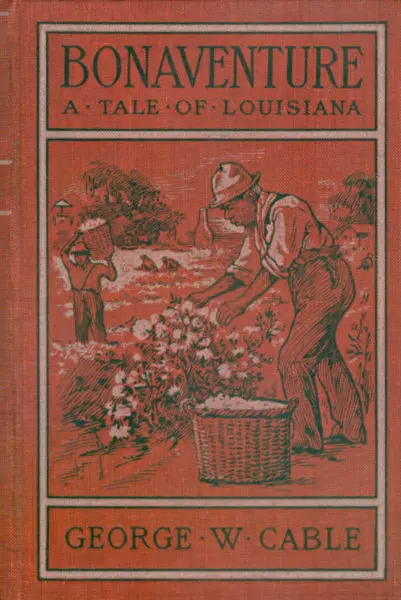
George Washington Cable
George Washington Cable
George Washington Cable
BEHIND THE BOOK
This eBook is for the use of anyone anywhere in the United States and most other parts of the world at no cost and with almost no restrictions whatsoever. You may copy it, give it away or re-use it under the terms of the Project Gutenberg License included with this eBook or online at www.gutenberg.org. If you are not located in the United States, you will have to check the laws of the country where you are located before using this eBook. Read the source licence.
The original source file, including credits and licence, is retained by this library. Request an original-format copy at no charge. Please include the book title and Project Gutenberg identifier #31470.
KEEP YOUR CURIOSITY GOING
Cécile Tormay

Moritz Busch
Coulson Kernahan
John L. Ransom

Maurice Baring
Frances Wright