THE CLASSIC COLLECTION✦An outlaw’s diary: the CommuneCLASSIC FREE BOOKS
An outlaw’s diary: the Commune
Cécile Tormay
THE CLASSIC COLLECTION · 1902
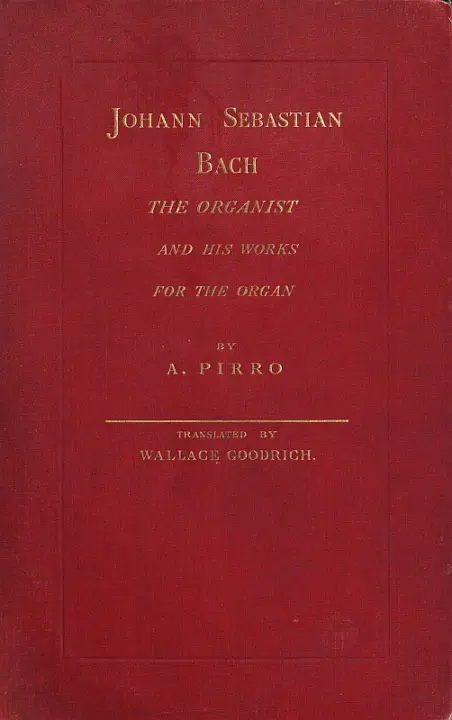
"Johann Sebastian Bach: The Organist and His Works for the Organ" by André Pirro is a historical account written in the late 19th century. The book delves into the life and compositions of Johann Sebastian Bach, particularly focusing on his work as an organist and the significance of his organ music. Through this exploration, it aims to provide insights into Bach’s musical contributions and his profound influence on the development of organ music. The opening of this work presents a preface that sets the tone for a deep analysis of Bach’s character and his musical genius. It portrays Bach as a humble and diligent figure who was dedicated to his craft, characterized by a combination of formidable talent and a commitment to his education and teaching. The narrative hints at Bach's intricate relationship with his predecessors, suggesting that his genius was informed by the works of notable composers before him, such as Frescobaldi and Buxtehude. By providing historical context and detailing the evolution of Bach's style, the introduction prepares readers for an in-depth study of his organ compositions, which will explore their structure and significance within the broader spectrum of classical music.
Introduction adapted from the source catalogue; source summaries may be automatically generated.
Free to read · English · 40,361 words · No account needed
MAKE TIME FOR A GOOD BOOK
On by default. Untick to stop anonymous reading totals. Each page counts after 10 seconds in view. How this works.
Anonymous counting is on unless you have switched it off.
In connection with the foregoing it will be interesting to learn the specifications of the principal organs of which Bach was able to avail himself during his long career. We find details concerning them in various works, notably in Adlung (Musica mechanica organoedi), or in the supplement which J.F. Agricola, an esteemed pupil of Bach, added to this work, published after the death of its author; and in the contemporary writings of local historians.
The organ at Arnstadt, the first at which Bach held the position of organist, possessed twenty-four registers, divided among two manuals and the pedal:[179]
[Footnote 179: This instrument was constructed in 1701, by J.F. Wender, an organ-builder of Mühlhausen. [The specification as compiled from the existing stop-handles by Mr. C.F.A. Williams ("Bach": J.M. Dent & Co.: London), differs slightly from the above, which is given by Spitta.--TR.]]
Great Organ.
1. Principal, 8'
2. Viola da Gamba, 8'
3. Quintatön, 16'
4. Gedackt (Bourdon), 8'
5. Quinte, 6'
6. Octave, 4'
7. Mixtur, 4 ranks
8. Gemshorn, 8'
9. Cymbel, 2 ranks
10. Trompete, 8'
11. Tremulant
12. Cymbelstern[180]
[Footnote 180: A sort of Glockenspiel, which produced l'accord parfait [undoubtedly the major triad].]
Choir Organ.
1. Principal, 4'
2. Lieblich Gedackt, 8'
3. Spitzflöte, 4'
4. Quinte, 3'
5. Sesquialter
6. Nachthorn (night horn), 4'
7. Mixtur, 2 ranks
Pedal Organ.
1. Principalbass, 8'
2. Subbass, 16'
3. Posaunenbass (trombone), 16'
4. Flötenbass 4'
5. Cornetbass, 2'[181]
[Footnote 181: This was a reed stop.]
The organ in the palace at Weimar contained the following stops,
according to A. Wette:[182]
[Footnote 182: Historische Nachrichten von der berühmten Residenzstadt Weimar. Weimar, 1737, p. 175, 176.]
Great.
1. Principal, 8'
2. Quintatön, 16'
3. Gemshorn, 8'
4. Gedackt, 8'
5. Quintatön, 4'
6. Octave, 4'
7. Mixture, 6 ranks
8. Cymbel, 3 ranks
9. Glockenspiel
Choir.
1. Principal, 8'
2. Violdigamba, 8'
3. Gedackt, 8'
4. Trompete, 8'
5. Kleingedackt
(small bourdon), 4'
6. Octave, 4'
7. Waldflöte 2'
8. Sesquialtera
Pedal.
1. Gross-Untersatz, 32'
2. Subbass, 16'
3. Posaun-Bass, 16'
4. Violon-Bass, 16'
5. Principal-Bass, 8'
6. Trompeten-Bass, 8'
7. Cornett-Bass, 4'
We have mentioned the special feature of the organ in Cöthen: a pedal which boasted of two octaves and a half, from great C to f' sharp; we should further emphasize in this organ, otherwise not especially noteworthy, the quality of the Principal[183] in the great organ, and of the eight-foot Trumpet in the pedal.
[Footnote 183: [The Principal here referred to is undoubtedly the
eight-foot Diapason.--TR.]]
The organ in the University church in Leipzig, of which Bach made an expert examination December 17, 1717, was a remarkable instrument, which he was very fond of playing. It was one of the masterworks of the manufacturer Scheibe. It had the following registers:
Great.
Your reading position is saved on this browser. Take it to another device with a library code. Reading pages adapt to text, rather than matching a printed edition.
BEHIND THE BOOK
This eBook is for the use of anyone anywhere in the United States and most other parts of the world at no cost and with almost no restrictions whatsoever. You may copy it, give it away or re-use it under the terms of the Project Gutenberg License included with this eBook or online at www.gutenberg.org. If you are not located in the United States, you will have to check the laws of the country where you are located before using this eBook. Read the source licence.
The original source file, including credits and licence, is retained by this library. Request an original-format copy at no charge. Please include the book title and Project Gutenberg identifier #59085.
KEEP YOUR CURIOSITY GOING
Cécile Tormay

Moritz Busch
John L. Ransom
Frances Wright
Cécile Tormay

Mabel Potter Daggett