THE CLASSIC COLLECTION✦An outlaw’s diary: the CommuneCLASSIC FREE BOOKS
An outlaw’s diary: the Commune
Cécile Tormay
THE CLASSIC COLLECTION · 1895
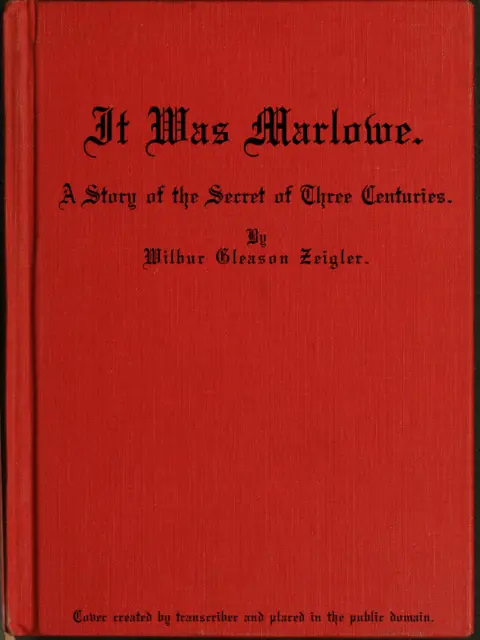
"It Was Marlowe: A Story of the Secret of Three Centuries" by Wilbur Gleason Zeigler is a historical novel written in the late 19th century. The narrative centers around the intriguing figure of Christopher Marlowe, a prominent playwright of the Elizabethan era, as it explores themes of authorship, scandal, and love, all set against the backdrop of the tumultuous societal changes of that time. At the start of the story, we meet Marlowe in the midst of the plague-stricken London of June 1593. A chance encounter with a youth named Tabbard leads to discussions regarding the Lady Anne and a potential romantic connection between them. Meanwhile, tensions brew as Marlowe navigates his professional life as a playwright and actor amid rumors of his controversial reputation and impending danger. Secrets unfold through Tabbard's news and Marlowe's upcoming clandestine meeting with Anne, setting the stage for a tale filled with intrigue, romance, and the shadow of Marlowe’s enigmatic past. This opening lays the groundwork for a plot that promises to delve into the complexities of Marlowe's life and the challenges he faces in a world rife with political and personal peril.
Introduction adapted from the source catalogue; source summaries may be automatically generated.
Free to read · English · 71,165 words · No account needed
MAKE TIME FOR A GOOD BOOK
On by default. Untick to stop anonymous reading totals. Each page counts after 10 seconds in view. How this works.
Anonymous counting is on unless you have switched it off.
46. “I wonder that the commentators should have overlooked so obvious an origin of this passage as Lucan’s description (Pharsalia lib. 1) of the prodigies which preceded the death of Cæsar.”
--Note in Furness’ Variorum, vol. 3, p. 17 (Hunter II, 214).
47 Marlowe’s translation of Lucan’s Pharsalia was first published in 1600. “Lucan’s First Booke Translated Line for Line by Chr. Marlow, at London, 1600.”
--Bullen’s Marlowe, vol. 3, p. 250.
48 “I hold then, that the object which Shakespere had in view in introducing this speech into Hamlet was to expose the weakness of his opponent Nash as a playwright.”
--Fleay, Macmillan’s Magazine, Dec., 1874.
[1] “Study of Shakespere,” by Swinburne, p. 52.
[2] Thomas Beard’s, the Puritan, Account of Marlowe’s Death in Bullen’s
Marlowe, p. 63.
[3] The performance commenced at 3 o’clock.--Dyce’s Shakespere, vol. 1,
p. 45.
[4] A nest of alleys near the bottom of St. Martin’s Lane, so called by Jonson.--Knight’s London, vol. 1, p. 369.
[5] Stow’s Survey, Ed. 1633, p. 470.
[6] Dyce’s Shakespere, vol. 1, p. 40.
[7] Taine’s History of English Literature, Book II, chap. 2.
[8] Induction to Cynthia’s Revels. Ben Jonson.
[9] Dyce’s Shakespere, vol. 1, p. 40.
[10] See note 15.
[11] See note 15.
[12] Swinburne’s Study of Shakespere, p. 24.
[13] “He trod the stage with applause.”--Langbaine.
[14] See notes 18 to 24.
[15] Hallam and Lamb.
[16] See note 35.
[17] Dyce’s Marlowe, Bullen’s Marlowe.
[18] “Doubtless Bame was backed by some person or persons of power and position.”--Bullen’s Marlowe, Introduction, lxix.
[19] “The Atheist’s Tragedie,” vol. iii.--Bullen’s Marlowe.
[20] Jew of Malta, Act. I.
[21] Halliwell-Phillipp’s Outlines, 105.
[22] Bullen’s Marlowe, Introduction, 58.
[23] 14 Eliz. c. 5 (1572).
[24] Id.
[25] “The earliest legitimate theater south of the Thames; opened early in 1592”--Halliwell-Phillipp’s Outlines, p. 79.
[26] So held in the case of the Dean of Asaph as the law; but the doctrine was vigorously attacked by Erskine in his great speech on the “Rights on Juries.” See British Eloquence by Goodrich, pp. 655-683.
[27] Chamber’s Enc. Eng. Lit., vol 1, 176.
And hell itself breathes out contagion to this world.
--Hamlet, ii, 2.
“Now could I drink hot blood.”
--Hamlet iii, 2.
“That you may drink your fill and quaff in blood.”
--Edward II., iii, 2.
Transcriber’s note:
Obvious printer errors corrected silently.
Inconsistent spelling and hyphenation are as in the original.
Your reading position is saved on this browser. Take it to another device with a library code. Reading pages adapt to text, rather than matching a printed edition.
BEHIND THE BOOK
This eBook is for the use of anyone anywhere in the United States and most other parts of the world at no cost and with almost no restrictions whatsoever. You may copy it, give it away or re-use it under the terms of the Project Gutenberg License included with this eBook or online at www.gutenberg.org. If you are not located in the United States, you will have to check the laws of the country where you are located before using this eBook. Read the source licence.
The original source file, including credits and licence, is retained by this library. Request an original-format copy at no charge. Please include the book title and Project Gutenberg identifier #57810.
KEEP YOUR CURIOSITY GOING
Cécile Tormay

Moritz Busch
Coulson Kernahan
John L. Ransom

Maurice Baring
Frances Wright