THE CLASSIC COLLECTION✦An outlaw’s diary: the CommuneCLASSIC FREE BOOKS
An outlaw’s diary: the Commune
Cécile Tormay
THE CLASSIC COLLECTION · 1895
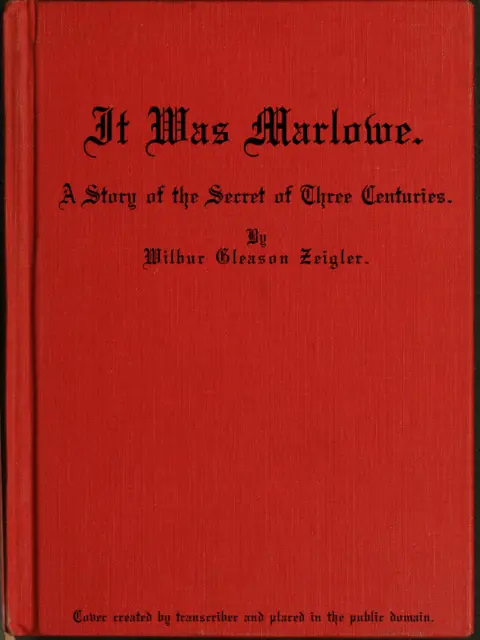
"It Was Marlowe: A Story of the Secret of Three Centuries" by Wilbur Gleason Zeigler is a historical novel written in the late 19th century. The narrative centers around the intriguing figure of Christopher Marlowe, a prominent playwright of the Elizabethan era, as it explores themes of authorship, scandal, and love, all set against the backdrop of the tumultuous societal changes of that time. At the start of the story, we meet Marlowe in the midst of the plague-stricken London of June 1593. A chance encounter with a youth named Tabbard leads to discussions regarding the Lady Anne and a potential romantic connection between them. Meanwhile, tensions brew as Marlowe navigates his professional life as a playwright and actor amid rumors of his controversial reputation and impending danger. Secrets unfold through Tabbard's news and Marlowe's upcoming clandestine meeting with Anne, setting the stage for a tale filled with intrigue, romance, and the shadow of Marlowe’s enigmatic past. This opening lays the groundwork for a plot that promises to delve into the complexities of Marlowe's life and the challenges he faces in a world rife with political and personal peril.
Introduction adapted from the source catalogue; source summaries may be automatically generated.
Free to read · English · 71,165 words · No account needed
MAKE TIME FOR A GOOD BOOK
On by default. Untick to stop anonymous reading totals. Each page counts after 10 seconds in view. How this works.
Anonymous counting is on unless you have switched it off.
--The Author.
36 Stratford on Avon was in the time of Shakespere’s youth “a bookless
neighborhood.”
--Halliwell-Phillipps Outlines, p. 88.
See also Id. p. 1 and 2.
37 “I consider myself bound to believe, till some positive proof be produced to the contrary, that Dido was completed for the stage by Nash after the decease of Marlowe.”
--Dyce’s Marlowe, p. 36.
“But Chapman had also been busy with a continuation of Marlowe’s
‘half-told tale.’”
--Dyce’s Marlowe, p. 42.
38. “It is a comfort to know that the ruffian who drew up the charges, a certain ‘Rychard Bame’, was hanged at Tyburn on 6th December, 1594. Doubtless Bame was backed by some person or persons of power and position. It was a deliberate attempt on the part of some fanatics to induce the public authorities to institute a prosecution for blasphemy against the poet.”
--Bullen’s Marlowe, p. 69.
39 The passage which, upon being read by the condemned, would entitle him to liberation. See Benefit of Clergy.
40 In Watts v. Brains, 2 Croke, 778, the jury returned a verdict of not guilty, but were sent back and brought in a verdict of guilty. The defendant was hanged and the jury fined.
41. For evidence of similarity in rhythm, diction and thought read the parallel passages at the heads of each chapter of this book.
42 “Black is the beauty of the brightest day; The golden ball of Heaven’s eternal fire, That danced with glory on the silver waves, Now wants the fuel that inflamed his beams; And all for faintness and for foul disgrace, He blinds his temples with a frowning cloud, Ready to darken earth with endless night.”
--II Tamburlaine, II, 5.
“The gaudy, babbling and remorseful day Is crept into the bosom of the sea, And now long howling wolves arouse the jades That drag the tragic melancholy night; Who with their drowsy slow and flagging wings Clip dead men’s graves, and from their misty jaws Breathe foul contagious darkness in the air.”
--Second Part Henry VI.
Aut Christopherus Marlowe, aut diabolus, “A study of Shakespere,”
by Swinburne, p. 52.
43 “Mr. Fleay believes him [the writer of the plays] to have been a partner of Shakespere, whose name so far is undiscoverable.”
--Morgan’s “Shakespere In Fact and In Criticism,” p. 18.
44 “There were tiers of galleries or scaffolds; beneath these, the boxes or rooms intended for persons of the higher class, and which at the private theaters were secured with locks, the keys being given to the individuals who engaged them.”
--Dyce’s Shakespere, p. 41.
45 “The top of his performance was the ghost in Hamlet.”
--Rowe’s Life of Shakespere.
Your reading position is saved on this browser. Take it to another device with a library code. Reading pages adapt to text, rather than matching a printed edition.
BEHIND THE BOOK
This eBook is for the use of anyone anywhere in the United States and most other parts of the world at no cost and with almost no restrictions whatsoever. You may copy it, give it away or re-use it under the terms of the Project Gutenberg License included with this eBook or online at www.gutenberg.org. If you are not located in the United States, you will have to check the laws of the country where you are located before using this eBook. Read the source licence.
The original source file, including credits and licence, is retained by this library. Request an original-format copy at no charge. Please include the book title and Project Gutenberg identifier #57810.
KEEP YOUR CURIOSITY GOING
Cécile Tormay

Moritz Busch
Coulson Kernahan
John L. Ransom

Maurice Baring
Frances Wright