Letters to a Friend, Written to Mrs. Ezra S. Carr, 1866-1879
John Muir
THE CLASSIC COLLECTION · 1913
"Irritability: A Physiological Analysis of the General Effect of Stimuli" by Max Verworn is a scientific publication written in the early 20th century. The text appears to focus on the concept of irritability as it pertains to living substances, exploring how different stimuli can affect physiological reactions and the laws governing these responses. The author discusses the historical perspectives on irritability and aims to unite experiments conducted over decades to form a systematic understanding of this fundamental physiological concept. The opening of the work introduces the reader to the historical context surrounding the study of irritability, outlining significant thinkers such as Francis Glisson and Albrecht von Haller, and their contributions to the understanding of living substances' responses to stimuli. Verworn sets the stage for a comprehensive exploration by discussing the philosophical and scientific evolutions that have shaped the field. He emphasizes the importance of studying irritability as a gateway to better understanding life's processes. The author also signals his intention to methodically investigate the effects of stimulation across various biological systems, laying a foundation for the detailed analysis that will follow in the subsequent chapters.
Introduction adapted from the source catalogue; source summaries may be automatically generated.
Free to read · English · 85,158 words · No account needed
MAKE TIME FOR A GOOD BOOK
On by default. Untick to stop anonymous reading totals. Each page counts after 10 seconds in view. How this works.
Anonymous counting is on unless you have switched it off.
[80] Max Verworn: “Psycho-physiologische Protistenstudien. Experimentelle Untersuchungen.” Jena 1889.
All these factors, the intensity with which the excitation extends from the point of stimulation, the rapidity of the extension, and finally the area over which conduction takes place, are manifestations of the intensity of stimulus, and as such alter with these in corresponding manner. If the end of a pseudopod is barely touched and thereby weakly stimulated, the response is restricted to a slight wrinkling of the surface, which slowly extends to the immediate neighborhood, whilst the more distant parts of the pseudopod are not affected at all by the excitation. (Figure 15, A.) On a stronger stimulation of the pseudopod by slight pressure, the response is likewise stronger, and the characteristic differentiation of the protoplasm, consisting in the strongly refractive strand in the axis and the turbid myelinlike outer mass, appears at the point of stimulation. From here a peculiar alteration spreads gradually further over the pseudopod, in that first upon its smooth surface a few myelinlike droplets are seen, which become larger and with the development of the strand in the axis, dissolve into a wrinkled mass on the surface. The further this process extends from the point of stimulation, the weaker it becomes and the more slowly it proceeds, until at last there is complete disappearance. (Figure 15, B.) The pseudopod has at the same time retracted to a considerable degree. If a still stronger stimulus is applied by firm pressure at the end of the pseudopod the process takes place with much greater violence. The differentiation of the protoplasm spreads centripetally from the point of stimulation over the whole pseudopod with great rapidity, and produces a quick retraction in the same, then involves the oppositely directed pseudopod, in which it then extends more and more slowly, until, proceeding in a centrifugal direction, it is at last gradually completely obliterated. When strong stimulation is applied, the process occurs with such rapidity that the contraction of the pseudopod is almost twitchlike. As the rapidity of the conduction alters within a wide limit according to the strength of the stimulus and the distance from the point of stimulation, it is self-evident that no constant figure can be stated. To give a general idea of the rapidity, they might be estimated according to observations I have made with second watch and ocular-micrometer as from within a slight fraction to that of a millimeter in the second. When a very long extended pseudopod is locally stimulated in the middle, the response spreads from the point affected in both directions diminishing in intensity and rapidity. The excitation extends equally in all directions. (Figure 16.) These facts show very clearly that in Difflugia the excitation following a localized stimulus is dependent on the intensity of the stimulus, and that according to the degree of this, the wave progresses in either stronger, more rapid and extended, or weaker, slower and more limited manner. With the greater distance from the point of stimulation the excitation undergoes an increasing decrement of its intensity and rapidity of conduction. Different species of Difflugia which I have investigated, Difflugia lobostoma, urceolata, pyriformis, have shown a complete conformity in this respect. A great number of other fresh water and marine rhizopods, the pseudopods of which I have used for analogous experiments, although differing in the manner of reaction in regard to the extent and rapidity of the course of excitation, manifest exactly the same fundamental principles. A very favorable form is, for instance, the much smaller Cyphoderia margaritacea, which is distinguished by a somewhat higher degree of excitability and rapidity of reaction.[81] The long straightly extended pseudopods are thinner and more threadlike than those of Difflugia and show upon stimulation as a result of their local excitation a simple contraction into clumps of the stimulated protoplasm without the characteristic differentiation of that of Difflugia. (Figure 17.) In the case of the marine rhizopods, Orbitolites (Figure 19), Amphistegina, etc., which I investigated at the Red Sea, the conduction of excitation takes place also as in Difflugia with a decrement of intensity and rapidity becoming larger with the distance from the point of stimulation until the wave of excitation is obliterated.
Your reading position is saved on this browser. Take it to another device with a library code. Reading pages adapt to text, rather than matching a printed edition.
BEHIND THE BOOK
This eBook is for the use of anyone anywhere in the United States and most other parts of the world at no cost and with almost no restrictions whatsoever. You may copy it, give it away or re-use it under the terms of the Project Gutenberg License included with this eBook or online at www.gutenberg.org. If you are not located in the United States, you will have to check the laws of the country where you are located before using this eBook. Read the source licence.
The original source file, including credits and licence, is retained by this library. Request an original-format copy at no charge. Please include the book title and Project Gutenberg identifier #66767.
KEEP YOUR CURIOSITY GOING
John Muir
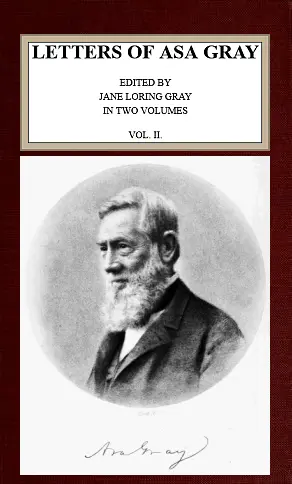
Asa Gray
Asa Gray
Florence Nightingale
Elizabeth Robins Pennell
Denison Olmsted