Letters to a Friend, Written to Mrs. Ezra S. Carr, 1866-1879
John Muir
THE CLASSIC COLLECTION · 1913
"Irritability: A Physiological Analysis of the General Effect of Stimuli" by Max Verworn is a scientific publication written in the early 20th century. The text appears to focus on the concept of irritability as it pertains to living substances, exploring how different stimuli can affect physiological reactions and the laws governing these responses. The author discusses the historical perspectives on irritability and aims to unite experiments conducted over decades to form a systematic understanding of this fundamental physiological concept. The opening of the work introduces the reader to the historical context surrounding the study of irritability, outlining significant thinkers such as Francis Glisson and Albrecht von Haller, and their contributions to the understanding of living substances' responses to stimuli. Verworn sets the stage for a comprehensive exploration by discussing the philosophical and scientific evolutions that have shaped the field. He emphasizes the importance of studying irritability as a gateway to better understanding life's processes. The author also signals his intention to methodically investigate the effects of stimulation across various biological systems, laying a foundation for the detailed analysis that will follow in the subsequent chapters.
Introduction adapted from the source catalogue; source summaries may be automatically generated.
Free to read · English · 85,158 words · No account needed
MAKE TIME FOR A GOOD BOOK
On by default. Untick to stop anonymous reading totals. Each page counts after 10 seconds in view. How this works.
Anonymous counting is on unless you have switched it off.
[24] Preyer: “Das myophysische Gesetz.” Jena 1874.
[25] Pfeffer: “Ueber chemotaktische Bewegungen von Bacterien, Flagellaten und Volvocineen.” Untersuchungen aus dem botanischen Institut zu Tübingen. Bd. II, 1888.
This rule of course only applies within the boundaries of the intensity between the threshold of stimulation and maximal stimulus. The interval, however, between these intensities varies considerably in different living substances. In this connection there are several forms of living substance which call for our special attention. In these the surprising condition seems to exist, that the interval between the threshold and the maximal stimulus is zero; that is, every stimulus which acts at all always produces a maximal response. Bowditch[26] first observed this behavior in the frog’s heart and this has also been confirmed by Kronecker.[27] The induction current produces, as Bowditch says, either a contraction or nothing. If the former, it is the strongest contraction which can be produced by an induction shock at the given time. Here for the first time a constancy of response was discovered which has been termed the all or none law. McWilliams[28] has later verified the same fact for the mammalian heart. Gotch[29] has also arrived at the same conclusion in connection with the nerve. He states that “the comparison of submaximal with maximal responses shows that although there is an obvious difference in the amount of E. M. F., there is little or no difference between such time relations as the moment of commencement, the moment of culmination of E. M. F. and the rate at which E. M. F. disappears.” Further: “the rate of propagation of the excitatory wave is the same whether this is maximal or submaximal.” He likewise assumes that the “all or none law” is applicable to the constituent fibers, and that the variations in the strength of response with weak and strong stimulation are brought about in the first instance by stimulation of a few, in the latter by a greater number of fibers in the nerve trunk. The same conclusion has been reached by Keith Lucas[30] for the single cross-striated fiber of the skeletal muscle, founded on the fact that by direct stimulation of a bundle of curarized muscle fibers, the contraction only increases inconstantly and not regularly with the increasing intensity of the stimulus. This is only comprehensible if one takes into consideration that, with the increasing intensity of the stimulus, a greater and greater number of fibers are stimulated. Keith Lucas[31] came to the same conclusion in the case of the muscle stimulated indirectly through the nerve. He, therefore, sees, because of the nature of the response of the single muscle cell, no difference between heart muscle and skeletal muscle. The “all or none law” applies to the individual muscle cells of both kinds. The difference between the heart and skeletal muscle, according to him, lies in the fact that in the heart the individual muscle cells in their totality stand together as conductors of excitation, whereas in the skeletal muscle the individual muscle fibers are separated, as far as conduction of excitation is concerned, by the sarcolemma. Finally, the recent investigations of Vészi[32] with strychnine poisoned ganglia cells of the posterior horns of the spinal cord, have made it appear probable that “the all or none law” can be applied likewise to the individual ganglion cell. He draws this conclusion not only from the fact that all reflex contractions of a muscle of a strychninized frog are maximal, whether they are produced by weak or strong stimuli, but also especially because of the loss in the strychninized spinal cord of the capacity of the summation of irritability. The normal spinal cord does not reflexly respond at all to weak single stimuli, but responds to equally weak faradic stimulation very readily. Therefore, the threshold lies very high for the individual induction shock and very low for faradic shocks. But these differences are equalized in the strychninized frog. This seems intelligible, when we assume that the strychninized cell responds to every stimulus, to which it responds at all, to the maximal extent which is permitted at that moment by its stored up energy, otherwise the excitation would necessarily be summated by faradic stimulation.
Your reading position is saved on this browser. Take it to another device with a library code. Reading pages adapt to text, rather than matching a printed edition.
BEHIND THE BOOK
This eBook is for the use of anyone anywhere in the United States and most other parts of the world at no cost and with almost no restrictions whatsoever. You may copy it, give it away or re-use it under the terms of the Project Gutenberg License included with this eBook or online at www.gutenberg.org. If you are not located in the United States, you will have to check the laws of the country where you are located before using this eBook. Read the source licence.
The original source file, including credits and licence, is retained by this library. Request an original-format copy at no charge. Please include the book title and Project Gutenberg identifier #66767.
KEEP YOUR CURIOSITY GOING
John Muir
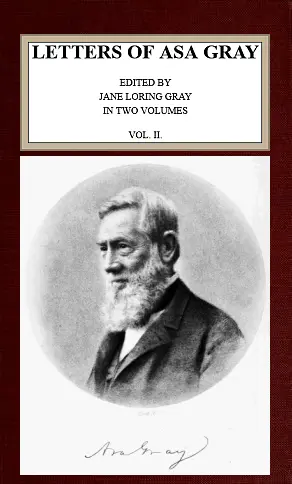
Asa Gray
Asa Gray
Florence Nightingale
Elizabeth Robins Pennell
Denison Olmsted