
Letters to a Friend, Written to Mrs. Ezra S. Carr, 1866-1879
John Muir
THE CLASSIC COLLECTION · 1913
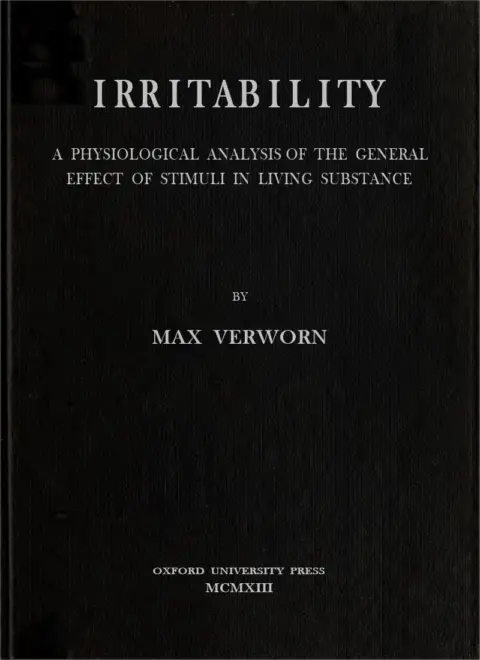
"Irritability: A Physiological Analysis of the General Effect of Stimuli" by Max Verworn is a scientific publication written in the early 20th century. The text appears to focus on the concept of irritability as it pertains to living substances, exploring how different stimuli can affect physiological reactions and the laws governing these responses. The author discusses the historical perspectives on irritability and aims to unite experiments conducted over decades to form a systematic understanding of this fundamental physiological concept. The opening of the work introduces the reader to the historical context surrounding the study of irritability, outlining significant thinkers such as Francis Glisson and Albrecht von Haller, and their contributions to the understanding of living substances' responses to stimuli. Verworn sets the stage for a comprehensive exploration by discussing the philosophical and scientific evolutions that have shaped the field. He emphasizes the importance of studying irritability as a gateway to better understanding life's processes. The author also signals his intention to methodically investigate the effects of stimulation across various biological systems, laying a foundation for the detailed analysis that will follow in the subsequent chapters.
Introduction adapted from the source catalogue; source summaries may be automatically generated.
Free to read · English · 85,158 words · No account needed
MAKE TIME FOR A GOOD BOOK
On by default. Untick to stop anonymous reading totals. Each page counts after 10 seconds in view. How this works.
Anonymous counting is on unless you have switched it off.
Since then the inhibitory processes in nerves have been frequently investigated by Schiff (1823–1896), Goltz (1834–1901) and others, who gave us a theory concerning the same. Only a small number of inhibitory processes were known at that time, as for instance the inhibition of the croak reflex of the frog, or the inhibition of the grasp reflex during copulation of these animals through skin stimuli, and a few other cases. They regarded the inhibitory nervous processes as a special state, of which the inhibition of the heart through the vagus was the best illustration. Further, the Russian physiologist Setschenow succeeded by directly stimulating certain parts of the central nervous system, especially the optic lobes of the frog, in producing inhibition. It was, therefore, frequently assumed, as Setschenow did, that in the brain there exist special inhibitory centers, just as there are motor centers. This view was later shown to be untenable. It is only quite recently, and especially since Sherrington has shown that inhibition plays a part in all antagonistic muscle movements, that we have obtained a broad and more thorough understanding of the inhibitory processes in the life of the organism, and a physiological explanation of this important group of activities of the central nervous system. This inhibitory effect of stimulation, brought about by the involvement of the central nervous system in the normal organism, was studied side by side with the depressing effects of stimulation. Claude Bernard (1813–1878)[9] first discovered that the excitation of all living substance could be depressed or totally suspended through the influence of certain anæsthetics, such as ether or chloroform. By a series of experiments, as simple as they were convincing, the French scientist showed that irritability could be depressed in mimosa leaves, the growth of germinating plant seeds and the ferment action of yeast cells stopped, likewise the disintegration of the carbon dioxide in the cells of the green leaf, as well as the development of the egg cells, and also the movements of the animal organism and the sensations of man. By this means he recognized that not only does all living protoplasm possess irritability, but that it can also by means of certain substances be put into the condition of “anæsthesia,” a state dependent upon a change of the protoplasm, which he termed “semi-coagulation.” Finally, besides the more apparent processes of excitation and those less so, belonging to the group of inhibition and depression, in the last century the knowledge of the subject was greatly increased by the addition of another group, which recently in consequence of various reasons has met with particular interest. These being effects of stimuli on the direction of movements of motile organisms, it became more and more recognized that these curious manifestations of irritability, which appeared to have such a surprising likeness to the mysterious attraction and repulsion in the sphere of electricity and magnetism, occur universally in the vegetable as well as in the animal world. These movements are of the greatest biological importance for the obtaining of food, propagation, protection against disease, etc. Botanists have long known of the geotaxis of the roots and stems of plants, the heliotaxis of their leaves and flowers and of the thigmotaxis of their tendrils. Likewise the phototaxis of freely moving protistæ had been often observed, especially by Ehrenberg[10] of Berlin, well known for his researches on infusoria. Then Engelmann, Pfeffer, Strassburger, Stahl, and many others discovered and studied more carefully the facts concerning chemotaxis, thigmotaxis, rheotaxis, geotaxis, phototaxis, etc., of bacteria, motile spores, rhizopoda, and so on. The question arose if one should regard this singular behavior of the unicellular organisms as an expression of conscious sensations, discrimination or will. This view was as determinedly denied on the one hand as it was accepted on the other. Whilst even today certain scientists still consider the reactions of the unicellular organisms as a manifestation of conscious sensation, discrimination or will, others look upon them as unconscious reflex reactions of cell organism, taking place as purely mechanically as the spinal cord reflexes of vertebrates. This divergence of opinion would have practically no value for the development of our knowledge of irritability had not here, as in the case of the relations between the mental and physical processes in man, the view been entertained with more or less fervor, that at some stage or other in the chain of the purely physiological processes of responsivity, an intangible factor had been introduced which was considered as the essential “cause” of the peculiar reactions to stimuli. It is not here the place to enter into the question if, and in what degree, animal psychology may be a field of scientific research. Even if one looks upon conscious processes as effects of stimulation, in both lower animals and in man, in no case should one assume them to be factors of an essentially different nature, interrupting the chain of the mechanical reactions; neither should one consider the particular characteristic responses observed in unicellular organisms as effects of non-mechanical “causes.” As a result, a mysticism, in reality quite foreign to it, would be introduced into physiology. As a matter of fact the physiological investigations for the tropic reactions of stimuli, which have been carried out in great number since the end of the eighties, have shown more and more clearly that this peculiar behavior of unicellular organisms towards unilateral stimuli is produced by a comparatively simple mechanism. The analysis of this shows a difference in the intensity of the exciting or depressing effect produced by the stimulus. The stimulus exerts its influence unequally upon the specific activity of the motor elements of different parts of the surface of the cell body. This difference in response causes the axis of the freely moving organism to assume a different direction in which to move. It is compelled to move in a definite direction and so, in this field, the apparently mysterious attraction and repulsion of living organisms toward stimuli has, by means of the most simple analysis, been robbed of its mystical character.
Your reading position is saved on this browser. Take it to another device with a library code. Reading pages adapt to text, rather than matching a printed edition.
BEHIND THE BOOK
This eBook is for the use of anyone anywhere in the United States and most other parts of the world at no cost and with almost no restrictions whatsoever. You may copy it, give it away or re-use it under the terms of the Project Gutenberg License included with this eBook or online at www.gutenberg.org. If you are not located in the United States, you will have to check the laws of the country where you are located before using this eBook. Read the source licence.
The original source file, including credits and licence, is retained by this library. Request an original-format copy at no charge. Please include the book title and Project Gutenberg identifier #66767.
KEEP YOUR CURIOSITY GOING
John Muir

Asa Gray
Asa Gray

Florence Nightingale
Elizabeth Robins Pennell
Denison Olmsted