
Letters to a Friend, Written to Mrs. Ezra S. Carr, 1866-1879
John Muir
THE CLASSIC COLLECTION · 1913
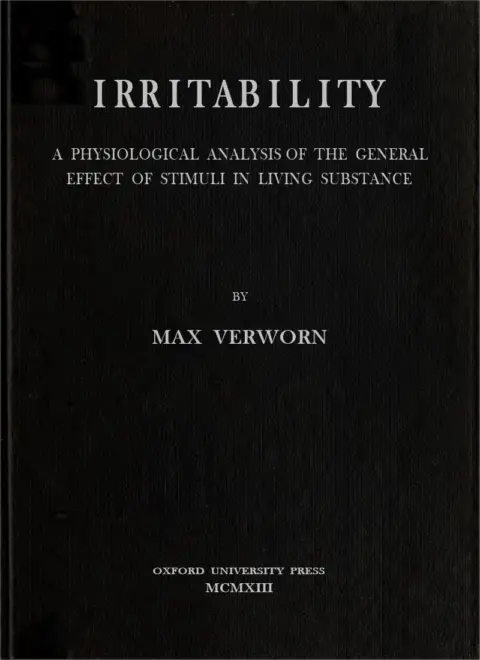
"Irritability: A Physiological Analysis of the General Effect of Stimuli" by Max Verworn is a scientific publication written in the early 20th century. The text appears to focus on the concept of irritability as it pertains to living substances, exploring how different stimuli can affect physiological reactions and the laws governing these responses. The author discusses the historical perspectives on irritability and aims to unite experiments conducted over decades to form a systematic understanding of this fundamental physiological concept. The opening of the work introduces the reader to the historical context surrounding the study of irritability, outlining significant thinkers such as Francis Glisson and Albrecht von Haller, and their contributions to the understanding of living substances' responses to stimuli. Verworn sets the stage for a comprehensive exploration by discussing the philosophical and scientific evolutions that have shaped the field. He emphasizes the importance of studying irritability as a gateway to better understanding life's processes. The author also signals his intention to methodically investigate the effects of stimulation across various biological systems, laying a foundation for the detailed analysis that will follow in the subsequent chapters.
Introduction adapted from the source catalogue; source summaries may be automatically generated.
Free to read · English · 85,158 words · No account needed
MAKE TIME FOR A GOOD BOOK
On by default. Untick to stop anonymous reading totals. Each page counts after 10 seconds in view. How this works.
Anonymous counting is on unless you have switched it off.
We have previously become acquainted with such a case and studied it in detail. This is the state of fatigue. Fatigue is a typical state of depression, that is, a state in which the vital process is retarded and irritability in response to stimuli correspondingly decreased. Fatigue is, however, as we have found, the result of a relative deficiency of oxygen. The amount of oxygen at disposal is not sufficient to allow of disintegration, increased by constant functional activity oxydatively taking place, to develop to its full extent. In consequence the previously cited sequence of processes takes place. A “depression of activity” is produced. Fatigue is true asphyxiation and it is here evident that depression proceeds from the same constituent processes of metabolism as excitation, brought about by a single stimulus. Excitation produced by constant stimuli gradually merges into depression as the amount of oxygen at disposal, even if augmented in the intact organism by the increased blood supply, for instance, is still insufficient to meet the demand made by the increased oxygen consumption as a result of continuous functional activity.
A further very interesting example of depression produced by oxygen deficiency is furnished by heat depression. It has long been known that with increasing temperature the vital manifestations of all poikilothermic organisms at first undergo a heightening of their intensity. If, however, after a maximum is reached, the temperature is still further increased a sudden depression sets in. The increase in the rapidity of the vital process as a result of increased temperature is readily understood when based on the well-known law discovered by van’t Hoff. Numerous investigations on the rapidity of the course of special vital manifestations, as, for instance the growth of the eggs of the frog and sea urchin, the assimilation of carbon dioxide in green plant cells, the number of vacuole pulsations in the infusoria cells, the frequency of the heart rate of the frog and of the mammal, etc., have shown that their increase does in fact follow the van’t Hoff law, being doubled or tripled in amount with every increase of ten degrees of temperature. The genesis of depression produced by heat, developed in different organisms at various heights of temperature, requires a closer analysis. This depression takes place at temperatures below that in which coagulation of proteins occurs. Therefore, under certain conditions, with which we shall presently become acquainted, it is capable of being recovered from, whereas in higher temperatures, in which albumen coagulates, vital activity is permanently obliterated. Depression produced by heat is, therefore, in itself not a necrobiotic process, which, as such, must necessarily lead to death. But rather like fatigue it must be looked upon as an asphyxiation process. Its relations to oxygen exchange have been chiefly demonstrated by Winterstein[202] by his investigations on the central nervous system of frogs and on medusæ. He found that when placed in a heated chamber in a temperature of 32–40° the activity and reflex excitability of the frog are at first augmented. Within the lapse of a short time this increase has become so great that the slightest touch produces tetanic contractions, similar to those characteristic of strychnine poisoning. Very soon, however, this state of high excitation is followed by one of depression, in which no response to stimuli can be obtained. The animal remains entirely motionless in any position in which it is placed, in the same manner as a frog whose nerve centers have been completely exhausted by strenuous activity. On the basis of our knowledge of the rôle played by the deficiency of oxygen in the bringing about of exhaustion the thought arose, if in this heat depression exhaustion might not likewise be the result of oxygen deficiency. This assumption has been most strikingly confirmed by the investigations of Winterstein. It has been demonstrated that recovery of the animal in a state of heat depression cannot be obtained by mere cooling, but is only brought about when at the same time a renewed oxygen supply is provided. For instance, a frog is depressed in the warm chamber and even when a strychnine injection has been introduced, does not show the slightest reaction to stimuli. In the warm water bath artificial circulation is now applied in the previously described manner with an oxygen-free saline solution at 30° C., so that the blood is displaced and thus the renewed oxygen supply to the nervous centers prevented. The animal can now be cooled and the warm saline solution be replaced by a cooled one without the least recovery taking place. If, however, blood of the ox with contained oxygen is substituted for the oxygen-free saline solution, the frog shows signs of recovery within a few minutes and after ten or fifteen minutes responds as a result of the strychnine to the merest touch with tetanic contractions of the whole body. By modifying these methods of investigation to a certain extent Bondy[203] has confirmed these results to the fullest extent. Later Winterstein by quantitative determinations of oxygen consumption on medusæ showed that at 30–35° C., at which temperature heat depression sets in, the consumption of oxygen shows an increase of about three and a half times compared to that in a temperature of 11–12° C. These facts show that we have in heat depression a process which, as far as its genesis is concerned, is completely analogous to that of fatigue. In fatigue, a relative want of oxygen is produced by the increased consumption following functional activity, in heat depression by the increase of the entire metabolism producing a corresponding increase of oxygen requirement. In both instances we have an excitation produced by external stimuli which result in an increase in the amount of oxygen required, and in both instances the oxygen at disposal is not sufficient to permanently meet the augmented demand. In both types, therefore, decomposition must become more and more anoxydative and the well-known series of processes is developed, which find their expression in depression.
Your reading position is saved on this browser. Take it to another device with a library code. Reading pages adapt to text, rather than matching a printed edition.
BEHIND THE BOOK
This eBook is for the use of anyone anywhere in the United States and most other parts of the world at no cost and with almost no restrictions whatsoever. You may copy it, give it away or re-use it under the terms of the Project Gutenberg License included with this eBook or online at www.gutenberg.org. If you are not located in the United States, you will have to check the laws of the country where you are located before using this eBook. Read the source licence.
The original source file, including credits and licence, is retained by this library. Request an original-format copy at no charge. Please include the book title and Project Gutenberg identifier #66767.
KEEP YOUR CURIOSITY GOING
John Muir
Asa Gray
Asa Gray
Florence Nightingale
Elizabeth Robins Pennell
Denison Olmsted