READ · DISCOVER · ENJOYClassic literature · Always free
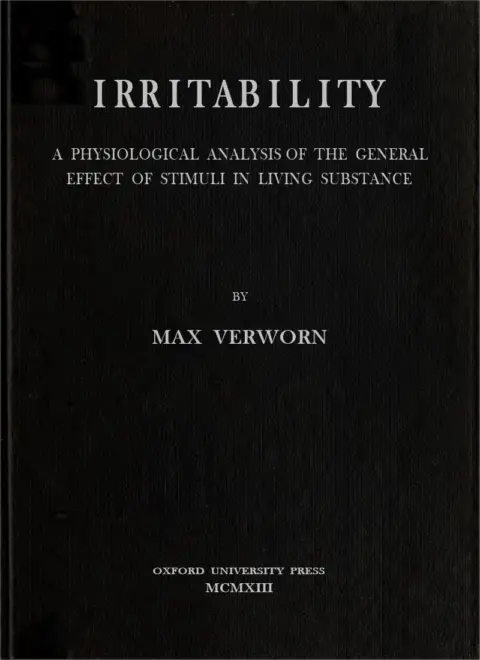
Irritability — digital edition cover

THE CLASSIC COLLECTION · 1913

Irritability

"Irritability: A Physiological Analysis of the General Effect of Stimuli" by Max Verworn is a scientific publication written in the early 20th century. The text appears to focus on the concept of irritability as it pertains to living substances, exploring how different stimuli can affect physiological reactions and the laws governing these responses. The author discusses the historical perspectives on irritability and aims to unite experiments conducted over decades to form a systematic understanding of this fundamental physiological concept. The opening of the work introduces the reader to the historical context surrounding the study of irritability, outlining significant thinkers such as Francis Glisson and Albrecht von Haller, and their contributions to the understanding of living substances' responses to stimuli. Verworn sets the stage for a comprehensive exploration by discussing the philosophical and scientific evolutions that have shaped the field. He emphasizes the importance of studying irritability as a gateway to better understanding life's processes. The author also signals his intention to methodically investigate the effects of stimulation across various biological systems, laying a foundation for the detailed analysis that will follow in the subsequent chapters.

Introduction adapted from the source catalogue; source summaries may be automatically generated.

Start reading ↓

Free to read · English · 85,158 words · No account needed

MAKE TIME FOR A GOOD BOOK

Irritability

On by default. Untick to stop anonymous reading totals. Each page counts after 10 seconds in view. How this works.

Anonymous counting is on unless you have switched it off.

Irritability

Among other investigations, which since this time have been made to explain the mechanism of inhibition, those of Gaskell,[170] Hering[171] and Meltzer[172] have received widest consideration. These theories are built upon the existence of the two phases of metabolism, and assume that inhibition, in contradistinction to dissimilatory excitation processes, depends upon an increase of the assimilative processes. The principal evidence which Gaskell advances is that when the vagus nerve of the tortoise heart, a typical inhibitory nerve, is stimulated, a positive variation of the demarcation current of the heart muscle occurs, whereas when a motor nerve of a skeleton muscle is stimulated the attached muscle shows a negative variation of the demarcation current. I must confess that this explanation of inhibitory processes, from the standpoint of an interpretation of processes in the living substance, seems very plausible, and I have accepted this even in my address on excitation and depression before the Frankfurter Naturforscher Versammlung.[173] I have since then endeavored to obtain experimental evidence to substantiate this theory, in that I attempted to prove that increase of the assimilatory processes brought about by stimulation would be associated with a reduction of the specific irritability. For this purpose I have sought for such cases in which a stimulus primarily and momentarily increases assimilative processes in a system in a state of metabolic equilibrium. I was disappointed, when, after years of investigation, I could not find such cases. There is only one kind of stimulus of which we can say with positiveness that it primarily increases the assimilative processes, that is, increased supply of food. But here the increase in the processes of assimilation never occurs momentarily, and indeed this increase is so extremely slight that it can only be demonstrated over a long course of time. These totally negative results of my investigation had awakened strong doubts concerning the assimilation hypothesis of inhibition. Above all, this explanation seemed to me to be impossible for the nervous system. I searched, therefore, for another explanation for the processes of inhibition in the nervous system. If the increase of energy production resulting from the application of a stimulus is dependent upon an excitation of a dissimilative nature, then one is justified to look upon the reduction of functional energy production as an expression of an antagonistic process to that of dissimilatory excitation. In this respect the Gaskell-Hering hypothesis of inhibition rests upon a firm foundation. When, however, this hypothesis assumes an antagonism between dissimilatory and assimilatory excitation, then it must not be overlooked that a second antagonism is possible between dissimilatory excitation and dissimilatory depression. The antagonism need not involve the two types of metabolism, it may depend upon variations of one type. When, therefore, the hypothesis that inhibition is brought about by assimilatory excitation meets with insuperable difficulties, the possibility should be considered if it is not more likely dependent upon dissimilatory depression. These reflections induced me to investigate if conditions could not be produced experimentally wherein dissimilatory depression could bring about inhibitory processes in the nervous system. The most essential requirement was, that dissimilatory depression should quickly develop and pass away with like rapidity, for inhibition of the nervous system sets in momentarily and disappears again momentarily. Another important requisite is, that both interference stimuli are individually capable of producing dissimilatory excitation, for the inhibitory processes of the nervous type may be assumed to be the result of dissimilatory excitation which produce by their interference inhibition, for the nerve fibers, as already stated, are capable of conducting only dissimilatory excitation to the responding organ. As I studied the problem in this manner, it became clear to me that all the conditions necessary for the genesis of inhibition are realized in the existence of the refractory period, and that I had already produced inhibition by prolonging the refractory period, by oxygen withdrawal, in the strychninized frog. If we take a strychninized frog in which the refractory period has been somewhat prolonged by oxygen withdrawal, so that the reaction is simply a short reflex contraction, and rhythmically stimulate the skin, a reaction is only obtained with the first few stimuli, which reactions rapidly decrease until a stage is reached wherein the succeeding stimuli are completely inoperative. (Figure 45.)[174] This inhibition is demonstrated even more clearly by the following experiment. Contractions of the triceps muscle of a strychninized frog are recorded which reflexly follow from stimulation of the central end of the cut sciatic nerve. Oxygen is withdrawn in the manner already referred to. At the proper stage of oxygen deficiency, rhythmic induction shocks applied to the central end of the nerve, the interval between the individual stimuli of which being longer than the duration of the refractory period, elicit reflex contractions of the muscles of the posterior extremity on the opposite side following each individual stimulus. If, however, in the same stage the central end of the nerve is stimulated with induction shocks at intervals briefer than the duration of the refractory period, a contraction is only observed during the very beginning, being brought about by the first stimulus, whereas the subsequent stimuli are ineffective, the muscles remaining at rest during their entire application. (Figure 46.) Tiedemann[175] at a later date continued these observations and analyzed them more in detail. In all these experiments, therefore, there is an interference of the frequent stimulus, because each succeeding stimulus occurs in the refractory period of the proceeding. In consequence there is a strong reduction of irritability and reaction is absent. That is, the centers during application of the frequent current are inhibited. If cessation of stimulation by frequent shocks takes place, stimulation by slowly succeeding individual shocks becomes effective again in a few seconds. This is the simplest example of the process of inhibition and by it I was led to seek in the refractory period the key of the mechanisms of the process of inhibition. This principle once recognized, further material for the more detailed working out and extension of the theory was gathered from the experiences already gained during the course of the preceding years in the researches on fatigue and the refractory period in the nerve. Here it became apparent that the processes resembling inhibition discovered by Schiff in the nerve preparation and which were studied anew at a later date by Wedenski, F. B. Hofmann and Amaja and in part attributed by Hofmann to fatigue of the nerve endings, by Fröhlich to fatigue of the nerve itself, were in principle of the same nature as the central inhibitions themselves. Fröhlich,[176] by his analysis of the observations of Richet, Luchsinger, Fick, Biedermann and Piotrowski on inhibition in the claw of the crab, then showed that inhibition can be influenced by the alteration of the intensity of the stimulus as well as its frequency. In a series of experimental researches he could then demonstrate that the widely extended antagonistic inhibitions and other special processes of inhibitions in the centers could on the basis of the same principle be physiologically explained. Here the supposition was confirmed that the development of a relative refractory period plays a very important rôle in the inhibition of the nervous centers. Thus, the relations of the processes of inhibition to the refractory period, once established, their entire field, up to then shrouded in darkness, has gradually in the course of years been completely elucidated.

Your reading position is saved on this browser. Take it to another device with a library code. Reading pages adapt to text, rather than matching a printed edition.

BEHIND THE WORDS

About Max Verworn

Max Verworn (1863–1921). Explore Irritability in this collection. These books span science & nature.

Explore this author’s books →

THE READERS’ VERDICT

How did this story stay with you?

Not rated yet
Your rating for Irritability

Be the first to share your verdict.

One rating per browser, which you can change or remove. A necessary browser identifier remembers your vote. How ratings work

A GOOD STORY DESERVES COMPANY

Pass this book along.

A great read is even better when it’s shared.

SEND A LITTLE INSPIRATION

Share this book

BEHIND THE BOOK

Edition & source details.

Title
Irritability
Author
Max Verworn
Publication year
1913
Digital edition publisher
Project Gutenberg
Gutenberg release date
2021-11-19
Language
English
Source edition imprint
$aUnited States :$bYale University Press,$c1913.
Source identifier
Project Gutenberg #66767
Contributors
No additional named contributors in source metadata

Public-domain source & licence

This eBook is for the use of anyone anywhere in the United States and most other parts of the world at no cost and with almost no restrictions whatsoever. You may copy it, give it away or re-use it under the terms of the Project Gutenberg License included with this eBook or online at www.gutenberg.org. If you are not located in the United States, you will have to check the laws of the country where you are located before using this eBook. Read the source licence.

Full source licence and obtaining an original copy

The original source file, including credits and licence, is retained by this library. Request an original-format copy at no charge. Please include the book title and Project Gutenberg identifier #66767.

the full Project Gutenberg License must appear
prominently whenever any copy of a Project Gutenberg work (any work
on which the phrase “Project Gutenberg” appears, or with which the
phrase “Project Gutenberg” is associated) is accessed, displayed,
performed, viewed, copied or distributed:

This eBook is for the use of anyone anywhere in the United States and most
other parts of the world at no cost and with almost no restrictions
whatsoever. You may copy it, give it away or re-use it under the terms
of the Project Gutenberg™ License included with this eBook or online
at www.gutenberg.org. If you
are not located in the United States, you will have to check the laws
of the country where you are located before using this eBook.

1.E.2. If an individual Project Gutenberg electronic work is
derived from texts not protected by U.S. copyright law (does not
contain a notice indicating that it is posted with permission of the
copyright holder), the work can be copied and distributed to anyone in
the United States without paying any fees or charges. If you are
redistributing or providing access to a work with the phrase “Project
Gutenberg” associated with or appearing on the work, you must comply
either with the requirements of paragraphs 1.E.1 through 1.E.7 or
obtain permission for the use of the work and the Project Gutenberg
trademark as set forth in paragraphs 1.E.8 or 1.E.9.

1.E.3. If an individual Project Gutenberg electronic work is posted
with the permission of the copyright holder, your use and distribution
must comply with both paragraphs 1.E.1 through 1.E.7 and any
additional terms imposed by the copyright holder. Additional terms
will be linked to the Project Gutenberg License for all works
posted with the permission of the copyright holder found at the
beginning of this work.

1.E.4. Do not unlink or detach or remove the full Project Gutenberg
License terms from this work, or any files containing a part of this
work or any other work associated with Project Gutenberg.

1.E.5. Do not copy, display, perform, distribute or redistribute this
electronic work, or any part of this electronic work, without
prominently displaying the sentence set forth in paragraph 1.E.1 with
active links or immediate access to the full terms of the Project
Gutenberg License.

1.E.6. You may convert to and distribute this work in any binary,
compressed, marked up, nonproprietary or proprietary form, including
any word processing or hypertext form. However, if you provide access
to or distribute copies of a Project Gutenberg work in a format
other than “Plain Vanilla ASCII” or other format used in the official
version posted on the official Project Gutenberg website
(www.gutenberg.org), you must, at no additional cost, fee or expense
to the user, provide a copy, a means of exporting a copy, or a means
of obtaining a copy upon request, of the work in its original “Plain
Vanilla ASCII” or other form. Any alternate format must include the
full Project Gutenberg License as specified in paragraph 1.E.1.

1.E.7. Do not charge a fee for access to, viewing, displaying,
performing, copying or distributing any Project Gutenberg works
unless you comply with paragraph 1.E.8 or 1.E.9.

1.E.8. You may charge a reasonable fee for copies of or providing
access to or distributing Project Gutenberg electronic works
provided that:

• You pay a royalty fee of 20% of the gross profits you derive from
the use of Project Gutenberg works calculated using the method
you already use to calculate your applicable taxes. The fee is owed
to the owner of the Project Gutenberg trademark, but he has
agreed to donate royalties under this paragraph to the Project
Gutenberg Literary Archive Foundation. Royalty payments must be paid
within 60 days following each date on which you prepare (or are
legally required to prepare) your periodic tax returns. Royalty
payments should be clearly marked as such and sent to the Project
Gutenberg Literary Archive Foundation at the address specified in
Section 4, “Information about donations to the Project Gutenberg
Literary Archive Foundation.”

• You provide a full refund of any money paid by a user who notifies
you in writing (or by e-mail) within 30 days of receipt that s/he
does not agree to the terms of the full Project Gutenberg™
License. You must require such a user to return or destroy all
copies of the works possessed in a physical medium and discontinue
all use of and all access to other copies of Project Gutenberg™
works.

• You provide, in accordance with paragraph 1.F.3, a full refund of
any money paid for a work or a replacement copy, if a defect in the
electronic work is discovered and reported to you within 90 days of
receipt of the work.

• You comply with all other terms of this agreement for free
distribution of Project Gutenberg™ works.


1.E.9. If you wish to charge a fee or distribute a Project
Gutenberg™ electronic work or group of works on different terms than
are set forth in this agreement, you must obtain permission in writing
from the Project Gutenberg Literary Archive Foundation, the manager of
the Project Gutenberg™ trademark. Contact the Foundation as set
forth in Section 3 below.

1.F.

1.F.1. Project Gutenberg volunteers and employees expend considerable
effort to identify, do copyright research on, transcribe and proofread
works not protected by U.S. copyright law in creating the Project
Gutenberg™ collection. Despite these efforts, Project Gutenberg™
electronic works, and the medium on which they may be stored, may
contain “Defects,” such as, but not limited to, incomplete, inaccurate
or corrupt data, transcription errors, a copyright or other
intellectual property infringement, a defective or damaged disk or
other medium, a computer virus, or computer codes that damage or
cannot be read by your equipment.

1.F.2. LIMITED WARRANTY, DISCLAIMER OF DAMAGES - Except for the “Right
of Replacement or Refund” described in paragraph 1.F.3, the Project
Gutenberg Literary Archive Foundation, the owner of the Project
Gutenberg™ trademark, and any other party distributing a Project
Gutenberg™ electronic work under this agreement, disclaim all
liability to you for damages, costs and expenses, including legal
fees. YOU AGREE THAT YOU HAVE NO REMEDIES FOR NEGLIGENCE, STRICT
LIABILITY, BREACH OF WARRANTY OR BREACH OF CONTRACT EXCEPT THOSE
PROVIDED IN PARAGRAPH 1.F.3. YOU AGREE THAT THE FOUNDATION, THE
TRADEMARK OWNER, AND ANY DISTRIBUTOR UNDER THIS AGREEMENT WILL NOT BE
LIABLE TO YOU FOR ACTUAL, DIRECT, INDIRECT, CONSEQUENTIAL, PUNITIVE OR
INCIDENTAL DAMAGES EVEN IF YOU GIVE NOTICE OF THE POSSIBILITY OF SUCH
DAMAGE.

1.F.3. LIMITED RIGHT OF REPLACEMENT OR REFUND - If you discover a
defect in this electronic work within 90 days of receiving it, you can
receive a refund of the money (if any) you paid for it by sending a
written explanation to the person you received the work from. If you
received the work on a physical medium, you must return the medium
with your written explanation. The person or entity that provided you
with the defective work may elect to provide a replacement copy in
lieu of a refund. If you received the work electronically, the person
or entity providing it to you may choose to give you a second
opportunity to receive the work electronically in lieu of a refund. If
the second copy is also defective, you may demand a refund in writing
without further opportunities to fix the problem.

1.F.4. Except for the limited right of replacement or refund set forth
in paragraph 1.F.3, this work is provided to you ‘AS-IS’, WITH NO
OTHER WARRANTIES OF ANY KIND, EXPRESS OR IMPLIED, INCLUDING BUT NOT
LIMITED TO WARRANTIES OF MERCHANTABILITY OR FITNESS FOR ANY PURPOSE.

1.F.5. Some states do not allow disclaimers of certain implied
warranties or the exclusion or limitation of certain types of
damages. If any disclaimer or limitation set forth in this agreement
violates the law of the state applicable to this agreement, the
agreement shall be interpreted to make the maximum disclaimer or
limitation permitted by the applicable state law. The invalidity or
unenforceability of any provision of this agreement shall not void the
remaining provisions.

1.F.6. INDEMNITY - You agree to indemnify and hold the Foundation, the
trademark owner, any agent or employee of the Foundation, anyone
providing copies of Project Gutenberg™ electronic works in
accordance with this agreement, and any volunteers associated with the
production, promotion and distribution of Project Gutenberg™
electronic works, harmless from all liability, costs and expenses,
including legal fees, that arise directly or indirectly from any of
the following which you do or cause to occur: (a) distribution of this
or any Project Gutenberg work, (b) alteration, modification, or
additions or deletions to any Project Gutenberg work, and (c) any
Defect you cause.

Section 2. Information about the Mission of Project Gutenberg

Project Gutenberg is synonymous with the free distribution of
electronic works in formats readable by the widest variety of
computers including obsolete, old, middle-aged and new computers. It
exists because of the efforts of hundreds of volunteers and donations
from people in all walks of life.

Volunteers and financial support to provide volunteers with the
assistance they need are critical to reaching Project Gutenberg’s
goals and ensuring that the Project Gutenberg collection will
remain freely available for generations to come. In 2001, the Project
Gutenberg Literary Archive Foundation was created to provide a secure
and permanent future for Project Gutenberg and future
generations. To learn more about the Project Gutenberg Literary
Archive Foundation and how your efforts and donations can help, see
Sections 3 and 4 and the Foundation information page at www.gutenberg.org.

Section 3. Information about the Project Gutenberg Literary Archive Foundation

The Project Gutenberg Literary Archive Foundation is a non-profit
501(c)(3) educational corporation organized under the laws of the
state of Mississippi and granted tax exempt status by the Internal
Revenue Service. The Foundation’s EIN or federal tax identification
number is 64-6221541. Contributions to the Project Gutenberg Literary
Archive Foundation are tax deductible to the full extent permitted by
U.S. federal laws and your state’s laws.

The Foundation’s business office is located at 41 Watchung Plaza #516,
Montclair NJ 07042, USA, +1 (862) 621-9288. Email contact links and up
to date contact information can be found at the Foundation’s website
and official page at www.gutenberg.org/contact

Section 4. Information about Donations to the Project Gutenberg
Literary Archive Foundation

Project Gutenberg™ depends upon and cannot survive without widespread
public support and donations to carry out its mission of
increasing the number of public domain and licensed works that can be
freely distributed in machine-readable form accessible by the widest
array of equipment including outdated equipment. Many small donations
($1 to $5,000) are particularly important to maintaining tax exempt
status with the IRS.

The Foundation is committed to complying with the laws regulating
charities and charitable donations in all 50 states of the United
States. Compliance requirements are not uniform and it takes a
considerable effort, much paperwork and many fees to meet and keep up
with these requirements. We do not solicit donations in locations
where we have not received written confirmation of compliance. To SEND
DONATIONS or determine the status of compliance for any particular state
visit www.gutenberg.org/donate.

While we cannot and do not solicit contributions from states where we
have not met the solicitation requirements, we know of no prohibition
against accepting unsolicited donations from donors in such states who
approach us with offers to donate.

International donations are gratefully accepted, but we cannot make
any statements concerning tax treatment of donations received from
outside the United States. U.S. laws alone swamp our small staff.

Please check the Project Gutenberg web pages for current donation
methods and addresses. Donations are accepted in a number of other
ways including checks, online payments and credit card donations. To
donate, please visit: www.gutenberg.org/donate.

Section 5. General Information About Project Gutenberg electronic works

Professor Michael S. Hart was the originator of the Project
Gutenberg concept of a library of electronic works that could be
freely shared with anyone. For forty years, he produced and
distributed Project Gutenberg eBooks with only a loose network of
volunteer support.

Project Gutenberg eBooks are often created from several printed
editions, all of which are confirmed as not protected by copyright in
the U.S. unless a copyright notice is included. Thus, we do not
necessarily keep eBooks in compliance with any particular paper
edition.

Most people start at our website which has the main PG search
facility: www.gutenberg.org.

This website includes information about Project Gutenberg,
including how to make donations to the Project Gutenberg Literary
Archive Foundation, how to help produce our new eBooks, and how to
subscribe to our email newsletter to hear about new eBooks.


KEEP YOUR CURIOSITY GOING

Your next chapter awaits.