
Letters to a Friend, Written to Mrs. Ezra S. Carr, 1866-1879
John Muir
THE CLASSIC COLLECTION · 1913
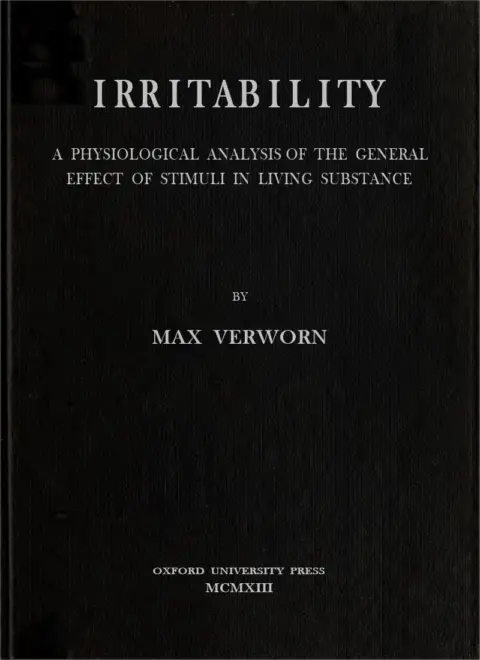
"Irritability: A Physiological Analysis of the General Effect of Stimuli" by Max Verworn is a scientific publication written in the early 20th century. The text appears to focus on the concept of irritability as it pertains to living substances, exploring how different stimuli can affect physiological reactions and the laws governing these responses. The author discusses the historical perspectives on irritability and aims to unite experiments conducted over decades to form a systematic understanding of this fundamental physiological concept. The opening of the work introduces the reader to the historical context surrounding the study of irritability, outlining significant thinkers such as Francis Glisson and Albrecht von Haller, and their contributions to the understanding of living substances' responses to stimuli. Verworn sets the stage for a comprehensive exploration by discussing the philosophical and scientific evolutions that have shaped the field. He emphasizes the importance of studying irritability as a gateway to better understanding life's processes. The author also signals his intention to methodically investigate the effects of stimulation across various biological systems, laying a foundation for the detailed analysis that will follow in the subsequent chapters.
Introduction adapted from the source catalogue; source summaries may be automatically generated.
Free to read · English · 85,158 words · No account needed
MAKE TIME FOR A GOOD BOOK
On by default. Untick to stop anonymous reading totals. Each page counts after 10 seconds in view. How this works.
Anonymous counting is on unless you have switched it off.
The conception of stimulation and irritability cannot however be
separated.
The founder of the doctrine of the irritability of living substance is Francis Glisson (1597–1677), member of the Collegium Medicum in London and at the same time Professor in Cambridge. It is a fact also not altogether without interest, that Glisson at the same time was in a certain sense a forerunner of those who interpreted nature from a physical standpoint. Glisson as an anatomist and physiologist was an excellent observer and experimenter, but the most prominent trait of his character was his inclination to philosophic observation and analysis of nature. His “Tractatus de natura substantiæ energetica”[1] must, therefore, be considered as the chief work of his life. In this voluminous book Glisson develops an entire system of natural philosophy, which in accord with the character of the philosophy of that time is unfortunately of an absolutely speculative nature and which had hardly emancipated itself from the scholasticism of the preceding period of thought. When the ideas of Glisson are isolated from the wilderness of scholastic phraseology, the system is somewhat as follows. The basis of all existence, “substance,” has according to him two general properties, its “fundamental subsistence,” that is, the essence of its being, and its “energetic subsistence,” that is, the essence of its activity. To these are added the properties possessed in specific cases, that is, its “additional subsistence.” The energetic subsistence forms the basis of all life. Life is therefore present not only in organic nature, but in all nature which is characterized by the union of the general energetic subsistence with the special additional subsistence of an animal and vegetable nature. In other forms of life in nature the energetic subsistence is combined with other special forms of the additional subsistence. The universal essence of all life, that is the energetic subsistence, has only three fundamental faculties: the “appetitiva,” the “perceptiva” and the “motiva.” The modus is the result of a “perceptio,” but the “perceptio” is not thinkable unless the object has the “appetitus” to receive the external influence. Glisson’s doctrine of irritability is based on this conception, which he develops in a second work already begun before the “Tractatus de natura substantiæ,” but not finished until later and only published after his death. In this “Tractatus de ventriculo et intestinis,”[2] Glisson dwells in detail on the physiological properties of animal structures and develops for the first time his conception of irritability in the chapter “De irritabilitate fibrarum.” The “irritability” manifests itself in the appearance of the alteration of movement, which is brought about by external influences on the animal structure, for: “Motiva fibrarum facultas nisi irritabilis foret, vel, perpetuo quiesceret, vel perpetuo idem ageret.” The fundamental factor of this irritability Glisson attributes to the “perceptio,” which he distinguishes as a “perceptio naturalis, sensitiva and animalis.” The want of clearness produced here by Glisson’s artificial distinctions and mode of expression is in part removed if we endeavor to transfer his meaning into our present methods of thought. This distinction would then simply point out the different means by which the stimuli can reach the irritable structures. The “Perceptio naturalis” is that which today we should call “direct response” to stimulation, that is, the excitation of the fiber by artificial stimuli applied directly to the tissue. Glisson shows here, that the intestines and muscles in the body immediately after death and even when removed from the body can be stimulated to movement by means of corrosive fluids or cold. The “Perceptio sensitiva” is, according to Glisson, the excitation of the fibers by external stimuli which act on the intact body as a whole by way of the sensory nerves. The “Perceptio ab appetitu animali regulata” finally is the excitation by inner stimuli proceeding from the brain. The Perceptio naturalis is possessed by all parts of the body, even the fluids, the bones and the fat. All of them are irritable. But a “vitale” and a special “animal” irritability they do not possess to a perceptible degree. These forms of irritability belong only to the special parts of the body. Here, however, the distinctions made by Glisson, are quite vague and contradictory. In his “Tractatus de ventriculo et intestinis” Glisson sharply distinguishes the “sensatio” from the “perceptio.” The perceptio in itself is not a sensation, for although individual organs of the body are irritable, as they all possess a “perceptio,” they are not in themselves sensitive. The “sensatio,” the sensation, only arises when the external “perceptio” of the individual organs combine through the nerves with the internal “perceptio” of the brain. “Nisi enim percepto externa ab interna simul percipiatur, non est cognitio sensitiva completa.” Sensitivity is, therefore, a special faculty, that is only based upon irritability.
Your reading position is saved on this browser. Take it to another device with a library code. Reading pages adapt to text, rather than matching a printed edition.
BEHIND THE BOOK
This eBook is for the use of anyone anywhere in the United States and most other parts of the world at no cost and with almost no restrictions whatsoever. You may copy it, give it away or re-use it under the terms of the Project Gutenberg License included with this eBook or online at www.gutenberg.org. If you are not located in the United States, you will have to check the laws of the country where you are located before using this eBook. Read the source licence.
The original source file, including credits and licence, is retained by this library. Request an original-format copy at no charge. Please include the book title and Project Gutenberg identifier #66767.
KEEP YOUR CURIOSITY GOING
John Muir

Asa Gray
Asa Gray

Florence Nightingale
Elizabeth Robins Pennell
Denison Olmsted