Letters to a Friend, Written to Mrs. Ezra S. Carr, 1866-1879
John Muir
THE CLASSIC COLLECTION · 1913
"Irritability: A Physiological Analysis of the General Effect of Stimuli" by Max Verworn is a scientific publication written in the early 20th century. The text appears to focus on the concept of irritability as it pertains to living substances, exploring how different stimuli can affect physiological reactions and the laws governing these responses. The author discusses the historical perspectives on irritability and aims to unite experiments conducted over decades to form a systematic understanding of this fundamental physiological concept. The opening of the work introduces the reader to the historical context surrounding the study of irritability, outlining significant thinkers such as Francis Glisson and Albrecht von Haller, and their contributions to the understanding of living substances' responses to stimuli. Verworn sets the stage for a comprehensive exploration by discussing the philosophical and scientific evolutions that have shaped the field. He emphasizes the importance of studying irritability as a gateway to better understanding life's processes. The author also signals his intention to methodically investigate the effects of stimulation across various biological systems, laying a foundation for the detailed analysis that will follow in the subsequent chapters.
Introduction adapted from the source catalogue; source summaries may be automatically generated.
Free to read · English · 85,158 words · No account needed
MAKE TIME FOR A GOOD BOOK
On by default. Untick to stop anonymous reading totals. Each page counts after 10 seconds in view. How this works.
Anonymous counting is on unless you have switched it off.
If a nerve of a nerve muscle preparation is drawn through a specially devised glass chamber so that the middle portion can be narcotized or asphyxiated and the nerve so arranged that it rests upon a pair of electrodes in the chamber and upon a second pair without the chamber and centrally located, then the nerve can be narcotized or asphyxiated and thereby the alterations in the irritability as well as the conductivity can be followed. In order to obtain as distinct a picture of this alteration as possible, I tested continuously the threshold of stimulation, which just produced minimal contraction in the muscle, and Fröhlich[111] continued these observations. As a result the following very remarkable conditions were observed. During the increase of the depth of narcosis or asphyxia the irritability sinks more and more with regularity. The conductivity remains unaltered for a long time, as the strength of the threshold stimulus is not changed until irritability has fallen to a definite point. When this is reached, conductivity disappears. (Figure 24.) The most important point in this connection, however, is, that the conductivity disappears simultaneously and practically momentarily for the excitation produced by both weak and strong stimuli. When the stimulation at the electrode placed centrally to the chamber does not bring about response for threshold stimuli, maximal stimuli at the same time also become inoperative. This is a very interesting point, the importance of which has not until now been recognized. This fact is not in harmony with the view held until now, that in the nerve fiber different strengths of stimuli bring about excitation of different intensity, and are then conducted. Let us now clearly comprehend this problem.
[111] Fröhlich: “Erregbarkeit und Leitfähigkeit des Nerven.” Zeitschr. f. allgem. Physiologie, Bd. III, 1904.
We have already seen that the wave of excitation meets with a decrement of its intensity in the narcotized stretch, which increases in strength as the irritability diminishes. If the value of the threshold is learned by stimulating the nerve at the electrodes centrally placed to the chamber with minimal stimuli, it would necessarily follow that this weak stimulus would bring about a corresponding weak excitation of the individual fibers and the wave of excitation already in the beginning of narcosis would be obliterated, for it would meet with a decrement, the result of the reduction in the irritability. A wave of excitation of minimal strength could under these conditions no longer reach the muscle, even in the beginning of narcosis. In spite of this the excitation, even when produced with threshold stimuli, passes through for a long time, even when the irritability in the chamber is greatly reduced, as shown by testing with the electrodes within the chamber. This is not consistent with the assumption that a threshold stimulus brings about the minimal excitation, even in the individual nerve fiber. But further: with a definite decrease of irritability of the narcotized stretch the capability of conductivity disappears, and indeed simultaneously for the weakest as well as the strongest stimuli. If it is assumed that weak stimuli bring about weak excitations in the nerve fiber, it must most certainly be expected that on the cessation of the response, weak stimuli applied at the central nerve end would still, by slight increase of the intensity of stimulation, be followed anew by reaction in the muscle. This is all the more to be expected, because the irritability of the narcotized stretch, as shown by stimulation with the electrodes inside the chamber, very gradually decreases, so that within the chamber stimuli of moderate strength are still effective. Instead the capability of conduction is completely obliterated, and even the strongest stimuli, applied to the end of the nerve, produce no response in the muscle. This in turn does not agree with the assumption that the intensity of excitation varies with the strength of the stimulus in the individual nerve fiber. The facts here alluded to are, therefore, either not correct, or the intensity of excitation in the individual nerve fibers is independent of the strength of the stimulus, and the view which we have entertained up to the present in this respect is incorrect.
Your reading position is saved on this browser. Take it to another device with a library code. Reading pages adapt to text, rather than matching a printed edition.
BEHIND THE BOOK
This eBook is for the use of anyone anywhere in the United States and most other parts of the world at no cost and with almost no restrictions whatsoever. You may copy it, give it away or re-use it under the terms of the Project Gutenberg License included with this eBook or online at www.gutenberg.org. If you are not located in the United States, you will have to check the laws of the country where you are located before using this eBook. Read the source licence.
The original source file, including credits and licence, is retained by this library. Request an original-format copy at no charge. Please include the book title and Project Gutenberg identifier #66767.
KEEP YOUR CURIOSITY GOING
John Muir
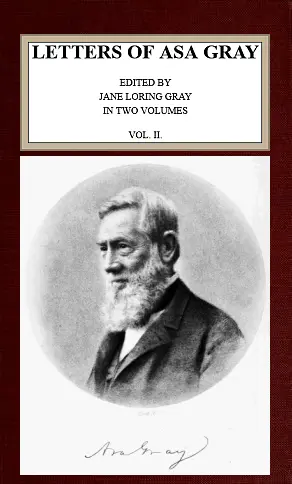
Asa Gray
Asa Gray
Florence Nightingale
Elizabeth Robins Pennell
Denison Olmsted