
Last letters from the living dead man
David Patterson (Spirit) Hatch
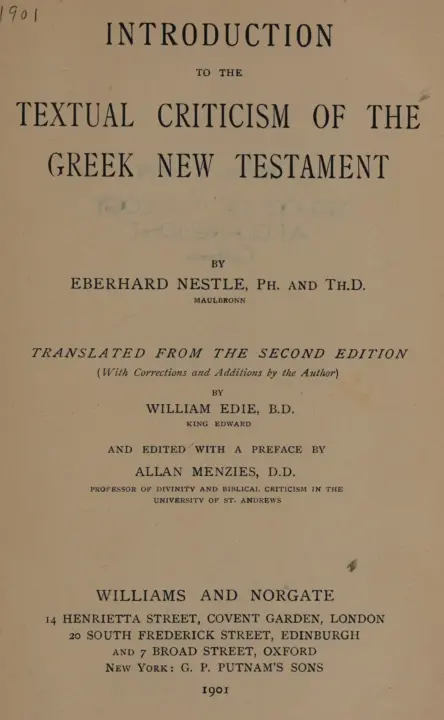
THE CLASSIC COLLECTION · 1901
"Introduction to the textual criticism of the Greek New Testament" by Eberhard Nestle is a scholarly handbook written in the early 20th century. It explains how the Greek New Testament text has been transmitted and assessed, surveying the history of printed editions alongside the evidence of manuscripts, ancient versions, and patristic quotations. The work aims to equip students and general readers with clear methods and an impartial, philological approach to evaluating readings. The opening of the work presents an editor’s preface outlining Nestle’s linguistic expertise, broad contributions to biblical scholarship, and deliberate avoidance of theological bias, and notes that the English version is a corrected and expanded translation of a later German edition. A contents list and addenda signal the scope: the history of the printed text, the materials used for criticism, and the theory and practice of evaluating variants. Chapter I then sketches the development from the first printed Greek New Testament and the great Polyglots, through Erasmus, the verse-division of Robert Estienne, Beza, and the Elzevir “Textus Receptus,” to the major critical milestones of Mill, Bengel, Wettstein, Griesbach, Lachmann, Tischendorf, Tregelles, and Westcott and Hort, with notices of later editors and practical editions (including comparative and Catholic efforts). At the start of Chapter II, Nestle lays out the evidential base—no autographs survive, so scholars rely on Greek manuscripts, early translations, and patristic citations—and introduces the scale of the evidence and the basic distinction between uncial and cursive manuscripts.
Introduction adapted from the source catalogue; source summaries may be automatically generated.
Free to read · English · 118,829 words · No account needed
MAKE TIME FOR A GOOD BOOK
On by default. Untick to stop anonymous reading totals. Each page counts after 10 seconds in view. How this works.
Anonymous counting is on unless you have switched it off.
Footnote 152:
Compare my conjecture of מִפַתְרֹם for מִתְרַפֵם, Ps. lxviii. 31, and see below, p. 236.
Footnote 153:
Meyer-Wendt^8, p. 51. For an example of Σ repeated by mistake, cf. ΕΙΣΣΤΕΛΟΣ in B, Mark xiii. 13. Its erroneous omission is quite common.
Footnote 154:
Bagster, London, 1887.
Footnote 155:
See Isaac Taylor’s History of the Transmission of Ancient Books to Modern Times (1827); and compare also the text-books on Hermeneutics, e.g. in I. v. Müller’s Handbuch der klassischen Altertumswissenschaft.
Footnote 156:
Benedicti regula monachorum. Recensuit Ed. Wölfflin, Lipsiae, Teubner, 1895, pp. xv. 85, 8vo. See also his article on the Latinity of Benedict in the Arch. f. Lat. Lexikogr. ix. 4, 1896, pp. 493-521.
Footnote 157:
Textgeschichte der Regula S. Benedicti (Abh. d. 3 Cl. d. k. Ak. d. Wiss., vol. xxi., Munich, 1898). Compare also The Text of St. Benedict’s Rule by Dom C. Butler, O.S.B. Reprinted from the Downside Review, December 1899, 12 pp.
Footnote 158:
TU. xiv. 1, 1896.
Footnote 159:
Krüger’s Sammlung, Heft xi., Freiburg and Leipzig, 1895.
Footnote 160:
TU., New Series, i. 1, 1897.
Footnote 161:
Compare also the differences between the editions of Josephus,
published by Niese and Naber.
Footnote 162:
See, however, the two articles by Lake and Brightman, On the Italian Origin of Codex Bezae in the Journal of Theological Studies, i. 441 ff.
Footnote 163:
See below on John viii. 57, p. 289.
Footnote 164:
An instructive discussion of the relationship between D{2} and E{3} is given in Hort’s Introduction, §§ 335-337. It is possible that one copyist in Rom. xv. 31-33 took ἵνα ἡ διακονία μου ἡ εἰς Ἱερουσαλὴμ ... διὰ θελήματος Θεοῦ, and the other καὶ ἡ δωροφορία μου ἡ ἐν Ἱερ ... διὰ θελήματος Χριστοῦ Ἰησοῦ—i.e. two entirely different recensions.
Footnote 165:
Zahn very properly remarks (Th. Lbl., 1899, 16, 179): “One must not, at least as regards the N. T., confound Eusebius with Pamphilus, or, if I might say so, with the firm of Pamphilus and Eusebius. If the fifty Bibles that Eusebius provided at the bidding of the Emperor for the use of the churches of the capital had contained a text of the N. T. prepared on the basis of the previous works and commentaries of Origen, the entire subsequent history of the text of the N. T. in the region of Constantinople, revealing as it does the extensive propagation of the Antiochean text, would be perfectly incomprehensible. As in the matter of the canon so also of the text of the N. T., Eusebius emancipated himself from the school of Origen, and attached himself to that of Antioch, at least in this particular instance fraught with such important consequences for the history of the Bible.”
Footnote 166:
See Hort, Introduction, §§ 188, 189.
Footnote 167:
Athanasius, writing to Constans, says in his first Apology: τῷ ἀδελφῷ σου οὐκ ἔγραψα ἢ μόνον ὅτε ... καὶ ὅτε πυκτία τῶν θείων γραφῶν κελεύσαντος αὐτοῦ μοι κατασκευάσαι, ταῦτα ποιήσας ἀπέστειλα.
Footnote 168:
Your reading position is saved on this browser. Take it to another device with a library code. Reading pages adapt to text, rather than matching a printed edition.
BEHIND THE BOOK
This eBook is for the use of anyone anywhere in the United States and most other parts of the world at no cost and with almost no restrictions whatsoever. You may copy it, give it away or re-use it under the terms of the Project Gutenberg License included with this eBook or online at www.gutenberg.org. If you are not located in the United States, you will have to check the laws of the country where you are located before using this eBook. Read the source licence.
The original source file, including credits and licence, is retained by this library. Request an original-format copy at no charge. Please include the book title and Project Gutenberg identifier #76224.
KEEP YOUR CURIOSITY GOING
David Patterson (Spirit) Hatch

David Patterson (Spirit) Hatch

David Patterson (Spirit) Hatch
Cécile Tormay

Moritz Busch
John L. Ransom