
Last letters from the living dead man
David Patterson (Spirit) Hatch
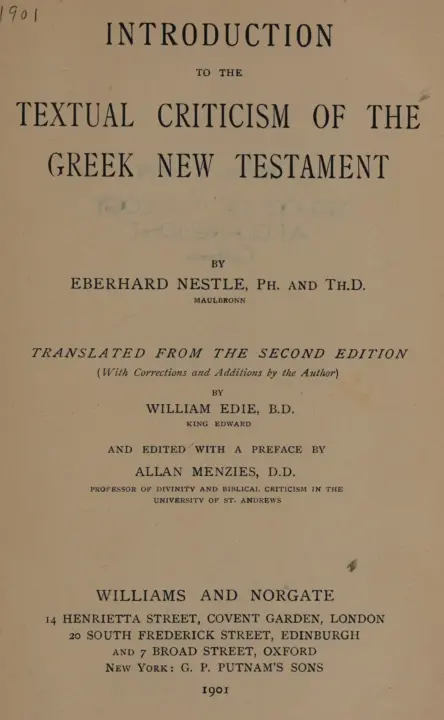
THE CLASSIC COLLECTION · 1901
"Introduction to the textual criticism of the Greek New Testament" by Eberhard Nestle is a scholarly handbook written in the early 20th century. It explains how the Greek New Testament text has been transmitted and assessed, surveying the history of printed editions alongside the evidence of manuscripts, ancient versions, and patristic quotations. The work aims to equip students and general readers with clear methods and an impartial, philological approach to evaluating readings. The opening of the work presents an editor’s preface outlining Nestle’s linguistic expertise, broad contributions to biblical scholarship, and deliberate avoidance of theological bias, and notes that the English version is a corrected and expanded translation of a later German edition. A contents list and addenda signal the scope: the history of the printed text, the materials used for criticism, and the theory and practice of evaluating variants. Chapter I then sketches the development from the first printed Greek New Testament and the great Polyglots, through Erasmus, the verse-division of Robert Estienne, Beza, and the Elzevir “Textus Receptus,” to the major critical milestones of Mill, Bengel, Wettstein, Griesbach, Lachmann, Tischendorf, Tregelles, and Westcott and Hort, with notices of later editors and practical editions (including comparative and Catholic efforts). At the start of Chapter II, Nestle lays out the evidential base—no autographs survive, so scholars rely on Greek manuscripts, early translations, and patristic citations—and introduces the scale of the evidence and the basic distinction between uncial and cursive manuscripts.
Introduction adapted from the source catalogue; source summaries may be automatically generated.
Free to read · English · 118,829 words · No account needed
MAKE TIME FOR A GOOD BOOK
On by default. Untick to stop anonymous reading totals. Each page counts after 10 seconds in view. How this works.
Anonymous counting is on unless you have switched it off.
See Coxe’s Catalogue of Greek MSS. in the Bodleian Library, 1854.
Footnote 142:
On cata or kata in the subscriptions, titles, prefaces, etc., of Latin manuscripts, see the index in W.-W., to which add the remarkable phrase cata tempus, which codex e gives in John v. 4, in place of secundum tempus in the other manuscripts.
Footnote 143:
See Field, Hexapla, i. p. lxxii.
Footnote 144:
The order, πραεῖς ... πτωχοί ... πενθοῦντες, in Baljon is due to a strange oversight which is not corrected in the Addenda et Corrigenda.
Footnote 145:
To the passages which may be adduced in support of the reading, add Clement, Hom. η 32 (Lagarde, 92, 35), ια 32 (118, 31).
Footnote 146:
Codex D and Syr^{sin} also agree in omitting v. 30, but this is probably no more than a remarkable coincidence.
Footnote 147:
See Urt., 55 ff., where works on this subject are cited.
Footnote 148:
See also Linwood, Remarks on Conjectural Emendations as applied to
the New Testament, 1873.
Footnote 149:
On the symbol m, see above, p. 114.
Footnote 150:
The converse occurs in Eusebius, Eccl. Hist., iv. 15, in the address of Polycarp’s Martyrium. There the reading κατὰ Πόντον, which is also found in the Syriac, should, according to Harnack’s Chronologie der altchristl. Lit., i. 341, be replaced by κατὰ πάντα τόπον, or rather by κατὰ τόπον which is found in 1 Macc. xii. 4; 2 Macc. xii. 2. Compare also the variation found in the manuscripts in 2 Cor. x. 15 between κοποις, πονοις, and τοποις, and between ποτος and τοπος in Judith vi. 21. See also Eusebius, Eccl. Hist., v. 15, 23.
Footnote 151:
The opposite view is expressed in Scrivener, ii. 244: “It is now agreed among competent judges that Conjectural Emendation must never be resorted to, even in passages of acknowledged difficulty”; and he quotes from Roberts (Words of the New Testament): “conjectural criticism is entirely banished from the field ... simply because there is no need for it.” With this, however, he does not quite agree. He admits that there are passages respecting which we cannot help framing a shrewd suspicion that the original reading differed from any form in which they are now presented to us. He notes as passages for which we should be glad of more light, Acts vii. 46, xiii. 32, xix. 40, xxvi. 28; Rom. viii. 2; 1 Cor. xii. 2, where Ephes. ii. 11 might suggest ὅτι ποτέ; 1 Tim. vi. 7; 2 Pet. iii. 10, 12; Jude 5, 22, 23. G. Krüger expresses himself to the same effect. He would have no conjecture, however well founded, received into the text. See his notice of Koetschau’s Origen in the L. Cbl., No. 39, 1899. I find that Swete has had no objection to adopt a conjecture of mine in his second edition of the last volume of the Cambridge Septuagint (Enoch xiv. 3). If such a thing is permissible in the case of Enoch, why should it not be allowable in the New Testament? As clever suggestions maybe noted ἐκολάφισαν for the hapax legomenon ἐκεφαλίωσαν, Mark xii. 4 (Linwood, Van de Sande-Bakhuyzen) and λανθάνουσι for μανθάνουσι, 1 Tim. v. 13 (Hitzig). Lagrange (Revue Biblique, 1900, p. 206) cautions us against “prêter de l’esprit à l’Esprit Saint.”
Your reading position is saved on this browser. Take it to another device with a library code. Reading pages adapt to text, rather than matching a printed edition.
BEHIND THE BOOK
This eBook is for the use of anyone anywhere in the United States and most other parts of the world at no cost and with almost no restrictions whatsoever. You may copy it, give it away or re-use it under the terms of the Project Gutenberg License included with this eBook or online at www.gutenberg.org. If you are not located in the United States, you will have to check the laws of the country where you are located before using this eBook. Read the source licence.
The original source file, including credits and licence, is retained by this library. Request an original-format copy at no charge. Please include the book title and Project Gutenberg identifier #76224.
KEEP YOUR CURIOSITY GOING
David Patterson (Spirit) Hatch

David Patterson (Spirit) Hatch

David Patterson (Spirit) Hatch
Cécile Tormay

Moritz Busch
John L. Ransom