
Last letters from the living dead man
David Patterson (Spirit) Hatch
THE CLASSIC COLLECTION · 1901
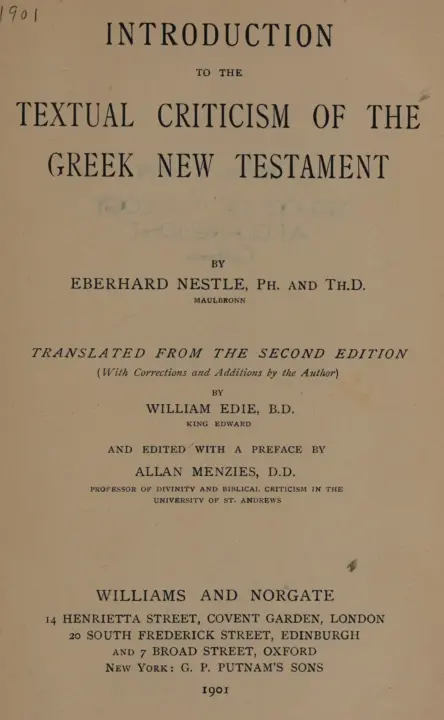
"Introduction to the textual criticism of the Greek New Testament" by Eberhard Nestle is a scholarly handbook written in the early 20th century. It explains how the Greek New Testament text has been transmitted and assessed, surveying the history of printed editions alongside the evidence of manuscripts, ancient versions, and patristic quotations. The work aims to equip students and general readers with clear methods and an impartial, philological approach to evaluating readings. The opening of the work presents an editor’s preface outlining Nestle’s linguistic expertise, broad contributions to biblical scholarship, and deliberate avoidance of theological bias, and notes that the English version is a corrected and expanded translation of a later German edition. A contents list and addenda signal the scope: the history of the printed text, the materials used for criticism, and the theory and practice of evaluating variants. Chapter I then sketches the development from the first printed Greek New Testament and the great Polyglots, through Erasmus, the verse-division of Robert Estienne, Beza, and the Elzevir “Textus Receptus,” to the major critical milestones of Mill, Bengel, Wettstein, Griesbach, Lachmann, Tischendorf, Tregelles, and Westcott and Hort, with notices of later editors and practical editions (including comparative and Catholic efforts). At the start of Chapter II, Nestle lays out the evidential base—no autographs survive, so scholars rely on Greek manuscripts, early translations, and patristic citations—and introduces the scale of the evidence and the basic distinction between uncial and cursive manuscripts.
Introduction adapted from the source catalogue; source summaries may be automatically generated.
Free to read · English · 118,829 words · No account needed
MAKE TIME FOR A GOOD BOOK
On by default. Untick to stop anonymous reading totals. Each page counts after 10 seconds in view. How this works.
Anonymous counting is on unless you have switched it off.
λούσαντι, Q P, Vulgate, Coptic,
Ethiopic.
viii. 13. ἀετοῦ, א A Q, Vulgate, Syriac, Coptic, Ethiopic.
ἀγγέλου, P, Armenian.
The two readings are combined not only by certain commentators, but in some manuscripts, ἀγγέλου ὡς ἀετοῦ.
xv. 6. λίθον καθαρόν, A C, am fu demid
tol.
λίνον καθαρόν, P, Syriac, Armenian, Clementine-Vulgate.
λινοῦν καθαρόν is read by Q, and καθαροὺς λίνους by א.
Tregelles and Westcott alone accept the reading λίθον; all the other editors regard it as an early transcriptional error. Holtzmann refers to the parallel passages i. 13, iv. 4, vii. 9, 13, xvii. 4, xviii. 16, xix. 8, 14, in support of λίνον, but they point rather the other way. For “fine linen” Apocalypse has βύσσινος five times, but never once λίνος, which means only the material, and not the garment made of it. Moreover, we find a parallel in the Old Testament, though in another connection, in Ezekiel xxviii. 13, where we read πάντα λίθον χρηστὸν ἐνδέδεσαι, so that λίθον here must not be so confidently rejected. Λίθον was more liable to be changed to λίνον than vice versa, as the Vulgate shows, in which the authorised printed edition has linteo where the manuscripts read lapidem. At the same time one cannot but admit that primitive transcriptional errors do occur. The reading ἀγγέλου in viii. 13, to which certain manuscripts prefix ἑνὸς, seems to me to be corroborated by ἄλλον ἄγγελον πετόμενον in xiv. 6. Or are we to read ἀετόν there in the face of all the witnesses?
v. 1. The correct text here is that adopted by Zahn: γεγραμμένον ἔσωθεν καὶ ὄπισθεν κατεσφραγισμένον. Grotius, though mistaken as to the true text, was the first to give the right interpretation of the words by taking ἔσω (ἔσωθεν) with γεγραμμένον, and ἔξωθεν (ὄπισθεν) with κατεσφραγισμένον. “Locus sic distinguendus γεγραμμένον ἔσω, καὶ ἔξωθεν κατεσφραγισμένον.” This combination of the words (“haec nova distinctio”) was combated for the reason among others that it deprived them of all their force and rendered them superfluous, for who ever saw a roll that was written on the outside and sealed on the inside. See Pole’s Synopsis, where it is said of Grotius, “tam infelix interpres Apocalypseos est magnus ille Hugo in rebus minusculis.” Zahn (Einleitung, ii. 596) improves the text of Grotius, but retains his connection of the words. He holds that ἔσωθεν and ὄπισθεν are not correlative terms, and that the idea of a papyrus roll written on both sides (ὀπισθόγραφον) must be abandoned; compare above, p. 43, n. 2. The book was, in fact, not a roll but a codex. Two things point to this. There is, first, the fact that is said to be ἐπὶ τὴν δεξιὰν. Had it been a roll it would have been ἐν τῇ δεξιᾷ. Moreover, the word used for opening the book is ἀνοῖξαι, and not, as in the case of rolls, ἀνελίσσειν, ἀνειλεῖν, or ἀναπτύσσειν. That it was not written on the outside is also shown by the fact that it was sealed with seven seals, the purpose of which was to make the reading of the book impossible. Not till the seventh seal is broken is the book open and its contents displayed. This βιβλίον is quite different from the βιβλαρίδιον mentioned in chapter x. 2, 9. See also E. Huschke, Das Buch mit 7 Siegeln (1860), to which Zahn refers (lib. cit. 597).
Your reading position is saved on this browser. Take it to another device with a library code. Reading pages adapt to text, rather than matching a printed edition.
BEHIND THE BOOK
This eBook is for the use of anyone anywhere in the United States and most other parts of the world at no cost and with almost no restrictions whatsoever. You may copy it, give it away or re-use it under the terms of the Project Gutenberg License included with this eBook or online at www.gutenberg.org. If you are not located in the United States, you will have to check the laws of the country where you are located before using this eBook. Read the source licence.
The original source file, including credits and licence, is retained by this library. Request an original-format copy at no charge. Please include the book title and Project Gutenberg identifier #76224.
KEEP YOUR CURIOSITY GOING
David Patterson (Spirit) Hatch

David Patterson (Spirit) Hatch

David Patterson (Spirit) Hatch
Cécile Tormay

Moritz Busch
John L. Ransom