
Last letters from the living dead man
David Patterson (Spirit) Hatch
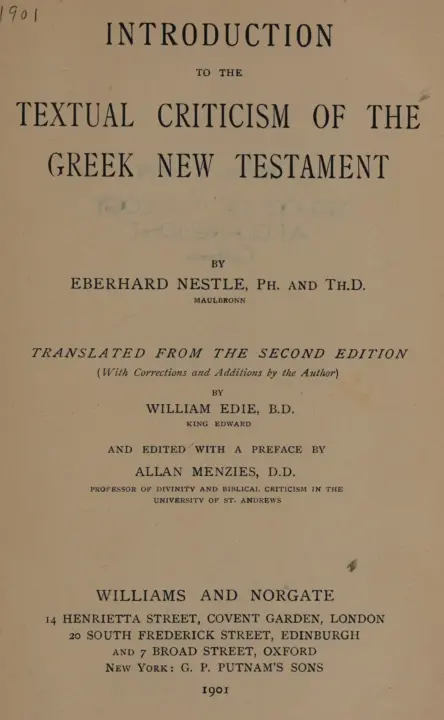
THE CLASSIC COLLECTION · 1901
"Introduction to the textual criticism of the Greek New Testament" by Eberhard Nestle is a scholarly handbook written in the early 20th century. It explains how the Greek New Testament text has been transmitted and assessed, surveying the history of printed editions alongside the evidence of manuscripts, ancient versions, and patristic quotations. The work aims to equip students and general readers with clear methods and an impartial, philological approach to evaluating readings. The opening of the work presents an editor’s preface outlining Nestle’s linguistic expertise, broad contributions to biblical scholarship, and deliberate avoidance of theological bias, and notes that the English version is a corrected and expanded translation of a later German edition. A contents list and addenda signal the scope: the history of the printed text, the materials used for criticism, and the theory and practice of evaluating variants. Chapter I then sketches the development from the first printed Greek New Testament and the great Polyglots, through Erasmus, the verse-division of Robert Estienne, Beza, and the Elzevir “Textus Receptus,” to the major critical milestones of Mill, Bengel, Wettstein, Griesbach, Lachmann, Tischendorf, Tregelles, and Westcott and Hort, with notices of later editors and practical editions (including comparative and Catholic efforts). At the start of Chapter II, Nestle lays out the evidential base—no autographs survive, so scholars rely on Greek manuscripts, early translations, and patristic citations—and introduces the scale of the evidence and the basic distinction between uncial and cursive manuscripts.
Introduction adapted from the source catalogue; source summaries may be automatically generated.
Free to read · English · 118,829 words · No account needed
MAKE TIME FOR A GOOD BOOK
On by default. Untick to stop anonymous reading totals. Each page counts after 10 seconds in view. How this works.
Anonymous counting is on unless you have switched it off.
[Sidenote: External testimony.]
When the Emperor Constantine e.g. asks Eusebius to supply him with fifty copies of the Scriptures at once, we cannot but suppose that these became authoritative over a large area. But in which of the classes into which our manuscripts have hitherto been divided are we to look for these now?[165] And conversely if, in another locality, heathen persecution was directed specially against the Bibles of the Christians, this cannot have been without some effect. According to C. Hülsen (Bilder aus der Geschichte des Kapitols, Rome, 1899), even the Roman Bishop Marcellinus, with his deacons Strabo and Cassianus, in the year 304, burned, in front of the temple of Juno Moneta, those Gospels which ten years later were made the law of Christian Rome by the Emperor Constantine. These scattered notices must be much more carefully collected and considered than hitherto, and combined with the results obtained from the collation of the manuscripts.
[Sidenote: Recensions.]
Most of our information with respect to the =recensions= of the Bible comes from the Syrian Church, and is concerned rather with the Old Testament than with the New; but the recensions of the former may throw some light on those of the latter.
[Sidenote: Lucian.]
(a) As the result of their researches, Westcott and Hort have made it very probable, on internal grounds, that a recension of an official nature was undertaken in Syria, perhaps at Antioch, about the fourth century, and that to this recension are due the origin and propagation of that form of the text of the New Testament which was widely disseminated in the Byzantine Empire, now represented in our later minuscules, and made the textus receptus by means of the first printed editions.
=Lucian=, the celebrated founder of the Antiochean school of exegesis, suffered martyrdom in the year 311 or 312, most probably the latter. Of all the names that we know, none has a better claim than his to be associated with such a recension, and the conjecture derives some support from the passage of Jerome cited above (p. 85).[166] It is, perhaps, even better supported by what we know of Lucian’s recension of the Old Testament. In his preface to the Chronicles, Jerome wrote: “Alexandria et Aegyptus in Septuaginta suis Hesychium laudat auctorem, Constantinopolis usque Antiochiam Luciani martyris exemplaria probat, mediae inter has provinciae Palaestinae (v.l. Palaestinos) codices legunt, quos ab Origene elaboratos Eusebius et Pamphilus vulgaverunt; totusque orbis hac inter se trifaria varietate compugnat.” Now it is true that the words of a man like Jerome must not be pressed too far, and what may have been true in his day might be quite different in a comparatively short time—think e.g. of the fifty copies of the Bible that Eusebius Pamphili had sent to Constantine, or the Bible or Bibles sent by Athanasius to Constans[167]—at the same time it has been established beyond all doubt by Field and Lagarde, that it is to Lucian we must refer a peculiar recension of the Greek Old Testament preserved in a good many manuscripts, the one found in the unfortunately small remnant of the Gothic Old Testament and especially in the numerous Biblical quotations of the famous theologian John of Antioch, better known as Chrysostom of Constantinople, who was a pupil of Lucian. The probability, therefore, is very great that the same thing will hold good of the New Testament portion of the Bible of Ulfilas and Chrysostom. As regards the former, Kauffmann has expressed a decided opinion to this effect in his work on the Gothic Bible cited above (p. 139). The supposition would be converted into something like certainty if it could be proved on palæographic grounds that this or that New Testament manuscript belongs to this or that Old Testament manuscript of Lucianic derivation as part of what was originally one and the same complete Bible. This is a point which I am not in a position personally to investigate, and I must therefore content myself with throwing out this suggestion, and with adding in support of it that we have the express testimony of the Menologies for saying that Lucian bequeathed to his pupils a copy of the Old and New Testaments written in three columns with his own hand.
Your reading position is saved on this browser. Take it to another device with a library code. Reading pages adapt to text, rather than matching a printed edition.
BEHIND THE BOOK
This eBook is for the use of anyone anywhere in the United States and most other parts of the world at no cost and with almost no restrictions whatsoever. You may copy it, give it away or re-use it under the terms of the Project Gutenberg License included with this eBook or online at www.gutenberg.org. If you are not located in the United States, you will have to check the laws of the country where you are located before using this eBook. Read the source licence.
The original source file, including credits and licence, is retained by this library. Request an original-format copy at no charge. Please include the book title and Project Gutenberg identifier #76224.
KEEP YOUR CURIOSITY GOING
David Patterson (Spirit) Hatch

David Patterson (Spirit) Hatch

David Patterson (Spirit) Hatch
Cécile Tormay

Moritz Busch
John L. Ransom