
Last letters from the living dead man
David Patterson (Spirit) Hatch
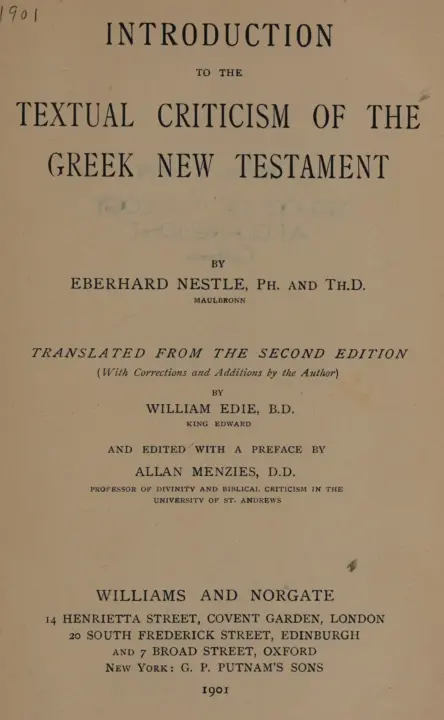
THE CLASSIC COLLECTION · 1901
"Introduction to the textual criticism of the Greek New Testament" by Eberhard Nestle is a scholarly handbook written in the early 20th century. It explains how the Greek New Testament text has been transmitted and assessed, surveying the history of printed editions alongside the evidence of manuscripts, ancient versions, and patristic quotations. The work aims to equip students and general readers with clear methods and an impartial, philological approach to evaluating readings. The opening of the work presents an editor’s preface outlining Nestle’s linguistic expertise, broad contributions to biblical scholarship, and deliberate avoidance of theological bias, and notes that the English version is a corrected and expanded translation of a later German edition. A contents list and addenda signal the scope: the history of the printed text, the materials used for criticism, and the theory and practice of evaluating variants. Chapter I then sketches the development from the first printed Greek New Testament and the great Polyglots, through Erasmus, the verse-division of Robert Estienne, Beza, and the Elzevir “Textus Receptus,” to the major critical milestones of Mill, Bengel, Wettstein, Griesbach, Lachmann, Tischendorf, Tregelles, and Westcott and Hort, with notices of later editors and practical editions (including comparative and Catholic efforts). At the start of Chapter II, Nestle lays out the evidential base—no autographs survive, so scholars rely on Greek manuscripts, early translations, and patristic citations—and introduces the scale of the evidence and the basic distinction between uncial and cursive manuscripts.
Introduction adapted from the source catalogue; source summaries may be automatically generated.
Free to read · English · 118,829 words · No account needed
MAKE TIME FOR A GOOD BOOK
On by default. Untick to stop anonymous reading totals. Each page counts after 10 seconds in view. How this works.
Anonymous counting is on unless you have switched it off.
Finally, when we enquire as to the relationship between Jerome and the Greek manuscript or manuscripts used by him, we find that that manuscript must have been most nearly related to the Sinaiticus, while it had no sort of connection with Codex D. Whether this result tells in favour of א or the reverse, we will not pronounce at present: Jerome certainly avers that he made use of a Graecorum codicum emendata conlatione ... sed veterum (p. 108), only veterum is a comparative term, and it might quite well happen that to Jerome that form of text appeared to be the best which was most recent or most widely circulated in his neighbourhood, and that he would have nothing to do with such a singular form of text as D exhibits, even supposing he was acquainted with it, a point we cannot decide. The intimate connection in various passages between his text and that of the cursive 473 (2^{pe}) is remarkable, and especially the many points of resemblance between the Irish manuscripts (D L R) and the members of the Ferrar Group.
And this brings us back from our survey of the history of the Latin text to that of the Greek, where we seem to have got at least one fixed point to begin with in this perplexing chaos, for that is the first impression we gain on glancing at the mass of Greek manuscripts before us. But here again our too sanguine hopes are likely to be disappointed, and we shall learn only too soon that even this is no Archimedean point from which we are able to regulate this world of disorder.
[Sidenote: Ferrar Group.]
If we find that in a certain number of manuscripts the passage usually indicated as John vii. 53-viii. 11 occurs in Luke, and in exactly the same place in each one—viz. after Luke xxi. 38—we must needs conclude that the manuscripts exhibiting this common peculiarity are intimately connected with each other. This is the case with the cursives 13, 69, 124, 346, 624, 626. Whether the others that are reckoned in this group have this same peculiarity, I am not perfectly sure. Now one would naturally expect that these manuscripts would also coincide in the other peculiarities characteristic of this group. [Sidenote: Variation.] But on the contrary, they part company over the very first and most conspicuous of these—viz. Matthew i. 16. Here, unfortunately, 13 and 69 are defective, but we can compare 124 and 346. And we find that whereas the former has the usual text, the latter, with the support of 556, 624, 626, exhibits in place of τὸν ἄνδρα ... Χριστός, the reading already mentioned, ᾧ μνηστευθεῖσα παρθένος Μαριὰμ ἐγέννησεν Ἰησοῦν τὸν λεγόμενον Χριστόν. Which of these readings is right, or whether both of them may not be wrong, we need not enquire at present. It is sufficient to point out that one and the same mother may give birth to very different children. The specific difference will be inherited from the other of the two parents, in this case represented by the copyist, and will depend on whether he is painstaking, careless, violent, arbitrary, well-informed, or the reverse. But the mother herself has a great number of hereditary or acquired peculiarities which, the latter no less than the former, may be transmitted to the children in a variety of ways. There is perhaps no manuscript in existence which is entirely free from corrections, while, on the other hand, there are many so overlaid with corrections that the original writing is scarcely now recognisable. Codex B, on the whole, is in a very good state of preservation, but it was supposed lately (see ThLz., 1899, col. 176) that its first hand wrote in John viii. 57, “and Abraham saw thee” instead of “and hast thou seen Abraham,” as all our editors read in that passage.[163] The supposition proved to be incorrect, but if that could possibly happen with B, what must have happened in the case of manuscripts that are so full of corrections as א and D, if they came to be copied in later times? Suppose that one scribe took the trouble to copy the text of the first hand, while another thought it his duty to follow the corrections, the result would be two manuscripts whose common origin would be scarcely recognisable. And in the course of centuries how often may not this process have been repeated. No wonder, therefore, that so few manuscripts have as yet been clearly made out to be the descendants of our oldest codices, so as to permit of their being removed from the board with one sweep, as having no independent testimony to contribute, as is the case with E{3} which is merely a bad copy of D{2} (p. 77), or that scholars cannot agree as to the relationship existing between two manuscripts like F{2} and G{3} (p. 77).[164] Nor need we be surprised to find that some of our most peculiar witnesses seem to have remained absolutely childless, while a less valuable race is perpetuated in many copies. The words of Homer—οἵη περ φύλλων γενεή, τοίη δὲ καὶ ἀνδρῶν—may be applied conversely to the leaves to which we entrust our immortality: habent sua fata libelli. The only unfortunate thing is that we are so little able to follow the course of these fates by means of external testimony.
Your reading position is saved on this browser. Take it to another device with a library code. Reading pages adapt to text, rather than matching a printed edition.
BEHIND THE BOOK
This eBook is for the use of anyone anywhere in the United States and most other parts of the world at no cost and with almost no restrictions whatsoever. You may copy it, give it away or re-use it under the terms of the Project Gutenberg License included with this eBook or online at www.gutenberg.org. If you are not located in the United States, you will have to check the laws of the country where you are located before using this eBook. Read the source licence.
The original source file, including credits and licence, is retained by this library. Request an original-format copy at no charge. Please include the book title and Project Gutenberg identifier #76224.
KEEP YOUR CURIOSITY GOING
David Patterson (Spirit) Hatch

David Patterson (Spirit) Hatch

David Patterson (Spirit) Hatch
Cécile Tormay

Moritz Busch
John L. Ransom