
The Writing of News A Handbook with Chapters on Newspaper Correspondence and Copy Reading
Charles G. (Charles Griffith) Ross
THE CLASSIC COLLECTION · 1901
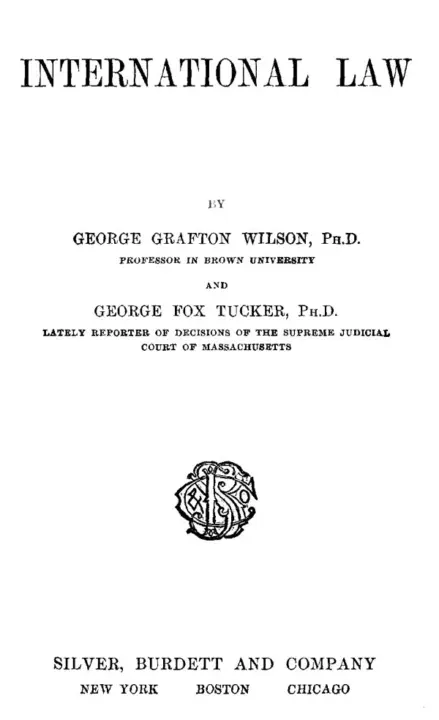
"International Law" by George Grafton Wilson and George Fox Tucker is a scientific publication written in the early 20th century. This work serves as a comprehensive introduction to the principles and practices of international law, emphasizing its growing significance due to increased global interaction and diplomacy. It covers a wide range of topics, from the historical roots and definitions of international law to the rights and obligations of states. The opening of the book begins with a preface explaining the authors' goal to provide a concise introduction to international law, which they believe has become more crucial in light of expanding international negotiations. They note that the text relies on established cases and codes to illustrate key principles, while also preparing appendices for easy reference to supporting materials. The initial chapters introduce foundational concepts, such as the definition of international law, its divisions into public and private law, and its historical development, outlining how these elements interplay within the context of states' relationships and interactions.
Introduction adapted from the source catalogue; source summaries may be automatically generated.
Free to read · English · 111,322 words · No account needed
MAKE TIME FOR A GOOD BOOK
On by default. Untick to stop anonymous reading totals. Each page counts after 10 seconds in view. How this works.
Anonymous counting is on unless you have switched it off.
+Art. 52.+ The violation of the clauses of an armistice by private individuals, on their own personal initiative, only affords the right of demanding the punishment of the guilty persons, and, if there is occasion for it, an indemnity for losses sustained.
+Chapter IV.+ Of Belligerents interned, and of Wounded treated, in
Neutral Territory
+Art. 53.+ The neutral State receiving in its territory troops belonging to the belligerent armies, will intern them, so far as it may be possible, away from the theater of war.
They may be kept in camps, or even confined in fortresses, or in places appropriated to this purpose.
It will decide whether the officers may be released on giving their parole not to quit the neutral territory without authority.
+Art. 54.+ In default of a special agreement, the neutral State which receives the belligerent troops will furnish the interned with provisions, clothing, and such aid as humanity demands.
The expenses incurred by the internment will be made good at the
conclusion of peace.
+Art. 55.+ The neutral State may authorize the transport across its territory of the wounded and sick belonging to the belligerent armies, provided that the trains which convey them do not carry either the personnel or matériel of war.
In this case the neutral State is bound to take the measures necessary for the safety and control of the operation.
+Art. 56.+ The Convention of Geneva is applicable to the sick and wounded interned on neutral territory.
+Convention for the Amelioration of the Condition of the Wounded in Armies in the Field between Switzerland, Baden, Belgium, Denmark, Spain, France, Hesse, Italy, Netherlands, Portugal, Prussia, Würtemburg, and acceded to by Sweden and Norway, Greece, Great Britain, Mecklenburg-Schwerin, Turkey, Bavaria, Austria, Russia, Roumania, Persia, Salvador, Montenegro, Servia, Bolivia, Chili, Argentine Republic, Peru, and Japan.+
Concluded August 22, 1864; ratifications exchanged at Geneva, June 22, 1865; acceded to by the United States, March 1, 1882; accession of United States accepted by Switzerland, on behalf of the Powers, June 9, 1882; proclaimed as to the original convention, but with reserve as to the additional articles, July 26, 1882.
After reciting the desire of the different governments "to soften, as much as depends on them, the evils of warfare, to suppress its useless hardships and improve the fate of wounded soldiers on the field of battle," the Convention names the negotiators,
Who, after having exchanged their powers and found them in good and due form, agree to the following articles:
+Article 1.+ Ambulances and military hospitals shall be acknowledged to be neuter, and as such, shall be protected and respected by belligerents so long as any sick or wounded may be therein.
Your reading position is saved on this browser. Take it to another device with a library code. Reading pages adapt to text, rather than matching a printed edition.
BEHIND THE BOOK
This eBook is for the use of anyone anywhere in the United States and most other parts of the world at no cost and with almost no restrictions whatsoever. You may copy it, give it away or re-use it under the terms of the Project Gutenberg License included with this eBook or online at www.gutenberg.org. If you are not located in the United States, you will have to check the laws of the country where you are located before using this eBook. Read the source licence.
The original source file, including credits and licence, is retained by this library. Request an original-format copy at no charge. Please include the book title and Project Gutenberg identifier #41759.
KEEP YOUR CURIOSITY GOING
Charles G. (Charles Griffith) Ross
Hannah Webster Foster

Emily Lawless
Edwin Hamlin Carr

Charles De Lano Hine
Andrew Ure