
The Writing of News A Handbook with Chapters on Newspaper Correspondence and Copy Reading
Charles G. (Charles Griffith) Ross
THE CLASSIC COLLECTION · 1901
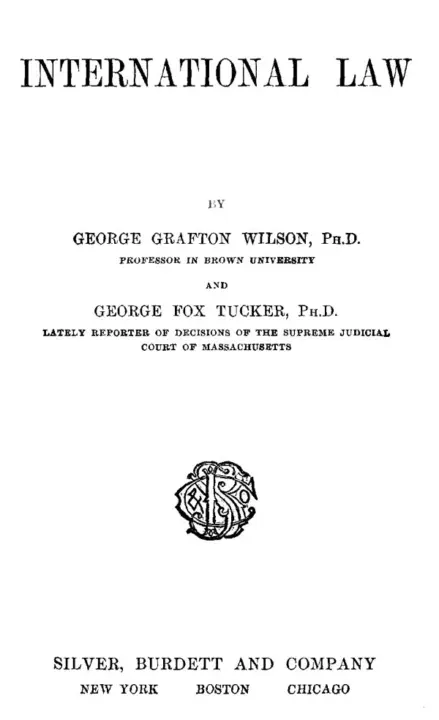
"International Law" by George Grafton Wilson and George Fox Tucker is a scientific publication written in the early 20th century. This work serves as a comprehensive introduction to the principles and practices of international law, emphasizing its growing significance due to increased global interaction and diplomacy. It covers a wide range of topics, from the historical roots and definitions of international law to the rights and obligations of states. The opening of the book begins with a preface explaining the authors' goal to provide a concise introduction to international law, which they believe has become more crucial in light of expanding international negotiations. They note that the text relies on established cases and codes to illustrate key principles, while also preparing appendices for easy reference to supporting materials. The initial chapters introduce foundational concepts, such as the definition of international law, its divisions into public and private law, and its historical development, outlining how these elements interplay within the context of states' relationships and interactions.
Introduction adapted from the source catalogue; source summaries may be automatically generated.
Free to read · English · 111,322 words · No account needed
MAKE TIME FOR A GOOD BOOK
On by default. Untick to stop anonymous reading totals. Each page counts after 10 seconds in view. How this works.
Anonymous counting is on unless you have switched it off.
+Art. 5.+ The army of occupation shall only levy such taxes, dues, duties, and tolls as are already established for the benefit of the State, or their equivalent if it be impossible to collect them, and this shall be done as far as possible in the form of and according to existing practice. It shall devote them to defraying the expenses of the administration of the country to the same extent as was obligatory on the legal Government.
+Art. 6.+ The army occupying a territory shall take possession only of the specie, the funds, and bills, etc., which are the actual property of the state; the depots of arms, means of transport, magazines, and supplies, and, in general, all the personal property of the State, which may be of service in carrying on the war.
Railway plant, land telegraphs, steam and other vessels, not included in cases regulated by maritime law, as well as depots of arms, and generally every kind of munitions of war, although belonging to companies or to private individuals, are to be considered equally as means of aid in carrying on a war, which cannot be left at the disposal of the enemy. Railway plant, land telegraphs, as well as the steam and other vessels above mentioned, shall be restored, and indemnities be regulated on the conclusion of peace.
+Art. 7.+ The occupying state shall only consider itself in the light of an administrator and usufructuary of the public buildings, real property, forests, and agricultural works belonging to the hostile state, and situated in the occupied territory. It is bound to protect these properties, and to administer them according to the laws of usufruct.
+Art. 8.+ The property of parishes, of establishments devoted to religion, charity, education, arts, and sciences, although belonging to the State, shall be treated as private property.
Every seizure, destruction of, or willful damage to such establishments, historical monuments, or works of art, or of science, should be prosecuted by the competent authorities.
+Chapter II.+ Of those who are to be recognized as Belligerents; of Combatants and Non-combatants
+Art. 9.+ The laws, rights, and duties of war are applicable not only to the army, but likewise to militia and corps of volunteers complying with the following conditions:
1. That they have at their head a person responsible for his
subordinates;
2. That they wear some settled, distinctive badge, recognizable at a
distance;
Your reading position is saved on this browser. Take it to another device with a library code. Reading pages adapt to text, rather than matching a printed edition.
BEHIND THE BOOK
This eBook is for the use of anyone anywhere in the United States and most other parts of the world at no cost and with almost no restrictions whatsoever. You may copy it, give it away or re-use it under the terms of the Project Gutenberg License included with this eBook or online at www.gutenberg.org. If you are not located in the United States, you will have to check the laws of the country where you are located before using this eBook. Read the source licence.
The original source file, including credits and licence, is retained by this library. Request an original-format copy at no charge. Please include the book title and Project Gutenberg identifier #41759.
KEEP YOUR CURIOSITY GOING
Charles G. (Charles Griffith) Ross
Hannah Webster Foster

Emily Lawless
Edwin Hamlin Carr

Charles De Lano Hine
Andrew Ure