
The Writing of News A Handbook with Chapters on Newspaper Correspondence and Copy Reading
Charles G. (Charles Griffith) Ross
THE CLASSIC COLLECTION · 1901
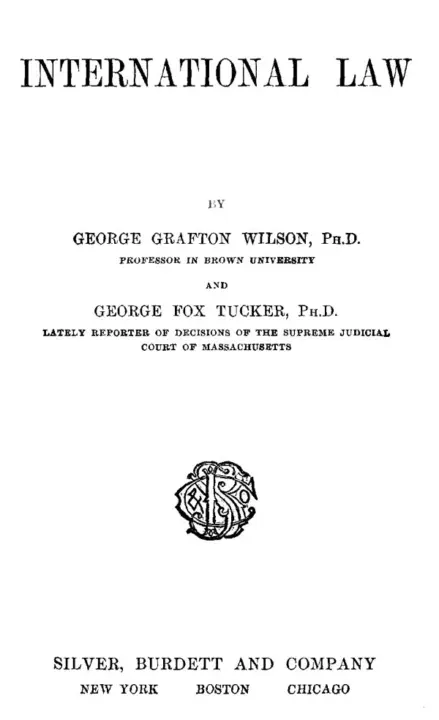
"International Law" by George Grafton Wilson and George Fox Tucker is a scientific publication written in the early 20th century. This work serves as a comprehensive introduction to the principles and practices of international law, emphasizing its growing significance due to increased global interaction and diplomacy. It covers a wide range of topics, from the historical roots and definitions of international law to the rights and obligations of states. The opening of the book begins with a preface explaining the authors' goal to provide a concise introduction to international law, which they believe has become more crucial in light of expanding international negotiations. They note that the text relies on established cases and codes to illustrate key principles, while also preparing appendices for easy reference to supporting materials. The initial chapters introduce foundational concepts, such as the definition of international law, its divisions into public and private law, and its historical development, outlining how these elements interplay within the context of states' relationships and interactions.
Introduction adapted from the source catalogue; source summaries may be automatically generated.
Free to read · English · 111,322 words · No account needed
MAKE TIME FOR A GOOD BOOK
On by default. Untick to stop anonymous reading totals. Each page counts after 10 seconds in view. How this works.
Anonymous counting is on unless you have switched it off.
While deception in war is admitted as a just and necessary means of hostility, and is consistent with honorable warfare, the common law of war allows even capital punishment for clandestine or treacherous attempts to injure an enemy, because they are so dangerous, and it is so difficult to guard against them.
The law of war, like the criminal law regarding other offenses, makes no difference on account of the difference of sexes, concerning the spy, the war-traitor, or the war-rebel.
Spies, war-traitors, and war-rebels are not exchanged according to the common law of war. The exchange of such persons would require a special cartel, authorized by the government, or, at a great distance from it, by the chief commander of the army in the field.
A successful spy or war-traitor, safely returned to his own army, and afterwards captured as an enemy, is not subject to punishment for his acts as a spy or war-traitor, but he may be held in closer custody as a person individually dangerous.
+Exchange of Prisoners--Flags of Truce--Flags of Protection+
Exchanges of prisoners take place--number for number--rank for rank--wounded for wounded--with added condition for added condition--such, for instance, as not to serve for a certain period.
In exchanging prisoners of war, such numbers of persons of inferior rank may be substituted as an equivalent for one of superior rank as may be agreed upon by cartel, which requires the sanction of the government, or of the commander of the army in the field.
A prisoner of war is in honor bound truly to state to the captor his rank; and he is not to assume a lower rank than belongs to him, in order to cause a more advantageous exchange, nor a higher rank, for the purpose of obtaining better treatment.
Offenses to the contrary have been justly punished by the commanders of released prisoners, and may be good cause for refusing to release such prisoners.
The surplus number of prisoners of war remaining after an exchange has taken place is sometimes released either for the payment of a stipulated sum of money, or, in urgent cases, of provision, clothing, or other necessaries.
Such arrangement, however, requires the sanction of the highest
authority.
The exchange of prisoners of war is an act of convenience to both belligerents. If no general cartel has been concluded, it can not be demanded by either of them. No belligerent is obliged to exchange prisoners of war.
A cartel is voidable as soon as either party has violated it.
No exchange of prisoners shall be made except after complete capture, and after an accurate account of them, and a list of the captured officers, has been taken.
Your reading position is saved on this browser. Take it to another device with a library code. Reading pages adapt to text, rather than matching a printed edition.
BEHIND THE BOOK
This eBook is for the use of anyone anywhere in the United States and most other parts of the world at no cost and with almost no restrictions whatsoever. You may copy it, give it away or re-use it under the terms of the Project Gutenberg License included with this eBook or online at www.gutenberg.org. If you are not located in the United States, you will have to check the laws of the country where you are located before using this eBook. Read the source licence.
The original source file, including credits and licence, is retained by this library. Request an original-format copy at no charge. Please include the book title and Project Gutenberg identifier #41759.
KEEP YOUR CURIOSITY GOING
Charles G. (Charles Griffith) Ross
Hannah Webster Foster

Emily Lawless
Edwin Hamlin Carr

Charles De Lano Hine
Andrew Ure