
The Writing of News A Handbook with Chapters on Newspaper Correspondence and Copy Reading
Charles G. (Charles Griffith) Ross
THE CLASSIC COLLECTION · 1901
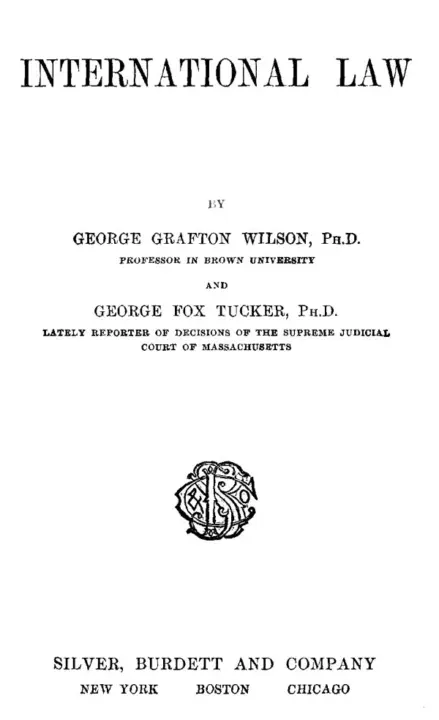
"International Law" by George Grafton Wilson and George Fox Tucker is a scientific publication written in the early 20th century. This work serves as a comprehensive introduction to the principles and practices of international law, emphasizing its growing significance due to increased global interaction and diplomacy. It covers a wide range of topics, from the historical roots and definitions of international law to the rights and obligations of states. The opening of the book begins with a preface explaining the authors' goal to provide a concise introduction to international law, which they believe has become more crucial in light of expanding international negotiations. They note that the text relies on established cases and codes to illustrate key principles, while also preparing appendices for easy reference to supporting materials. The initial chapters introduce foundational concepts, such as the definition of international law, its divisions into public and private law, and its historical development, outlining how these elements interplay within the context of states' relationships and interactions.
Introduction adapted from the source catalogue; source summaries may be automatically generated.
Free to read · English · 111,322 words · No account needed
MAKE TIME FOR A GOOD BOOK
On by default. Untick to stop anonymous reading totals. Each page counts after 10 seconds in view. How this works.
Anonymous counting is on unless you have switched it off.
If the people of that portion of an invaded country which is not yet occupied by the enemy, or of the whole country, at the approach of a hostile army, rise, under a duly authorized levy, en masse to resist the invader, they are now treated as public enemies, and, if captured, are prisoners of war.
No belligerent has the right to declare that he will treat every captured man in arms of a levy en masse as a brigand or bandit.
If, however, the people of a country, or any portion of the same, already occupied by an army, rise against it, they are violators of the laws of war, and are not entitled to their protection.
The enemy's chaplains, officers of the medical staff, apothecaries, hospital nurses and servants, if they fall into the hands of the American Army, are not prisoners of war, unless the commander has reasons to retain them. In this latter case, or if, at their own desire, they are allowed to remain with their captured companions, they are treated as prisoners of war, and may be exchanged if the commander sees fit.
A hostage is a person accepted as a pledge for the fulfillment of an agreement concluded between belligerents during the war, or in consequence of a war. Hostages are rare in the present age.
If a hostage is accepted, he is treated like a prisoner of war, according to rank and condition, as circumstances may admit.
A prisoner of war is subject to no punishment for being a public enemy, nor is any revenge wreaked upon him by the intentional infliction of any suffering, or disgrace, by cruel imprisonment, want of food, by mutilation, death, or any other barbarity.
So soon as a man is armed by a sovereign government and takes the soldier's oath of fidelity, he is a belligerent; his killing, wounding, or other warlike acts are not individual crimes or offenses. No belligerent has a right to declare that enemies of a certain class, color, or condition, when properly organized as soldiers, will not be treated by him as public enemies.
The law of nations knows of no distinction of color, and if an enemy of the United States should enslave and sell any captured persons of their army, it would be a case for the severest retaliation, if not redressed upon complaint.
The United States can not retaliate by enslavement; therefore death must be the retaliation for this crime against the law of nations.
A prisoner of war remains answerable for his crimes committed against the captor's army or people, committed before he was captured, and for which he has not been punished by his own authorities.
Your reading position is saved on this browser. Take it to another device with a library code. Reading pages adapt to text, rather than matching a printed edition.
BEHIND THE BOOK
This eBook is for the use of anyone anywhere in the United States and most other parts of the world at no cost and with almost no restrictions whatsoever. You may copy it, give it away or re-use it under the terms of the Project Gutenberg License included with this eBook or online at www.gutenberg.org. If you are not located in the United States, you will have to check the laws of the country where you are located before using this eBook. Read the source licence.
The original source file, including credits and licence, is retained by this library. Request an original-format copy at no charge. Please include the book title and Project Gutenberg identifier #41759.
KEEP YOUR CURIOSITY GOING
Charles G. (Charles Griffith) Ross
Hannah Webster Foster

Emily Lawless
Edwin Hamlin Carr

Charles De Lano Hine
Andrew Ure