
The Writing of News A Handbook with Chapters on Newspaper Correspondence and Copy Reading
Charles G. (Charles Griffith) Ross
THE CLASSIC COLLECTION · 1901
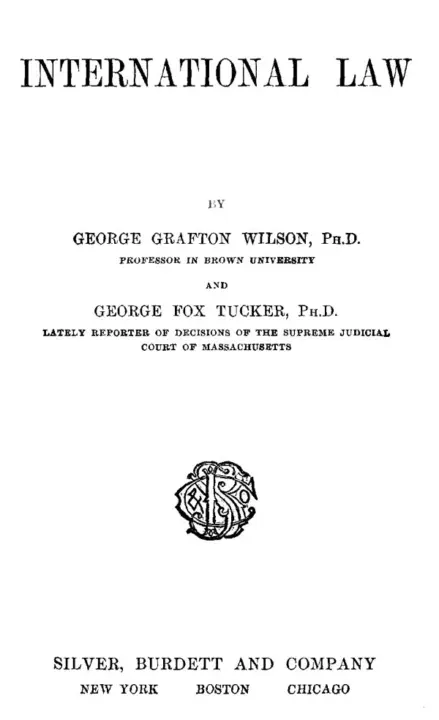
"International Law" by George Grafton Wilson and George Fox Tucker is a scientific publication written in the early 20th century. This work serves as a comprehensive introduction to the principles and practices of international law, emphasizing its growing significance due to increased global interaction and diplomacy. It covers a wide range of topics, from the historical roots and definitions of international law to the rights and obligations of states. The opening of the book begins with a preface explaining the authors' goal to provide a concise introduction to international law, which they believe has become more crucial in light of expanding international negotiations. They note that the text relies on established cases and codes to illustrate key principles, while also preparing appendices for easy reference to supporting materials. The initial chapters introduce foundational concepts, such as the definition of international law, its divisions into public and private law, and its historical development, outlining how these elements interplay within the context of states' relationships and interactions.
Introduction adapted from the source catalogue; source summaries may be automatically generated.
Free to read · English · 111,322 words · No account needed
MAKE TIME FOR A GOOD BOOK
On by default. Untick to stop anonymous reading totals. Each page counts after 10 seconds in view. How this works.
Anonymous counting is on unless you have switched it off.
During the years 1648 to 1815 the relations of states became more complex, and the business of international negotiation more delicate. Diplomatic practice, always tending to look to precedent, suffered severe strains under the ambitious monarchs occupying the thrones of Europe after the Peace of Westphalia. Principles and precedent were often disregarded to obtain political ends. So great was the friction that at length some of the more commonly disputed questions were settled at the Congress of Vienna, 1815.
(b) The question of relative =rank= of state agents gave rise, in the days before the Congress of Vienna, to many difficulties. The protocol of that Congress of March 9, 1815, together with the eighth article adopted at the Congress of Aix-la-Chapelle, Nov. 21, 1818, give the basis of present practice as follows:--
"In order to prevent in future the inconveniences which have frequently occurred, and which may still occur, from the claims of Precedence among the different Diplomatic characters, the Plenipotentiaries of the Powers who signed the Treaty of Paris have agreed on the following Articles, and think it their duty to invite those of other Crowned Heads to adopt the same regulations:--
+Division of Diplomatic Characters+
+Art.+ I. Diplomatic characters are divided into Three classes: That of Ambassadors, Legates, or Nuncios.
That of Envoys, Ministers, or other persons accredited to Sovereigns.
That of Chargés d'Affaires accredited to Ministers for foreign
affairs.
+Representative Character+
+Art.+ II. Ambassadors, Legates, or Nuncios only shall have the
Representative character.
+Special Missions+
+Art.+ III. Diplomatic characters charged with any special Mission shall not, on that account, assume any superiority of Rank.
+Diplomatic Precedence+
+Art.+ IV. Diplomatic characters shall rank in their respective
classes according to the date of the official notification of their
arrival.
+Representatives of the Pope+
The present Regulation shall not occasion any change respecting the Representative of the Pope.
+Form for Reception of Diplomatic Agents+
+Art.+ V. There shall be a regular form adopted by each State for the reception of Diplomatic Characters of every Class.
+Diplomatic Agents of Courts Allied by Family
or Other Ties+
+Art.+ VI. Ties of consanguinity or family alliance between Courts confer no Rank on their Diplomatic Agents. The same rule also applies to political alliances.
+Alteration of Signatures in Acts or Treaties+
+Art.+ VII. In Acts or Treaties between several Powers that admit alternity, the order which is to be observed in the signatures of Ministers shall be decided by ballot.[210]
+Art.+ VIII. It is agreed between the Five Courts that Ministers Resident accredited to them shall form, with respect to their Precedence, an intermediate class between Ministers of the Second Class and Chargés d'Affaires."[211]
Your reading position is saved on this browser. Take it to another device with a library code. Reading pages adapt to text, rather than matching a printed edition.
BEHIND THE BOOK
This eBook is for the use of anyone anywhere in the United States and most other parts of the world at no cost and with almost no restrictions whatsoever. You may copy it, give it away or re-use it under the terms of the Project Gutenberg License included with this eBook or online at www.gutenberg.org. If you are not located in the United States, you will have to check the laws of the country where you are located before using this eBook. Read the source licence.
The original source file, including credits and licence, is retained by this library. Request an original-format copy at no charge. Please include the book title and Project Gutenberg identifier #41759.
KEEP YOUR CURIOSITY GOING
Charles G. (Charles Griffith) Ross
Hannah Webster Foster

Emily Lawless
Edwin Hamlin Carr

Charles De Lano Hine
Andrew Ure