
Letters to a Friend, Written to Mrs. Ezra S. Carr, 1866-1879
John Muir
THE CLASSIC COLLECTION · 1913
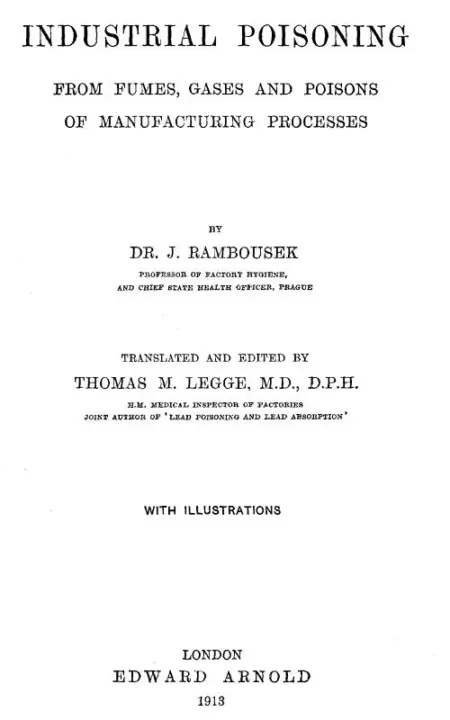
"Industrial Poisoning from Fumes, Gases and Poisons of Manufacturing Processes" by Dr. J. Rambousek is a scientific publication written in the early 20th century. The work systematically addresses the dangers posed by various industrial poisons arising from fumes, gases, and toxic materials in manufacturing settings. It aims to raise awareness among workers, employers, and health officials about the risks, symptoms, and preventive measures associated with industrial poisoning. The opening of the text sets the stage for an in-depth examination of industrial poisoning, emphasizing the complexity of managing health risks in the chemical industry. It outlines the various industries and their manufacturing processes associated with hazardous chemicals, highlighting statistical data regarding poisoning incidents. Specifically, it notes cases of acute and chronic poisoning due to exposure to substances like sulphur dioxide and other harmful chemicals, while also stressing the role of proper hygiene programs and preventive measures that have been effective in reducing these risks in modern factories. This introduction firmly establishes the book's importance as a comprehensive resource for understanding and mitigating the dangers linked to industrial processes.
Introduction adapted from the source catalogue; source summaries may be automatically generated.
Free to read · English · 111,977 words · No account needed
MAKE TIME FOR A GOOD BOOK
On by default. Untick to stop anonymous reading totals. Each page counts after 10 seconds in view. How this works.
Anonymous counting is on unless you have switched it off.
Brat, ‘Bedeutung der Sauerstofftherapie in der Gewerbehygiene, XIV. Intern. Kongr. f. Hyg. u. Dem. und Zeitschr. f. Gew.-Hyg. 1908, Heft 13, S. 305; Dräger, ‘Zur Physiologie des Rettungsapparates mit komprim. Sauerstoff, I. Intern. Kongr. f. Rett.-Wes., Frankfurt a. M. 1908, und Fabrikfeuerwehr 1908, Heft 19, S. 74; Klocke, ‘Die Bedeutung der Sauerstoffinhalationen in der Gewerbehygiene,’ Zeitschr. f. Gew.-Hyg. 1906, Heft 20, S. 559; Dräger, ‘Neue Untersuchungen über die Erfordernisse eines zur Arbeit brauchbaren Rettungsapparates,’ Zeitschr. f. Gew.-Hyg. 1905, S. 49; Klocke, ‘Sauerstoffrettungsapparate,’ Soz. Techn. 1908, Nr. 14, S. 272.
Egli, Unf. b. chem. Arb., I, S. 23, und II, S. 45; Rambousek, ‘Gewerbekrankh. in Böhmen,’ Concordia 1910, Heft 6, und Amtsarzt 1910, Heft 7.
Ogata, Arch. f. Hyg., Bd. 2; Lehmann, Arch. f. Hyg., Bd. 18, S. 180 ff; Klocke ‘(SO₂-Vergiftung und O-Inhal.),’ Zeitschr. f. Gew.-Hyg. 1906, S. 562 und 617; ‘SO₂-Absorption beim Atemprozess,’ Chem. Ztg. 1909, S. 246; ‘Tod durch Einatmung von Schwefelsäuredampf,’ Zeitschr. f. Gew.-Hyg. 1907, S. 430; ‘Schwefel-dioxydvergiftung in England,’ Concordia 1909, Heft 5, S. 105; ‘Schwefels.-Vergiftung, Chem. Ind. 1909 (Ber. d. Berufsgen. f. chem. Ind. pro 1908, S. 26); Egli, Unf. b. chem. Arb., ii, S. 52.
‘Verg. durch nitrose Gase in einer Zellulosefabrik,’ Zeitschr. f. Gew.-Hyg. 1908 Heft 24, S. 565; ‘Behandlung von Nitrosevergiftungen durch Sauerstoffinhalationen,’ Zeitschr. f. Gew.-Hyg. 1908, Heft 20, S. 560; ‘Behandlung durch Chloroform,’ Zeitschr. f. Gew.-Hyg. 1904, Heft 10, S. 226, und 1907, Heft 8, S. 183; ‘Vergiftungen durch nitrose Gase (Zusammenfassung),’ Holtzmann, Concordia, 1908, Nr. 23, S. 498.
Leymann, Arch. f. Hyg., Bd. 7, S. 231; Binz, Arch. f. exp. Path., Bd. 13; Vierteljahrsschr. f. ger. Med. 1888, S. 345; Lehmann, Arch. f. Hyg., Bd. 34, S. 302, und Arch. f. Hyg., Bd. 17, S. 336; Arch. f. exp. Path. u. Ph. 1887, S. 231; Egli, Unf. b. chem. Arb., II, S. 51; Chlorverg., Chem. Ind. 1907, S. 347, 1908, S. 325; Neisser, Intern. Uebers. über Gew.-Hyg., I, S. 94; ‘Chlorverg. in England,’ Concordia 1909, S. 105.
Literatur Über Chlorakne.—Herxheimer, Münchn. med. Wochenschr. 1899 S. 278; Bettmann, D. med. Wochenschr. 1901, S. 437; Lehmann, Arch. f. Dermatol. 1905, S. 323; Leymann, ‘Erk.-Verh. der chem. Grossind.,’ Concordia 1906, Nr. 7-9; Holtzmann, D. Vierteljahrsschr. f. öffentl. Ges.-Pfl. 1907, Bd. 39, S. 258.
Vaubel, Chem. Ztg. 1903; Leymann, Concordia 1906, Nr. 7; Egli, Unf. b. chem.-Arb. 1902, S. 49; Rumpf, D. med. Wochenschr. 1908, Bd. 34, S. 1331.
Lehmann, Arch. f. Hyg. 1894, Bd. 20, S. 26; Leymann, Concordia 1906,
Heft 7.
Lehmann, ‘Verauche über die Wirkung,’ Arch. f. Hyg., Bd. 5; ‘Vers. über die Resorption,’ Arch. f. Hyg., Bd. 17 u. 67; ‘Versuche über die Gewöhnung,’ Arch. f. Hyg., Bd. 34; Lewin, ‘Tödl. Ammoniakverg. in einer chem. Fabrik, Berl. klin. Wochenschr. 1908; ‘Tödl. Ammoniakverg.,’ Zeitschr. f. Gew.-Hyg. 1909, Wr. 9, S. 242; ‘Ammoniakverg. in der Kälte-Ind.’
Your reading position is saved on this browser. Take it to another device with a library code. Reading pages adapt to text, rather than matching a printed edition.
BEHIND THE BOOK
This eBook is for the use of anyone anywhere in the United States and most other parts of the world at no cost and with almost no restrictions whatsoever. You may copy it, give it away or re-use it under the terms of the Project Gutenberg License included with this eBook or online at www.gutenberg.org. If you are not located in the United States, you will have to check the laws of the country where you are located before using this eBook. Read the source licence.
The original source file, including credits and licence, is retained by this library. Request an original-format copy at no charge. Please include the book title and Project Gutenberg identifier #60605.
KEEP YOUR CURIOSITY GOING
John Muir

Asa Gray
Asa Gray

Florence Nightingale
Elizabeth Robins Pennell
Denison Olmsted