
Letters to a Friend, Written to Mrs. Ezra S. Carr, 1866-1879
John Muir
THE CLASSIC COLLECTION · 1913
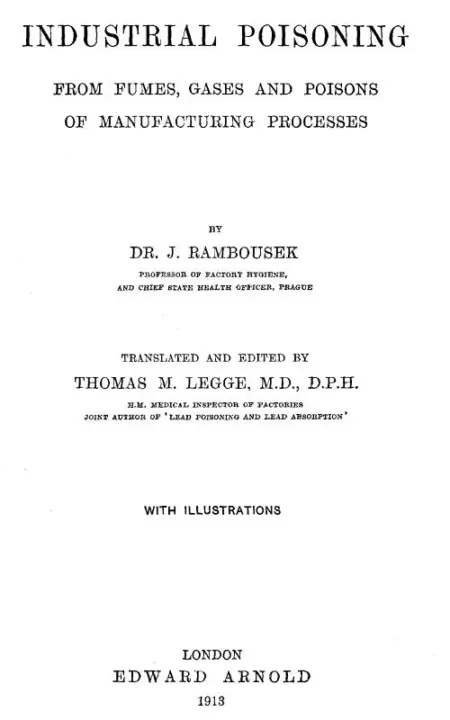
"Industrial Poisoning from Fumes, Gases and Poisons of Manufacturing Processes" by Dr. J. Rambousek is a scientific publication written in the early 20th century. The work systematically addresses the dangers posed by various industrial poisons arising from fumes, gases, and toxic materials in manufacturing settings. It aims to raise awareness among workers, employers, and health officials about the risks, symptoms, and preventive measures associated with industrial poisoning. The opening of the text sets the stage for an in-depth examination of industrial poisoning, emphasizing the complexity of managing health risks in the chemical industry. It outlines the various industries and their manufacturing processes associated with hazardous chemicals, highlighting statistical data regarding poisoning incidents. Specifically, it notes cases of acute and chronic poisoning due to exposure to substances like sulphur dioxide and other harmful chemicals, while also stressing the role of proper hygiene programs and preventive measures that have been effective in reducing these risks in modern factories. This introduction firmly establishes the book's importance as a comprehensive resource for understanding and mitigating the dangers linked to industrial processes.
Introduction adapted from the source catalogue; source summaries may be automatically generated.
Free to read · English · 111,977 words · No account needed
MAKE TIME FOR A GOOD BOOK
On by default. Untick to stop anonymous reading totals. Each page counts after 10 seconds in view. How this works.
Anonymous counting is on unless you have switched it off.
9. Employers shall, at their own expense, provide and maintain for the use of the workers, overalls or clothing for use during work only, in addition to gloves and respirators.
10. In a part of the building separated from the workrooms, there shall be provided for the use of the workers exposed to lead dust or fumes, a cloak room and lavatory kept in good order, provided with basins or taps in sufficient number, a plentiful supply of water, soap and a towel for each worker replaced at least once a week.
The cloak rooms shall be provided with cupboards or drawers with locks or padlocks, the ordinary clothing being kept apart from the working clothes.
11. A warm bath or shower bath shall be provided each week for the workers exposed to lead dust or fumes.
A warm bath or shower bath shall be provided every day after work, for each worker employed, either in emptying or cleaning the condensing chambers and flues, in repairing furnaces in lead works, in carrying lead corrosions from the beds in white lead factories, in packing red lead, in grinding lead enamels and in dry dusting.
12. Employers are required to exhibit, in a conspicuous position in the works, regulations imposing on the workers the following obligations:—
To use the appliances, gloves, respirators, and working clothes
placed at their disposal.
Not to bring into the works either food or drink.
To pay great care, before each meal, to the cleanliness of the
mouth, nose, and hands.
To take the baths weekly or daily as provided in section 11.
13. The Minister of Labour may, by Order made with the advice of the Consultative Committee for Arts and Manufactures, exempt an establishment for a specified period, from all or part of the requirements of Regs. 2ᵃ, 2ᵇ, 2ᶜ, 5² and 6¹ in any case where it is found that observance of these requirements is practically impossible, and that the health and safety of the workers are assured by conditions at least equivalent to those prescribed in the present Order.
14. Subject to additional postponements which may be granted by the Minister in pursuance of Section 6 of the Act of 12th June, 1893 (as amended by that of 11th July, 1903), the delay required for the carrying out of the alterations necessitated by the present Decree is limited to one year from the date of its publication.
15. The Ministry of Labour is charged with the administration
of this Decree.
This decree was supplemented by further noteworthy additions requiring medical supervision in lead industries as follows:
DECREE OF DECEMBER 28, 1909, ORGANISING MEDICAL SERVICE IN INDUSTRIES EXPOSING THE WORKERS TO RISK OF LEAD POISONING
Your reading position is saved on this browser. Take it to another device with a library code. Reading pages adapt to text, rather than matching a printed edition.
BEHIND THE BOOK
This eBook is for the use of anyone anywhere in the United States and most other parts of the world at no cost and with almost no restrictions whatsoever. You may copy it, give it away or re-use it under the terms of the Project Gutenberg License included with this eBook or online at www.gutenberg.org. If you are not located in the United States, you will have to check the laws of the country where you are located before using this eBook. Read the source licence.
The original source file, including credits and licence, is retained by this library. Request an original-format copy at no charge. Please include the book title and Project Gutenberg identifier #60605.
KEEP YOUR CURIOSITY GOING
John Muir

Asa Gray
Asa Gray

Florence Nightingale
Elizabeth Robins Pennell
Denison Olmsted