
Letters to a Friend, Written to Mrs. Ezra S. Carr, 1866-1879
John Muir
THE CLASSIC COLLECTION · 1913
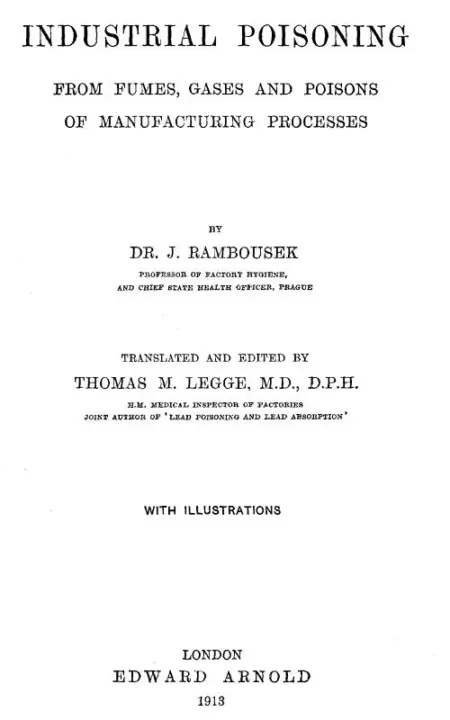
"Industrial Poisoning from Fumes, Gases and Poisons of Manufacturing Processes" by Dr. J. Rambousek is a scientific publication written in the early 20th century. The work systematically addresses the dangers posed by various industrial poisons arising from fumes, gases, and toxic materials in manufacturing settings. It aims to raise awareness among workers, employers, and health officials about the risks, symptoms, and preventive measures associated with industrial poisoning. The opening of the text sets the stage for an in-depth examination of industrial poisoning, emphasizing the complexity of managing health risks in the chemical industry. It outlines the various industries and their manufacturing processes associated with hazardous chemicals, highlighting statistical data regarding poisoning incidents. Specifically, it notes cases of acute and chronic poisoning due to exposure to substances like sulphur dioxide and other harmful chemicals, while also stressing the role of proper hygiene programs and preventive measures that have been effective in reducing these risks in modern factories. This introduction firmly establishes the book's importance as a comprehensive resource for understanding and mitigating the dangers linked to industrial processes.
Introduction adapted from the source catalogue; source summaries may be automatically generated.
Free to read · English · 111,977 words · No account needed
MAKE TIME FOR A GOOD BOOK
On by default. Untick to stop anonymous reading totals. Each page counts after 10 seconds in view. How this works.
Anonymous counting is on unless you have switched it off.
[F] Fischer adopts a chemical basis in his classification. His two main subdivisions are (1) inorganic and (2) organic poisons. The sub-divisions of the inorganic poisons are (a) non-metallic—chlorine, calcium chloride, hydrochloric acid, potassium chlorate, hydrofluoric acid, carbonic oxide, phosgene, carbon dioxide, cyanogen compounds, ammonia, nitrous fumes, phosphorus, phosphoretted hydrogen, arsenic compounds, antimony compounds, sulphur dioxide, sulphuric acid, sulphuretted hydrogen, carbon bisulphide, chloride of sulphur; and (b) metallic—chromic acid and chromates, manganese dioxide, sulphate of nickel, mercury and lead. The sub-divisions of (2) the organic substances are into (a) the unsaturated carbon compounds—benzene, petroleum, methyl-, ethyl-, amyl-, and allyl-alcohol, oxalic acid, formal- and acetaldehyde, acrolein, acetone, methyl-bromide and iodide, nitro-glycerin, dimethyl-sulphate and amyl acetate, and (b) the aromatic series benzene, nitro-, chloro-nitro-, dinitro-, chloro-dinitro-benzene, phenol, picric acid, phenyl-hydrazine, aniline, and certain aniline colours, para-nitraniline, pyridine, naphthalene, nitro-naphthalene, naphthlyamine, naphthol, benzidine, acridine, turpentine, and nicotine.
[G] A Prussian Ministerial Decree, dated March 31, 1892, deals with the preparation of nitrate of mercury.
[H] In Great Britain and Ireland the White Phosphorus Matches Prohibition Act became operative from January 1, 1910. In the United States of America a Prohibition Act became operative on July 1, 1913.
[I] Reprinted by permission of the Controller of H.M. Stationery Office.
[J] Use of Oxygen Cylinder.—Open the valve gradually by tapping the lever key (which must first be extended to its full length) with the wrist, until the oxygen flows in a gentle stream from the mouthpiece into the patient’s mouth. The lips should not be closed round the mouthpiece. The nostrils should be closed during breathing in, and opened during breathing out.
If the teeth are set, close the lips and one nostril. Let the conical end of the mouthpiece slightly enter the other nostril during breathing in, and remove it for breathing out.
[K] The suggested regulations made after his inquiry (see p. 149) by Dr.
Copeman are:
1. Ferro-silicon should not be sent out from the works immediately after manufacture, but after being broken up into pieces of the size in which it is usually sold, should be stored under cover, but exposed to the air as completely as possible, for at least a month before being despatched from the works.
2. Manufacturers should be required to mark in bold letters each barrel or other parcel of ferro-silicon with the name and percentage grade (certified by chemical analysis) of the material; the name of the works where it is produced; the date of manufacture; and date of despatch.
Your reading position is saved on this browser. Take it to another device with a library code. Reading pages adapt to text, rather than matching a printed edition.
BEHIND THE BOOK
This eBook is for the use of anyone anywhere in the United States and most other parts of the world at no cost and with almost no restrictions whatsoever. You may copy it, give it away or re-use it under the terms of the Project Gutenberg License included with this eBook or online at www.gutenberg.org. If you are not located in the United States, you will have to check the laws of the country where you are located before using this eBook. Read the source licence.
The original source file, including credits and licence, is retained by this library. Request an original-format copy at no charge. Please include the book title and Project Gutenberg identifier #60605.
KEEP YOUR CURIOSITY GOING
John Muir

Asa Gray
Asa Gray

Florence Nightingale
Elizabeth Robins Pennell
Denison Olmsted