
Letters to a Friend, Written to Mrs. Ezra S. Carr, 1866-1879
John Muir
THE CLASSIC COLLECTION · 1913
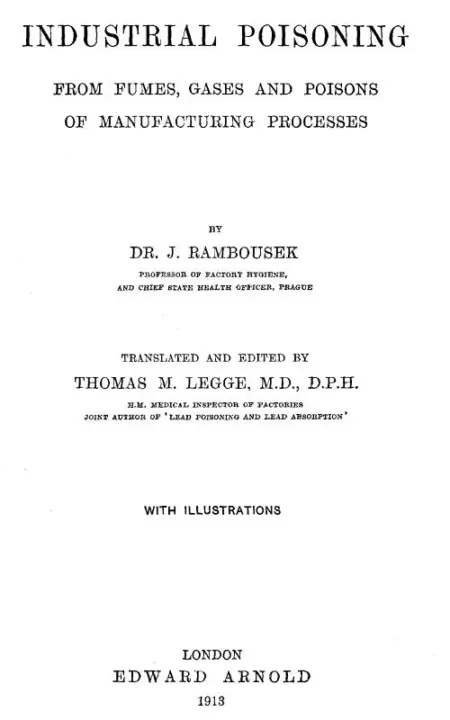
"Industrial Poisoning from Fumes, Gases and Poisons of Manufacturing Processes" by Dr. J. Rambousek is a scientific publication written in the early 20th century. The work systematically addresses the dangers posed by various industrial poisons arising from fumes, gases, and toxic materials in manufacturing settings. It aims to raise awareness among workers, employers, and health officials about the risks, symptoms, and preventive measures associated with industrial poisoning. The opening of the text sets the stage for an in-depth examination of industrial poisoning, emphasizing the complexity of managing health risks in the chemical industry. It outlines the various industries and their manufacturing processes associated with hazardous chemicals, highlighting statistical data regarding poisoning incidents. Specifically, it notes cases of acute and chronic poisoning due to exposure to substances like sulphur dioxide and other harmful chemicals, while also stressing the role of proper hygiene programs and preventive measures that have been effective in reducing these risks in modern factories. This introduction firmly establishes the book's importance as a comprehensive resource for understanding and mitigating the dangers linked to industrial processes.
Introduction adapted from the source catalogue; source summaries may be automatically generated.
Free to read · English · 111,977 words · No account needed
MAKE TIME FOR A GOOD BOOK
On by default. Untick to stop anonymous reading totals. Each page counts after 10 seconds in view. How this works.
Anonymous counting is on unless you have switched it off.
In other countries similar action was set on foot. In Austria, where the subject is of special importance in view of the part played by lead in the home industries, the Government undertook to improve the conditions in industries attended with risk of lead poisoning. For this purpose the Statistical Office of the Ministry of Commerce and Labour has, since 1904, carried out extensive inquiries into lead and zinc smelting works, paint and colour factories, the painting and varnishing trades, letterpress printing, and the ceramic industry. The results are contained in the volume ‘Lead Poisoning in Smelting Works and Industries Generally’ (published by Hölder, Vienna).
As in Germany and Austria, so also in Great Britain, France, Switzerland, Belgium, and the Netherlands, regulations in various lead industries were enforced after previous official inquiry and report.
A general code, however, affecting all lead industries has only been published in one or two states. And yet this would, in my opinion, be of very great practical value as it is hardly possible to regulate each single branch of industry.
In Germany the Regulations dated May 26, 1903, dealing with lead colours are certainly comprehensive, but relate primarily to paint factories, and are not, therefore, a general Order in the sense indicated. In Saxony the decree of June 27, 1901, made notification of lead poisoning compulsory, and in the subsequent decree of April 16, 1909, prescribed general measures against lead poisoning. In Switzerland single cantons have made general regulations. In France, by a decree dated April 23, 1908 (in pursuance of the general law of June 12, 1893), all industries attended with risk of lead poisoning were brought under Regulation.
We give the provisions of this interesting decree, as it is a good example of the kind of Regulations we have in mind.
DECREE OF THE PRESIDENT OF THE FRENCH REPUBLIC (APRIL 23, 1908) RELATING TO CERTAIN INDUSTRIES IN WHICH LEAD IS USED
1. In the lead industries hereinafter mentioned, viz.: smelting, cupellation of argentiferous lead, manufacture of accumulators, glass-making, manufacture and use of lead enamels, manufacture of pottery, decoration of porcelain or faience, ceramic chromo-lithography, manufacture of lead alloys, oxides, salts and colours—employers, directors or managers are required, apart from the general measures prescribed by the Decree of 29 November, 1904, to take special measures for protection and health as set forth in the following sections.
2. Lead melting pots shall be erected in an airy place
separated from the other workrooms.
Hoods or other means for the effectual removal of fumes shall
be provided:—
(a) Over the openings for the run of lead and slag in lead
smelting.
(b) Before the furnace doors in the manufacture of lead
oxides.
(c) Above the pots for melting lead or its alloys, in the other industries enumerated in Section 1.
Your reading position is saved on this browser. Take it to another device with a library code. Reading pages adapt to text, rather than matching a printed edition.
BEHIND THE BOOK
This eBook is for the use of anyone anywhere in the United States and most other parts of the world at no cost and with almost no restrictions whatsoever. You may copy it, give it away or re-use it under the terms of the Project Gutenberg License included with this eBook or online at www.gutenberg.org. If you are not located in the United States, you will have to check the laws of the country where you are located before using this eBook. Read the source licence.
The original source file, including credits and licence, is retained by this library. Request an original-format copy at no charge. Please include the book title and Project Gutenberg identifier #60605.
KEEP YOUR CURIOSITY GOING
John Muir

Asa Gray
Asa Gray

Florence Nightingale
Elizabeth Robins Pennell
Denison Olmsted