THE CLASSIC COLLECTION✦My diaries, being a personal narrative of events 1888-1914, Part 2 (1900-1914)CLASSIC FREE BOOKS
My diaries, being a personal narrative of events 1888-1914, Part 2 (1900-1914)
Wilfrid Scawen Blunt
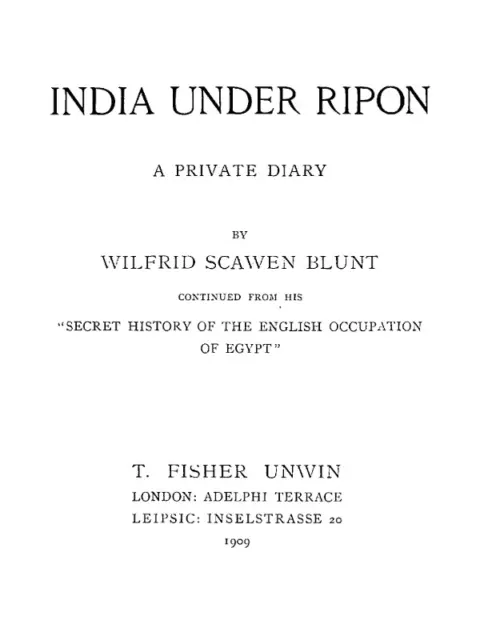
THE CLASSIC COLLECTION · 1909
"India under Ripon: A Private Diary" by Wilfrid Scawen Blunt is a historical account written in the early 20th century. The work provides insights into the socio-political climate of India during Lord Ripon's tenure as Viceroy in the late 19th century, exploring themes of governance, reform, and the burgeoning movement towards Indian self-assertion. Blunt's personal observations serve to illuminate a critical period in Indian history, marked by unrest and the quest for rights and equality among native populations. At the start of the diary, Blunt sets the stage for his journey through India, outlining his intentions to engage directly with the people and understand their perspectives on British rule. He reflects on the significant political changes occurring during Lord Ripon's administration, noting the tensions stemming from the oppressive policies of previous administrations and the hardship faced by the Indian populace, especially during famines. The narrative introduces the reader to the intricacies of Indian society, including the divisions between various communities and the impact of British rule on local governance and economic conditions, all of which are pivotal to understanding the historical dynamics of resistance and reform.
Introduction adapted from the source catalogue; source summaries may be automatically generated.
Free to read · English · 105,687 words · No account needed
MAKE TIME FOR A GOOD BOOK
On by default. Untick to stop anonymous reading totals. Each page counts after 10 seconds in view. How this works.
Anonymous counting is on unless you have switched it off.
Ghulam Mohammed Munshi, of Bombay, 212.
Gladstone, Rt. Honble. W. E., 1-5, 9, 14, 83, 96, 106, 146, 208,
211.
Godley, Sir Arthur, 180.
Gordon, General C. G., 83, 95, 167-168, 189, 194, 208, 213, 230;
my letter to, 168.
Gordon, Sir Arthur, 24.
Gorst, Sir John, 83, 84, 175-185.
Gough, Major, in the Nizam’s service, 69.
Grant-Duff, Sir Mount Stewart, 36, 37, 41, 45, 53, 177, 193, 196,
219.
Gregory, Sir William, 23, 25.
Hamilton, Sir Edward, private secretary to Mr. Gladstone, 9, 11,
122, 177, 180.
Hanna, Mr., a Christianized Hindu, 51.
Henderson, Mr., of the Secret Police, 186, 196, 204.
“Hindu Patriot,” 94.
“Hindu Prakash,” 81.
Hindu worship, 24, 31, 32, 46, 48, 49, 282-285.
Hodson, Colonel, 166, 169.
Holkar, Maharajah, 301.
Hörnli, Dr., Swiss Director of the Calcutta Madrasa, 98, 105, 124.
Humayum, Emperor, his tomb at Delhi, 169.
Humayum Jah Bahadur, head of Mohammedan community of Madras, 41.
Hunter, Sir William, statistician, 130, 132, 133, 138, 239, 291; his letter in Appendix, 332.
Hyderabad, 57-82, 175-207, 304.
“Ideas about India,” 231, 335.
Ik-Balet-Dowlah. See Vikar-el-Omra.
Ikhram Ullah, of Delhi, Seyd Ahmed’s nephew, 121, 158, 161, 163,
164, 170.
Ilbert Bill, 5, 16, 17, 44, 85, 96, 100, 102, 103, 106, 108, 109, 111, 113, 121, 132, 133, 145, 177, 269, 271, 272, 273.
Ilbert, Mrs., 96, 130, 132;
Sir Courtenay, 132.
Import duties, 223, 224, 250, 251, 253.
Income Tax, 223, 251, 252.
“Indian Club,” 115.
“Indian Mirror,” 85, 106.
“Indian Spectator,” 82, 132.
Industrial ruin, 213, 239, 240, 247-251, 253, 306.
Insults to Natives, 121, 141, 146, 147, 148, 150, 152, 157, 174,
263-266.
Jehan Kadur, Prince, brother of the King of Oude, 120, 125.
Jemal-ed-Din Afghani, Seyd, 12, 13, 63, 80, 97, 99, 108, 112, 123,
128.
Jeypore, 172.
Jijibhoy, Sir Jamsetji, 88, 95, 214.
Johnstone, Dr., Bishop of Calcutta, 99.
Kabraji, Kaikhosna Nowrosji, editor of the “Rast” of Bombay, 214,
215.
Kaisar Bagh meeting, 155.
Kalbarga, 81, 198, 203, 204, 206, 207.
Keay, Seymour, Mr., 58, 116, 118.
Kebir-ed-Din, Mohammedan editor in Calcutta, 106.
Kerr, Rev. Schomberg, S.J., Lord Ripon’s chaplain, 87, 179, 182.
Kimberley, Earl of, Secretary of State for India, 18, 96.
Knight, Mr., editor of “Statesman,” 92.
Kokhnis, 213, 287.
Kolapur, Mahratta Diwan of, 218.
Kottub, the, 165, 170.
Krishna, Maharajah of, 130, 131, 137.
Kristo Das Pal, editor of “The Hindu Patriot,” Member of the Legislative Council, 94, 133.
Laik Ali, Salar Jung (the younger). See Salar Jung.
Lambert, Mr., head of Secret Police, 182, 185.
Land assessment, 42, 86, 87, 130, 155, 171, 207, 213, 218, 221, 222,
225, 239.
Land Settlement, Permanent, 94, 213, 216, 221, 222, 225, 241, 242,
252;
recommended, 252.
Local Self-Government Bill, 85, 213, 246, 270, 271, 272.
Loharo, Chief of, 161, 165, 169.
Lucknow, 150-155.
Lyall, Sir Alfred, Lieutenant-Governor of North-West Provinces, 6, 11, 107, 117, 120, 144, 145, 147, 148, 149, 150, 157, 177.
Lytton, Robert, Earl of, 6, 7, 79, 89, 94, 177, 202, 216, 335.
Madhava Rao, Sir, 38, 88.
Madras, 35-45, 303.
Madrasa, Culcutta, 135.
Madura, 29-33.
Mahbub Ali. See The Nizam.
Mahdi Ali, Prince, of Lucknow, 153, 154.
Mahdi, the Soudanese, 112, 123, 125, 168, 180, 189, 194, 197, 203, 208, 209, 210, 217, 223.
Mahmud Sami Pasha, 19, 25, 120.
Malabari, Behramji, Parsi editor of the “Indian Spectator,” 82,
173, 177, 211, 225.
Malays of Ceylon, 23.
Malkum Khan, Prince, 188.
Mandlik, Mr., 178.
Manockji Rustemji, Mr., 88, 95.
Mayo Hall meeting at Allahabad, 145, 149.
Mazhar, Abd-el-Rahman, Cadi of Bagdad, 120.
Meade, Sir Richard, 58, 84, 93.
Mehdy Hassan, Mulvi, of Lucknow, 79.
Mir Alum tank, 61, 193.
Mirza Agha Khan, the Nizam’s Persian tutor, 204.
Moguls, Last of the, 143, 144.
Mohammed Ali Bey, Master of Nizam’s Horse, 193, 201.
Mohammed Ibrahim, Chief Mujtahed at Lucknow, 153.
Mohammed Yusuf, Member of Calcutta Council, 123.
Mohammedan Question, 278-298.
Mohammedans of Southern India, 27, 28, 29, 41, 45, 287, 288, 289.
Mohunt, the, 49.
Monier Williams, Professor, 226.
Moore, Colonel, 165, 166, 167, 179, 184, 187, 191.
Moors of Ceylon, 23, 25-27, 287, 288.
Mukerji, Rasbihari, of Uttarpara, 101, 120;
Sambhu Chandra, 106;
family of, 124.
Mullen, Dr., at Ulwar, 171.
Mulvi A. M., 104, 107, 112, 136.
Muteswami, Judge, of Madras, 40, 42, 44.
National Conference at Calcutta, 114, 116, 117, 118.
Native States, 299-305.
Nawaiz Jung, Sultan El Kaiti, Prince of Hadramaut at Hyderabad, 65,
66, 79, 80.
Nizam, Mahbub Ali, the, 62, 66, 67, 72, 77, 110, 137-183, 186, 189, 190, 192, 193, 195, 197, 198, 203-206, 210, 212, 219, 330, 334, 335, 336; his stables, 61, 66; intrigue against, 67, 70, 74, 75, 76, 89, 90, 91, 93, 109, 117, 119, 136, 179, 205, 206, 228; his installation, 91, 109, 119, 132, 155, 159, 175-207.
Norendro Nath Sen, editor of the “Indian Mirror,” 85.
Nur-el-Huda, Seyd, of Patna, 100, 139.
Your reading position is saved on this browser. Take it to another device with a library code. Reading pages adapt to text, rather than matching a printed edition.
Wilfrid Scawen Blunt
Wilfrid Scawen Blunt
Wilfrid Scawen Blunt
Wilfrid Scawen Blunt
BEHIND THE BOOK
This eBook is for the use of anyone anywhere in the United States and most other parts of the world at no cost and with almost no restrictions whatsoever. You may copy it, give it away or re-use it under the terms of the Project Gutenberg License included with this eBook or online at www.gutenberg.org. If you are not located in the United States, you will have to check the laws of the country where you are located before using this eBook. Read the source licence.
The original source file, including credits and licence, is retained by this library. Request an original-format copy at no charge. Please include the book title and Project Gutenberg identifier #49177.
KEEP YOUR CURIOSITY GOING
Wilfrid Scawen Blunt
Wilfrid Scawen Blunt

E. W. (Edgar Watson) Howe
Cécile Tormay

Moritz Busch
John L. Ransom