THE CLASSIC COLLECTION✦My diaries, being a personal narrative of events 1888-1914, Part 2 (1900-1914)CLASSIC FREE BOOKS
My diaries, being a personal narrative of events 1888-1914, Part 2 (1900-1914)
Wilfrid Scawen Blunt
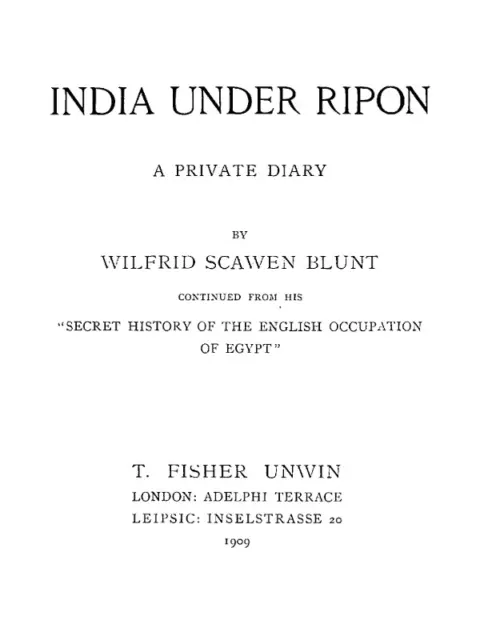
THE CLASSIC COLLECTION · 1909
"India under Ripon: A Private Diary" by Wilfrid Scawen Blunt is a historical account written in the early 20th century. The work provides insights into the socio-political climate of India during Lord Ripon's tenure as Viceroy in the late 19th century, exploring themes of governance, reform, and the burgeoning movement towards Indian self-assertion. Blunt's personal observations serve to illuminate a critical period in Indian history, marked by unrest and the quest for rights and equality among native populations. At the start of the diary, Blunt sets the stage for his journey through India, outlining his intentions to engage directly with the people and understand their perspectives on British rule. He reflects on the significant political changes occurring during Lord Ripon's administration, noting the tensions stemming from the oppressive policies of previous administrations and the hardship faced by the Indian populace, especially during famines. The narrative introduces the reader to the intricacies of Indian society, including the divisions between various communities and the impact of British rule on local governance and economic conditions, all of which are pivotal to understanding the historical dynamics of resistance and reform.
Introduction adapted from the source catalogue; source summaries may be automatically generated.
Free to read · English · 105,687 words · No account needed
MAKE TIME FOR A GOOD BOOK
On by default. Untick to stop anonymous reading totals. Each page counts after 10 seconds in view. How this works.
Anonymous counting is on unless you have switched it off.
Yours very truly,
CLAUDE CLERK.
Abd-el-Ghaffar, Mohammed, 129.
Abd-el-Hak of Hyderabad, 191, 194, 195, 196, 202.
Abd-el-Latif, Nawab, head of the Sunni Mohammedans at Calcutta, 14, 86, 97, 98, 99, 104, 110, 111, 127, 131, 134, 138, 219; his son-in-law, Seyd Mohammed, 134, 136; his son, Abd-el-Rahman, 99, 108, 109, 117.
Abd-el-Rahman Minni, Sheykh, Arab horse-dealer of Bombay, 208, 209,
211, 212, 216.
Abd-el-Rahman, Seyd, of Madras, 41;
his Eurasian wife, 41, 44.
Abraham, Mr. Matthew, of Bellari, 53.
“Abu Nadara,” James Sanua, editor of, 13, 64, 123.
Afghans and Persians, 14, 98, 188, 192.
Agha Khan, The Chief of the Khoja sect, residing at Bombay, 210,
211, 212, 213.
Agricultural danger, the, 82, 236-254.
Ahmed, Mulvi, Municipal Councillor of Calcutta, 110.
Akbar Huseyn, translator of “Future of Islam,” 119-124, 146, 163.
Ali Abdallah, of Hyderabad, 62, 68.
Aligarh College, 119, 155-160.
Ali Hamid Bey, Turkish Consul at Bombay, 211-215.
Allahabad, 144-150.
Amir Ali, the Honble. Seyd, Leader of the new school of Mohammedans at Calcutta, 86, 87, 96, 97, 98, 103, 104, 105, 110, 111, 113, 121, 128, 131, 138, 219.
Amir Hassan, Rajah of Mahmudabad, 125, 148, 149, 152, 153, 154, 155,
229.
Amir Huseyn, Mulvi Seyd, Deputy-Collector, 93, 97.
Anjuman i Islam meeting at Calcutta, 124, 126.
Arab horses, 61, 62, 66, 67, 110, 129, 208, 212.
Arabi Pasha, 15, 22, 23, 25, 88, 98, 112, 113, 118, 124, 289.
Arabs in India, 59, 60, 61, 65, 66, 71, 209, 211, 212, 213, 287.
Bafiti, Mohammed, Sheykh es Saadat of Medina, 139.
Bailey, Sir Stuart, 78, 92, 93, 109, 117, 182.
Banerji, Surendra Nath, the Calcutta orator, 102, 109, 114, 137.
Baring, Sir Evelyn, Lord Cromer, 11, 14, 55, 120, 167, 177.
Barrow, General, 152.
Beck, Mr., of Aligarh College, 156.
Behar, Province of, 139.
Bellari, 50-55;
famine at, 54.
Benares, 142, 143, 144.
Benares, Maharajah of, 120, 142, 143.
Bengal Permanent Land Settlement, 86, 94, 108, 221, 252.
Bengal Rent Bill, 86, 93, 94, 102, 108.
Bentinck, Lord William, 95.
Berar Provinces, intrigue for the retention of, 58, 74, 75, 77, 83, 89, 91, 149, 179, 184-205, 206, 336.
Bilgrami, Seyd Ali, 61, 63, 204.
Bilgrami Seyd Huseyn, private secretary to Salar Jung, now member of the Indian Council in London, 61, 64, 68, 74, 75, 77, 79, 93, 185, 186, 190, 191, 199, 200.
Bolarum, 174, 190.
Bombay, 82, 173, 174, 208-226.
“Bombay Gazette,” 191, 208.
Bose, Mr., Secretary of the National Conference at Calcutta, 114,
118, 121.
Bulbul of the Deccan, 198, 199, 201, 203.
Burmah, 16, 17.
Bushir-ed-Dowlah, nobleman of Hyderabad, 69, 73, 76, 91, 180, 182,
185.
Calcutta, 85-138.
Calcutta races, 110.
Caliphate, Arabian, 13, 119;
Ottoman, 63, 119, 124.
Canning, Lord, 95, 270.
Ceylon, 19-26.
Chandanagore, 113.
Cheragh Ali, Mulvi, of Hyderabad, 64, 70, 79, 197.
Christians, Native, 24, 46, 51, 55, 100, 282.
Churchill, Lord Randolph, 9, 12, 83, 84, 146, 175, 177, 230, 334.
Clerk, Major, the Nizam’s tutor, 65, 67, 184, 198, 204;
his letters in Appendix, 335, 336;
Mrs., 137, 196, 197.
Colombo, 19, 26.
Colvin, Sir Auckland, 8, 113, 150, 272.
Connaught, H.R.H. the Duke of, 55, 165.
Connemara, Lord, 43.
Constitutional Reform, plan of, 215, 310-326.
Cordery, Mr., Resident at Hyderabad, 58, 80, 89, 136, 150, 174, 178, 179, 182, 184, 185, 190, 191, 193, 196, 199, 203, 206, 219, 228, 335, 336.
Cornwallis, Lord, his land settlement of Bengal, 86.
Council, Indian, in London, 215, 316.
Councils, Provincial, 316, 317, 318, 319.
Couper, Sir George, 154.
Covenanted Civil Service, 36, 40, 43, 47, 55, 60, 75, 83, 95, 114, 116, 206, 215, 234, 267, 268, 273, 275, 310-318.
Curzon of Kedleston, Lord, 91, 205, 334.
Debt, Public, 323.
Debts, Village, 7, 42, 232, 243-246.
Deccan College, 81.
Deccan horsemanship, 67.
Delawar Huseyn, Deputy-Magistrate at Calcutta, 115.
Delhi, 161-171;
capture of, 169, 170;
horrors committed at, 163, 164;
last King of, 163, 167, 169.
Deportation, 13, 80, 235.
Dobbs, Colonel, 191.
Dravidians, 23, 34.
Dufferin, Marquess of, 177, 202, 229.
Durand, Sir Mortimer, Secretary to the Calcutta Foreign Office, 117,
180.
Eden, Sir Ashley, 100.
Eid el Temini, Sheykh, Arab horse dealer at Bombay, 209, 217.
Emperors of Delhi, 172.
Englishwomen in India, 248, 261, 262.
Eurasians, 41, 44, 51, 52.
Famine, 2, 50, 54, 216, 232, 241.
Ferdunji Nowrosji, Parsi Councillor at Bombay, 223.
Fergusson, Sir James, Governor of Bombay, 209, 219-224.
Ferid-ed-Din Ahmed, Mulvi of Cawnpore, 119, 125, 126, 139, 144, 145,
147, 148, 189.
Ferukshah, Prince, 134.
Finance, 247-254.
Flying foxes, 65.
Forest Laws, 42, 210, 216, 224, 241, 242.
Frere, Sir Bartle, 81, 249.
“Future of Islam,” 62, 112, 119, 123, 124, 126, 158, 231, 295.
Future of self-government, 107-118, 234, 235, 299-326.
Gaignaud, Mademoiselle, Governess in Salar Jung’s household, 70, 200; her account of Sir Salar Jung’s death, 200, 201.
Geary, Mr., editor of “Bombay Gazette,” 191.
Ghaleb Jung, an Arab of Hyderabad, 59.
Ghose, Dr., of Calcutta, 137.
Your reading position is saved on this browser. Take it to another device with a library code. Reading pages adapt to text, rather than matching a printed edition.
Wilfrid Scawen Blunt
Wilfrid Scawen Blunt

Wilfrid Scawen Blunt
Wilfrid Scawen Blunt
BEHIND THE BOOK
This eBook is for the use of anyone anywhere in the United States and most other parts of the world at no cost and with almost no restrictions whatsoever. You may copy it, give it away or re-use it under the terms of the Project Gutenberg License included with this eBook or online at www.gutenberg.org. If you are not located in the United States, you will have to check the laws of the country where you are located before using this eBook. Read the source licence.
The original source file, including credits and licence, is retained by this library. Request an original-format copy at no charge. Please include the book title and Project Gutenberg identifier #49177.
KEEP YOUR CURIOSITY GOING
Wilfrid Scawen Blunt
Wilfrid Scawen Blunt

E. W. (Edgar Watson) Howe
Cécile Tormay

Moritz Busch
John L. Ransom