THE CLASSIC COLLECTION✦My diaries, being a personal narrative of events 1888-1914, Part 2 (1900-1914)CLASSIC FREE BOOKS
My diaries, being a personal narrative of events 1888-1914, Part 2 (1900-1914)
Wilfrid Scawen Blunt
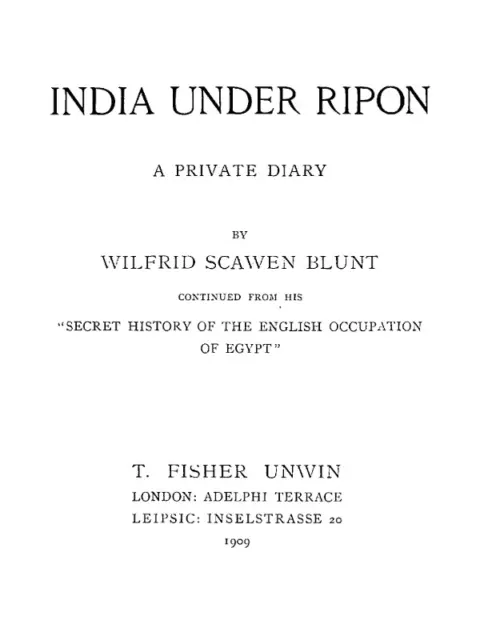
THE CLASSIC COLLECTION · 1909
"India under Ripon: A Private Diary" by Wilfrid Scawen Blunt is a historical account written in the early 20th century. The work provides insights into the socio-political climate of India during Lord Ripon's tenure as Viceroy in the late 19th century, exploring themes of governance, reform, and the burgeoning movement towards Indian self-assertion. Blunt's personal observations serve to illuminate a critical period in Indian history, marked by unrest and the quest for rights and equality among native populations. At the start of the diary, Blunt sets the stage for his journey through India, outlining his intentions to engage directly with the people and understand their perspectives on British rule. He reflects on the significant political changes occurring during Lord Ripon's administration, noting the tensions stemming from the oppressive policies of previous administrations and the hardship faced by the Indian populace, especially during famines. The narrative introduces the reader to the intricacies of Indian society, including the divisions between various communities and the impact of British rule on local governance and economic conditions, all of which are pivotal to understanding the historical dynamics of resistance and reform.
Introduction adapted from the source catalogue; source summaries may be automatically generated.
Free to read · English · 105,687 words · No account needed
MAKE TIME FOR A GOOD BOOK
On by default. Untick to stop anonymous reading totals. Each page counts after 10 seconds in view. How this works.
Anonymous counting is on unless you have switched it off.
Oude, King of, 120, 125.
Palmer, Professor, his mission, 15, 16, 19, 166, 167.
Parsis, 214, 285-287.
Patna, 139-141;
outrage case, 141, 146, 147, 174, 178, 182, 194, 264-266.
Patterson, Mr., 147.
Peishkar, the, Minister of the Nizam, 62, 70, 71, 76, 78, 137, 185,
186, 201.
“Pioneer, The,” Anglo-Indian newspaper of Allahabad, 8, 149, 150,
159.
Pollen, Walter, A.D.C. to Lord Ripon, 85, 177, 180, 194.
Poona, 81.
Poverty of India, 50, 213, 236-246, 254.
Press laws, 2, 235.
Press, Native, 255.
Primrose, Sir Henry, Lord Ripon’s private secretary, 9, 85, 142, 167, 177, 179, 180, 191, 266.
Princes of India, 35, 38, 162, 164, 301, 302, 304.
Purani Palace at Hyderabad, 204.
Queen Victoria, 2, 3, 132, 325;
her proclamation, 132, 312.
Race hatred, causes of, 73, 74, 100, 101, 102, 231-235, 255-277.
Ragunath Rao, a distinguished Mahratta Brahmin of Madras, 38, 42,
43, 88, 178, 194, 219.
Rajputana, 171, 172.
Ramanatha, Mr., head of the Tamil community at Colombo, 24.
Rangiar Naidu, Zemindar of Madras, 41, 50.
Rasul Yar Khan, Nawab, of Hyderabad, 14, 59, 63, 71, 80, 182, 185, 187, 197, 198, 201, 203, 204.
Raza Huseyn, Seyd, Kadi of Patna, 129, 139.
Ripon, Marquis of, 1-4, 36, 37, 55, 76, 77, 82, 83, 85, 88-91, 95, 96, 109, 122, 131, 132, 136, 137, 138, 141, 147, 148, 177-184, 186, 187, 189-196, 202, 203, 205, 206, 219, 228, 229, 232, 253, 268-273, 315, 334-336; his character, 3, 4, 55, 96, 97, 148, 269, 270, 326; reasons of his failure, 5, 6, 53, 55, 95, 122, 130; his ideas, 37; talks with, 89, 90, 91, 92, 178, 179, 190, 194, 195, 196; his opinions about Berar, 91, 183, 184; his speech at the Nizam’s installation, 186, 187; his great popularity, 270-273.
Roberts, Field Marshal Sir Frederick (Lord Roberts), 187, 189, 192,
193, 196.
Rogay, Mr. Mohammed, wealthy Moslem of Bombay, 82, 139, 210, 211,
223, 225, 263.
Saadut Ali, Salar Jung’s brother, 186, 193.
Sabunji, Mr., 12, 13, 19.
Salar Jung, Sir (the elder), 61, 63, 74, 89, 90, 149, 186, 191; his death, 63, 89, 173, 200, 201, 212, 300, 335.
Salar Jung (the younger), Laik Ali, 66, 68, 70, 72, 76, 77, 90, 91, 93, 99, 109, 132, 180, 182, 183, 186, 188, 189, 190, 193, 194, 195, 197, 201, 202, 204, 205, 228, 330, 334, 335.
Salt tax, 2, 36, 41, 50, 53, 95, 140, 158, 207, 218, 222, 223, 224,
232, 242, 243, 254.
Sami Ullah, Mulvi, of Aligarh, 103, 105, 155, 156, 157.
Sandwal, Dr., a Christian Hindu, 100.
Sanskrit College, 46, 49.
Scindia, Maharajah, 301.
Sebapathy Ayar, a Christianized Hindu, 55, 204.
Self-Government, the future of, 299-326.
Seyd Abdallah, merchant of Mecca, 71.
Seyd Ahmed Afghani, 187-188.
Seyd Ahmed, Mulvi, of Aligarh, Founder of Aligarh College, 117, 127,
155-160, 181, 188.
Shankar, Rao, Pandit, Oriental translator to Bombay Government, 222.
Shere Ali, Amir of Afghanistan, 187, 188.
Shiahs and Sunnis, 63, 72, 134, 151, 153, 154, 163, 212, 213, 295.
Shooting accident, 157.
Shustari, Seyd Ali, a poet and wag, 69, 71, 201, 203.
Sirhadé Huseyn, of Patna, 140.
Siva Prasad, Rajah, 120, 125.
Solomon, our servant, 46, 174.
Souter, Sir Frank, 216, 217.
Southern India described, 27;
Moslems of, 27-29, 41, 45, 287-289.
“Statesman, The,” 136, 191.
Stewart, Sir Donald, High Court Judge, 146, 187.
Strachey, Sir John, 6, 142, 147, 240, 246, 253.
Subramania Ayer, journalist of Madras, 36.
Suleyman Kadur, Prince, 120, 125.
Suliman Jah, Prince, of the Mogul family, 161, 162, 164, 165.
Sultan, Ottoman, 13, 63, 64, 79, 111, 125, 161, 230.
Tagore, Sir Jotendro Mohun, 86, 87, 96.
Tamils, the, of Ceylon, 23, 27.
Tanjore, 34.
Tea Planters, 17, 18, 145.
Telang, Kashinath, member of Bombay Council, 220, 223.
Temple, Sir Richard, 216, 218, 249.
Tenth Hussars, 153.
Tippara, Rajah of, 115.
Tirupati, 46-49.
Trevelyan, Sir Charles, 40.
Trevor, Mr., 60, 67, 80, 92, 93, 178, 199, 201.
Trichinopoly, 33.
Tuticorin, 27.
Tyabji, Bedr-ed-Din, of Bombay, 225.
University, Mohammedan, 98, 117, 119, 126, 127, 131, 133, 134, 167, 179, 190, 198, 199, 200, 202, 203, 204, 206, 208, 212, 227; scheme of, in Appendix, 337.
Ulwar, 171, 172, 229.
Uttarpara, 101.
Varada Rao, of Madras, 38, 42, 45.
Viceroy’s Council, Debate on the Ilbert Bill, 132, 133.
Vikar-el-Omra, Ik Balet Dowlah, nobleman of Hyderabad, 64, 67, 69, 73, 137, 157, 182, 188, 193.
Village evictions, 242.
Village poverty, 50, 53, 54, 55, 87-94, 95, 102, 118, 140, 158, 207, 213, 232, 236, 237, 306.
Villayet Ali, Nawab of Patna, 140, 141, 183, 264.
Wedderburn, Sir William, Bart., 213, 215, 216, 240;
reforms recommended by, 215.
West, Mr., Vice-Chancellor of the Bombay University, 219, 224.
“Wind and the Whirlwind, The,” 14, 136, 153, 184.
Yemen, politics of, 123;
horses of, 128, 129;
a sheykh of, 128.
Transcriber’s Notes:
Your reading position is saved on this browser. Take it to another device with a library code. Reading pages adapt to text, rather than matching a printed edition.
Wilfrid Scawen Blunt
Wilfrid Scawen Blunt

Wilfrid Scawen Blunt
Wilfrid Scawen Blunt
BEHIND THE BOOK
This eBook is for the use of anyone anywhere in the United States and most other parts of the world at no cost and with almost no restrictions whatsoever. You may copy it, give it away or re-use it under the terms of the Project Gutenberg License included with this eBook or online at www.gutenberg.org. If you are not located in the United States, you will have to check the laws of the country where you are located before using this eBook. Read the source licence.
The original source file, including credits and licence, is retained by this library. Request an original-format copy at no charge. Please include the book title and Project Gutenberg identifier #49177.
KEEP YOUR CURIOSITY GOING
Wilfrid Scawen Blunt
Wilfrid Scawen Blunt

E. W. (Edgar Watson) Howe
Cécile Tormay

Moritz Busch
John L. Ransom