
The story of Betty
Carolyn Wells
THE CLASSIC COLLECTION · 1920
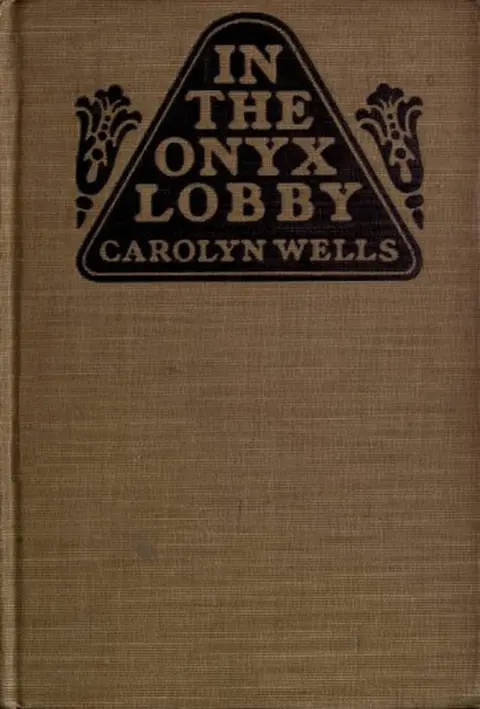
"In the Onyx Lobby" by Carolyn Wells is a novel written in the early 20th century. The narrative intertwines themes of love, ambition, and rivalry primarily surrounding two feuding women, Miss Letitia Prall and Mrs. Everett, who share a long-standing animosity. At the heart of this drama is Richard Bates, a young inventor caught between his ambitions and familial loyalty, as he navigates his feelings for Dorcas Everett amidst the backdrop of their mothers' feud. At the start of "In the Onyx Lobby," we are introduced to the fraught dynamics between Miss Prall and Mrs. Everett, residents of The Campanile, who have maintained their rivalry for several decades. Richard Bates, Miss Prall's nephew, is reluctant to take up his Uncle Binney's offer to join a bakery business, preferring to pursue his inventive ideas. However, when Bates and Dorcas Everett's romantic feelings emerge, the tension escalates as both young lovers grapple with their mothers' opposition and the pressures stemming from their families’ feud. This complex beginning sets the stage for a murder mystery that intertwines personal relationships with deeper themes of social class and gender roles, as well as the potential consequences of long-held grudges.
Introduction adapted from the source catalogue; source summaries may be automatically generated.
Free to read · English · 65,246 words · No account needed
MAKE TIME FOR A GOOD BOOK
On by default. Untick to stop anonymous reading totals. Each page counts after 10 seconds in view. How this works.
Anonymous counting is on unless you have switched it off.
“Only this, sir. To me, a good detective story is not the one that keeps you guessing,—nor the one that keeps you in fearful suspense as to the outcome, but the one that gives you a chance to solve the riddle yourself. The one that puts all the cards on the table, and gives you a chance at it.”
“And you can usually work it out?”
“Sometimes,—not always. But the fun is in trying.”
“You ought to have been a detective, Moore. You’ve the taste for it evidently. Well, good-night; hope you discover the clue and solve the mystery. Shall you finish your book to-night?”
“Oh, yes, sir. I’m more than half way through it.”
“Well, tell me in the morning if you guessed right. Good-night, Moore.”
“Good-night, Mr Vail.”
The elevator went down, and Bob Moore left the car to return to his
book.
But he did not return to the story. A more engrossing one was opened to him at that moment. A glance toward the front doorway showed him a figure of a man, lying in a contorted heap on the floor, about half way between himself and the entrance.
He went wonderingly toward it, his heart beating faster as he drew near.
“Dead!” he breathed softly, to himself, “no, not dead!—oh, my God, it’s Sir Herbert Binney!”
In the onyx lobby, at the very foot of one of the tall ornate capitaled columns was the prostrate Binney. Apparently he was a dying man; blood was flowing from some wound, his face was drawn in convulsive agony, from his stiffening fingers he let fall a pencil, but his lips were framing inarticulate words.
Bob Moore’s wits did not desert him. Instead, his thoughts seemed to flash with uncanny quickness.
“Binney’s dying,” he told himself, “he’s been murdered! Gee! what an excitement there will be! He’s babbling,—he’s going to tell who killed him! If I scoot for Doctor Pagett, this chap’ll be dead before I get back,—if I wait,—I’ll be called down for not going—but I must get it out of him,—if I can—what is that, Sir, try to tell me——”
Bending over the stricken man, Moore listened intently, and caught the words,—or words which sounded like,—“Get—them—get J—J—anyway,—get—J——”
With a sudden gasping gurgle, the man was dead.
Bewildered, but striving hard to grasp the situation and do his exact duty, Moore looked about, and quickly concluded his next move was to call the doctor.
Your reading position is saved on this browser. Take it to another device with a library code. Reading pages adapt to text, rather than matching a printed edition.
Carolyn Wells

Carolyn Wells & Harry Persons Taber

Carolyn Wells

Carolyn Wells
BEHIND THE BOOK
This eBook is for the use of anyone anywhere in the United States and most other parts of the world at no cost and with almost no restrictions whatsoever. You may copy it, give it away or re-use it under the terms of the Project Gutenberg License included with this eBook or online at www.gutenberg.org. If you are not located in the United States, you will have to check the laws of the country where you are located before using this eBook. Read the source licence.
The original source file, including credits and licence, is retained by this library. Request an original-format copy at no charge. Please include the book title and Project Gutenberg identifier #35254.
KEEP YOUR CURIOSITY GOING
Coulson Kernahan

Maurice Baring
Frances Wright
Cécile Tormay

Frederic Jesup Stimson

W. H. P. (William Henry Pope) Jarvis