
The story of Betty
Carolyn Wells
THE CLASSIC COLLECTION · 1920
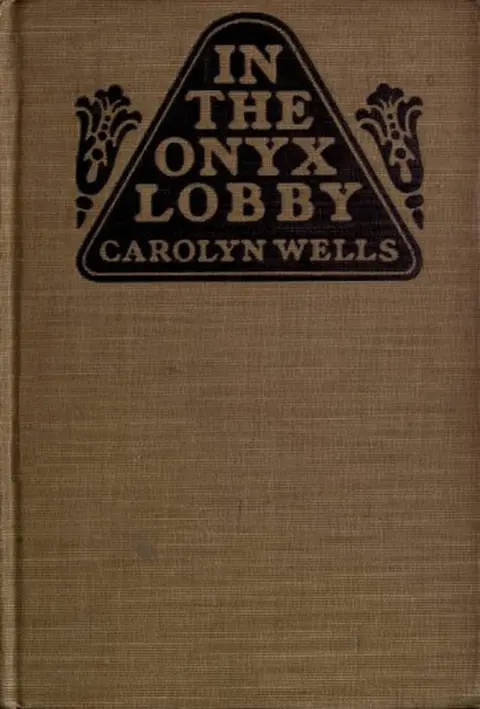
"In the Onyx Lobby" by Carolyn Wells is a novel written in the early 20th century. The narrative intertwines themes of love, ambition, and rivalry primarily surrounding two feuding women, Miss Letitia Prall and Mrs. Everett, who share a long-standing animosity. At the heart of this drama is Richard Bates, a young inventor caught between his ambitions and familial loyalty, as he navigates his feelings for Dorcas Everett amidst the backdrop of their mothers' feud. At the start of "In the Onyx Lobby," we are introduced to the fraught dynamics between Miss Prall and Mrs. Everett, residents of The Campanile, who have maintained their rivalry for several decades. Richard Bates, Miss Prall's nephew, is reluctant to take up his Uncle Binney's offer to join a bakery business, preferring to pursue his inventive ideas. However, when Bates and Dorcas Everett's romantic feelings emerge, the tension escalates as both young lovers grapple with their mothers' opposition and the pressures stemming from their families’ feud. This complex beginning sets the stage for a murder mystery that intertwines personal relationships with deeper themes of social class and gender roles, as well as the potential consequences of long-held grudges.
Introduction adapted from the source catalogue; source summaries may be automatically generated.
Free to read · English · 65,246 words · No account needed
MAKE TIME FOR A GOOD BOOK
On by default. Untick to stop anonymous reading totals. Each page counts after 10 seconds in view. How this works.
Anonymous counting is on unless you have switched it off.
But even the astonishing disclosure of the scrawled statement did not cause Bob Moore to lose his head. Excited and startled though he was, he was also alertly conscious that he must conduct himself with care. He had a vague fear that he might be connected with the case and weirdly enough he had a secret fear that he might not!
Already in fancy he saw himself doing marvelously clever detective work that should result in getting the criminal of whom the dying efforts of the victim strove to tell him. But he must be careful not to put himself forward, not to overstep his privileges, and, above all, not to seem too eager to help in the search for the murderer, for he felt sure his offers of assistance would be deemed presumptuous.
Doctor Pagett came running down the stairs, knotting his necktie as he
descended.
“Binney!” he exclaimed; “the Englishman who makes Buns. What’s this
paper?”
“I haven’t touched it, Doctor; I haven’t touched anything. You can see for yourself what the paper says.”
“Women did this,” said the doctor, his eyes fairly bulging; “what—what does it mean? Where were you?”
“Up at the tenth floor, taking Mr Vail up. He came in,—there was no Binney about then!—and I took him up in the elevator to his floor, and when I came down, Mr Binney was there just as you see him now,—only, he was still alive.”
“Alive!”
“Yes, sir,—just dying. He mumbled a word or two——”
“What did he say?”
“He said—‘Get—get——’ but he couldn’t say who. That’s all,—then he drew a long breath and died.”
“You came straight to me?”
“Yes, sir. I flew! I thought it my duty to hesitate that moment, in case he might get out the name of the murderer.”
“I think you did all right, Moore. He’s surely dead,—and, just as surely, he was murdered. And by women! But how is it possible? However, that’s not my province. We must get the police, and also, notify his people. He lived in the Prall apartment, didn’t he?”
“No; he was there a lot; they’re his relatives, I believe, but he had his own apartment, a small one on the eighth floor. Miss Prall, she’s on the eighth, too, shall I call her up?”
“Oh, that’s pretty awful. Call the nephew, young Bates, first.”
“Shall I telephone or go up there——?”
“Go up—no, telephone,—somebody might come in, and want you.”
“Hello,” Richard Bates responded to Moore’s telephone call.
“Mr Bates?”
“Yes.”
Your reading position is saved on this browser. Take it to another device with a library code. Reading pages adapt to text, rather than matching a printed edition.
Carolyn Wells

Carolyn Wells & Harry Persons Taber

Carolyn Wells

Carolyn Wells
BEHIND THE BOOK
This eBook is for the use of anyone anywhere in the United States and most other parts of the world at no cost and with almost no restrictions whatsoever. You may copy it, give it away or re-use it under the terms of the Project Gutenberg License included with this eBook or online at www.gutenberg.org. If you are not located in the United States, you will have to check the laws of the country where you are located before using this eBook. Read the source licence.
The original source file, including credits and licence, is retained by this library. Request an original-format copy at no charge. Please include the book title and Project Gutenberg identifier #35254.
KEEP YOUR CURIOSITY GOING
Coulson Kernahan

Maurice Baring
Frances Wright
Cécile Tormay

Frederic Jesup Stimson

W. H. P. (William Henry Pope) Jarvis