
The Writing of News A Handbook with Chapters on Newspaper Correspondence and Copy Reading
Charles G. (Charles Griffith) Ross
THE CLASSIC COLLECTION · 1919
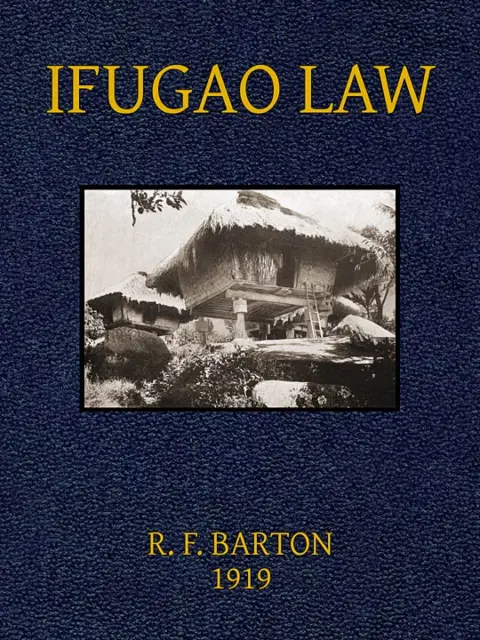
"Ifugao Law" by R. F. Barton is an ethnographic account written in the early 20th century. This publication delves into the legal system and customs of the Ifugao people, a group known for their intricate rice terraces in the Philippines. It examines the roots of Ifugao law, including its connection to customs and taboos, and explores topics ranging from family law and property rights to criminal law and social responsibilities. The opening of the work introduces the Ifugao culture, emphasizing its lack of formal political governance yet robust systems of customary law derived from taboos and social norms. It posits that, despite being labeled as "barbaric" by outsiders, the Ifugao people maintain relative peace and cohesion through their customary laws, which are crucial to their social fabric. Barton sets the stage for a thorough examination of the unique aspects of Ifugao law, including marriage contracts, property inheritance, and clan responsibilities, while situating these practices within a broader anthropological discourse on primitive societies.
Introduction adapted from the source catalogue; source summaries may be automatically generated.
Free to read · English · 54,145 words · No account needed
MAKE TIME FOR A GOOD BOOK
On by default. Untick to stop anonymous reading totals. Each page counts after 10 seconds in view. How this works.
Anonymous counting is on unless you have switched it off.
kalakal, an edible water beetle found in the rice fields.
kalun, advice.
kindut, carried under the arm.
kinta, surplus; portion of food left after appetite has been satisfied.
kolating, harvest feast.
kulpe, feast at time rice fields are planted.
kumadangyang, to become wealthy.
labod, blood payment; indemnity for homicide or severe wounds.
lanad, commission of go-between. Also called liwa.
linutu, cooked.
liwa, fee of go-between. See lanad.
lukbu, commission; fee paid an agent.
luktap, unaggravated adultery; adultery unaccompanied by great scandal and by insults to offended spouse.
lupe, interest; increase.
maginlotan, death blanket, usually imported. Of less value than
the dili.
ma-ibuy, property for whose transfer the ibuy ceremony is necessary.
mangdad, pig or chicken, given by kindred of bride to kindred of groom as a return for pig given the former by the latter in the hango and hingot ceremonies.
manikam, priest who performs certain ceremonies preliminary to the
uyauwe feast (see tikman).
mata-na, his eyes.
mommon, preliminary marriage ceremony.
monbaga, asker, requester.
monbiyao, an alliance between families of different districts. Celebrated by very pretentious ceremonies.
mongatang, seller.
monkalun, advocate, adviser. Specifically, in law, the go-between in
a penal or civil case.
montudol, a "shower"; specifically, a traitor to his village;
a betrayer.
nabungol, jeweled.
nadulpig, in addition to; accompanying.
na-imbalbalayen (lit., "made one's child"), adopted child.
na-oha, single; one only; one alone.
na-onom, six at a time; a unit consisting of six subunits, or parts.
natauwinan, four at a time.
nate, dead.
natuku, consisting of three subunits, or parts.
nawatwat, poverty-stricken; term applied to the lowest class of
Ifugao society.
nemnem, mind, feeling, thought, emotion, worry, intention. The term is of very broad meaning and applies to the mind or any act thereof.
nikkop (lit., "taken to one's self"), adopted child, or a servant that is treated as one of the family.
nunbadi, a pair; consisting of two subunits or parts; two together.
nundopa, the "jumping down from."
nungolat (lit., "he who was strong"), the conceiver, or originator, of a plot; he who assembles others to himself, and leads them in committing an injury or offense.
nunlidludagan, place where it was laid, or had fallen.
nunókop, a payment of two units of a series by means of a single article. The Ifugao prefers to divide all sales into ten subpayments. If the sale be comparatively small, two subpayments may be paid by one article, as by a death blanket.
oban, a blanket, about eight feet long and two feet wide, with which a baby is carried on the back of an elder. It is of great religious and poetic significance.
ohok, sticks or trellis for climbing vines.
om, yes; affirmative.
ongot, menace; threat.
Your reading position is saved on this browser. Take it to another device with a library code. Reading pages adapt to text, rather than matching a printed edition.
BEHIND THE BOOK
This eBook is for the use of anyone anywhere in the United States and most other parts of the world at no cost and with almost no restrictions whatsoever. You may copy it, give it away or re-use it under the terms of the Project Gutenberg License included with this eBook or online at www.gutenberg.org. If you are not located in the United States, you will have to check the laws of the country where you are located before using this eBook. Read the source licence.
The original source file, including credits and licence, is retained by this library. Request an original-format copy at no charge. Please include the book title and Project Gutenberg identifier #40807.
KEEP YOUR CURIOSITY GOING
Charles G. (Charles Griffith) Ross
Hannah Webster Foster

Emily Lawless
Edwin Hamlin Carr

Charles De Lano Hine
Andrew Ure