
The Writing of News A Handbook with Chapters on Newspaper Correspondence and Copy Reading
Charles G. (Charles Griffith) Ross
THE CLASSIC COLLECTION · 1919
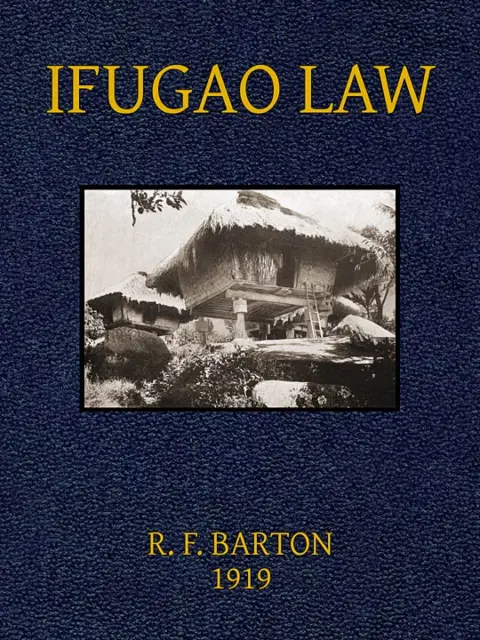
"Ifugao Law" by R. F. Barton is an ethnographic account written in the early 20th century. This publication delves into the legal system and customs of the Ifugao people, a group known for their intricate rice terraces in the Philippines. It examines the roots of Ifugao law, including its connection to customs and taboos, and explores topics ranging from family law and property rights to criminal law and social responsibilities. The opening of the work introduces the Ifugao culture, emphasizing its lack of formal political governance yet robust systems of customary law derived from taboos and social norms. It posits that, despite being labeled as "barbaric" by outsiders, the Ifugao people maintain relative peace and cohesion through their customary laws, which are crucial to their social fabric. Barton sets the stage for a thorough examination of the unique aspects of Ifugao law, including marriage contracts, property inheritance, and clan responsibilities, while situating these practices within a broader anthropological discourse on primitive societies.
Introduction adapted from the source catalogue; source summaries may be automatically generated.
Free to read · English · 54,145 words · No account needed
MAKE TIME FOR A GOOD BOOK
On by default. Untick to stop anonymous reading totals. Each page counts after 10 seconds in view. How this works.
Anonymous counting is on unless you have switched it off.
otak, a large knife, universally carried by the Ifugaos. It is used in war or in work; commonly called throughout the Philippines "bolo" in both English and Spanish.
paduldul, comfort; causing consolation.
paghok, landmark; usually chunks of wood or stone buried at a
boundary line.
pakimáan, "causing to chew betels together."
pango, jewels, usually agate beads.
paniyu, taboo.
panuyu, mutual accusation, false accusation.
paowa, prohibition, truce.
patang, interest paid in advance on something borrowed.
piduan, repetition.
pinokla, a ceremony to cure wounds.
pinohat, carried under the arm.
ponga, ceremony to remove the prohibition on marriage of cousins. Full
cousins may not marry.
pugug, finish; termination.
puhu-na, his heart.
putu-na, his belly.
pu-u, base.
*runo, a tall reed that covers the mountain sides. House walls, mats, floors, and fences are made of it. It also makes an effective missile.
tandong, one of the principal payments made on family property. It corresponds to the initial payment made when an article is bought on installments among our people.
tanig, term applied to the principal marriage ceremony in the Benaue district. Corresponds to bubun in the Kiangan district.
tayap, wing.
te, because.
tikman, ceremony of tying up the bellies, appetites, passions, and desires of the guests at a feast.
tobong, spit on which edible water beetles are grilled.
tokop, the placing beside an article its equivalent.
tokom, fine assessed for putting another in the position of being
an accomplice.
tombok, gossip.
tomok, fine for manslaughter, wounds.
tudong, woman's sweet-potato basket. It is used as a raincoat when
at work in the fields.
tulang, brother (see Appendix 1).
tuldag, series of ceremonies at the time rice is put in the granaries.
tulud, a ceremony of witchcraft, in which, following the recitation of a myth for magic purposes, the characters of the myth recited are made to perform, or declare their will to perform, the desire of the priest.
tumuk, persons of the middle class. Persons are accounted of this class who have rice sufficient for the use of their family throughout the year, and those who, having surplus rice, have not been initiated into the ranks of the kadangyang by means of the uyauwe feast.
tungul, ceremony at the time of placing rice in granaries. One of the three greater ceremonials of rice culture.
ubunana, his seat.
ugâ, treachery.
ulitao, uncle (see Appendix 1).
ulitaon, spouse of uncle or aunt (see Appendix 1).
ulpitan, the placing on each side of an article its equivalent.
umuhun, burning off the grass preparatory to spading fields.
Your reading position is saved on this browser. Take it to another device with a library code. Reading pages adapt to text, rather than matching a printed edition.
BEHIND THE BOOK
This eBook is for the use of anyone anywhere in the United States and most other parts of the world at no cost and with almost no restrictions whatsoever. You may copy it, give it away or re-use it under the terms of the Project Gutenberg License included with this eBook or online at www.gutenberg.org. If you are not located in the United States, you will have to check the laws of the country where you are located before using this eBook. Read the source licence.
The original source file, including credits and licence, is retained by this library. Request an original-format copy at no charge. Please include the book title and Project Gutenberg identifier #40807.
KEEP YOUR CURIOSITY GOING
Charles G. (Charles Griffith) Ross
Hannah Webster Foster

Emily Lawless
Edwin Hamlin Carr

Charles De Lano Hine
Andrew Ure