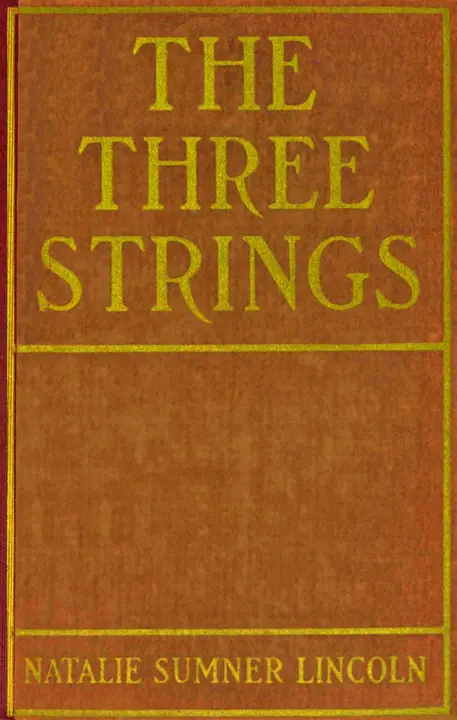
The three strings
Natalie Sumner Lincoln
THE CLASSIC COLLECTION · 1916
"I Spy" by Natalie Sumner Lincoln is a novel written during the early 20th century, around the time of World War I. The story unfolds against the backdrop of war, espionage, and the emotional struggles of its characters, particularly highlighting familial and romantic tensions amidst the chaos of the time. The narrative introduces John Hargraves, a young officer about to leave for the front, and explores his relationships with his uncle, Sir Percival Hargraves, and the women in his life, including Kathleen, an American girl who plays a significant role in his emotional journey. The opening of "I Spy" establishes a tense atmosphere, set in November 1914, where John and his uncle discuss the war and the undercurrents of espionage affecting England. Their conversation reveals deep concerns over the German Secret Service's influence within England, illustrating the pervasive anxiety of the time. Shortly after, John departs for Victoria Station, where he encounters a mysterious man associated with the German spy network. The chapter skillfully sets the stage for the unfolding drama, hinting at elements of intrigue, danger, and romance while introducing key characters whose lives are intricately connected to the war. As the story progresses, it promises to delve into themes of loyalty, love, and the impact of war on personal lives.
Introduction adapted from the source catalogue; source summaries may be automatically generated.
Free to read · English · 61,719 words · No account needed
MAKE TIME FOR A GOOD BOOK
On by default. Untick to stop anonymous reading totals. Each page counts after 10 seconds in view. How this works.
Anonymous counting is on unless you have switched it off.
"Yes, sir. They were what any gentleman would wear in the evening. In his pockets I found a wallet containing twenty dollars in bills, three dollars in loose change, and his keys. Here they are, sir," and Mitchell, as he mentioned each ticketed article, laid them on the table before the coroner, who examined them carefully.
"Was there anything about the room which especially claimed your attention?" Mitchell paused and glanced thoughtfully at his polished shoes. "Let me alter that question," said the coroner hastily. "Did you find any indication in the room that Mr. Spencer expected to return to it?"
"His clothes were there, and the electric light by the bureau was burning, notwithstanding the fact that it was nearly nine o'clock in the morning."
The coroner consulted his papers, "That is all just now," and Mitchell departed. "Ask Mr. Whitney to step here," directed Penfield, a second afterward.
"Beg pardon, sir," and the morgue master stepped before the platform. "Mr. Whitney went back to his residence to escort his daughter here. Mrs. Whitney, however, is waiting in the next room."
"Very well, bring Mrs. Whitney here," and the coroner left his seat to assist her to the platform. Mrs. Whitney's customary self-control and air of good breeding had not deserted her, and whatever her inward tribulation at appearing before a coroner's jury, it was successfully concealed as she repeated the oath after the morgue master.
"Your full name?" questioned Coroner Penfield.
"Minna Caswell Whitney, daughter of the late Judge William Caswell, of
New York."
"You were married to Winslow Whitney in--"
"And you have resided in Washington since then?"
"Yes, except in the summer months when we went to our home in Massachusetts or, occasionally, abroad."
"Will you kindly state what took place at your house on Tuesday evening,
Mrs. Whitney?"
"I entertained the Sisters in Unity, and afterward went to bed." The concise reply wrung a smile from Foster.
"At what hour did the members of your club depart?"
"A little before one o'clock, Wednesday morning."
"Then did you go direct to bed?"
"No, I first showed Miss Kiametia Grey who, owing to an attack of
faintness, was spending the night at my home, to her room; then I
retired."
"Were you aware that Mr. Spencer was also spending the night under
your roof?"
"Not until Miss Grey informed me of the fact; I had inadvertently placed her in the same room with Mr. Spencer. I immediately took her to another room."
"Was Mr. Spencer's bedroom in darkness when you ushered Miss Grey into
it?"
"It was."
"Did not your husband tell you of Mr. Spencer's presence?"
Your reading position is saved on this browser. Take it to another device with a library code. Reading pages adapt to text, rather than matching a printed edition.
Natalie Sumner Lincoln
Natalie Sumner Lincoln
Natalie Sumner Lincoln
Natalie Sumner Lincoln
BEHIND THE BOOK
This eBook is for the use of anyone anywhere in the United States and most other parts of the world at no cost and with almost no restrictions whatsoever. You may copy it, give it away or re-use it under the terms of the Project Gutenberg License included with this eBook or online at www.gutenberg.org. If you are not located in the United States, you will have to check the laws of the country where you are located before using this eBook. Read the source licence.
The original source file, including credits and licence, is retained by this library. Request an original-format copy at no charge. Please include the book title and Project Gutenberg identifier #9812.
KEEP YOUR CURIOSITY GOING
Coulson Kernahan

Maurice Baring
Frances Wright
Cécile Tormay

Frederic Jesup Stimson

W. H. P. (William Henry Pope) Jarvis