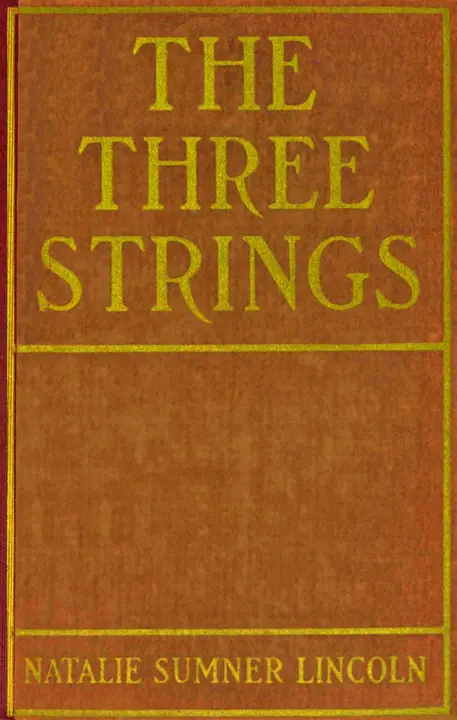
The three strings
Natalie Sumner Lincoln
THE CLASSIC COLLECTION · 1916
"I Spy" by Natalie Sumner Lincoln is a novel written during the early 20th century, around the time of World War I. The story unfolds against the backdrop of war, espionage, and the emotional struggles of its characters, particularly highlighting familial and romantic tensions amidst the chaos of the time. The narrative introduces John Hargraves, a young officer about to leave for the front, and explores his relationships with his uncle, Sir Percival Hargraves, and the women in his life, including Kathleen, an American girl who plays a significant role in his emotional journey. The opening of "I Spy" establishes a tense atmosphere, set in November 1914, where John and his uncle discuss the war and the undercurrents of espionage affecting England. Their conversation reveals deep concerns over the German Secret Service's influence within England, illustrating the pervasive anxiety of the time. Shortly after, John departs for Victoria Station, where he encounters a mysterious man associated with the German spy network. The chapter skillfully sets the stage for the unfolding drama, hinting at elements of intrigue, danger, and romance while introducing key characters whose lives are intricately connected to the war. As the story progresses, it promises to delve into themes of loyalty, love, and the impact of war on personal lives.
Introduction adapted from the source catalogue; source summaries may be automatically generated.
Free to read · English · 61,719 words · No account needed
MAKE TIME FOR A GOOD BOOK
On by default. Untick to stop anonymous reading totals. Each page counts after 10 seconds in view. How this works.
Anonymous counting is on unless you have switched it off.
"You were but echoing what I hear on all sides," answered Miller
bitterly.
"True," Foster nodded. "Kathleen's extraordinary silence, when by a few words she could explain what happened yesterday morning before her screams aroused the household, is causing unfavorable comment and unfortunate conjecture."
"The mystery will be explained this afternoon," and quiet confidence rang in Miller's pleasantly modulated tones. "Hello, I see some members of the Diplomatic Corps are present."
"And the so-called 'four hundred,'" growled Foster. The close atmosphere had started him coughing, and he scowled at Baron Frederic von Fincke who was seated near by. "Where is the jury?" he asked, as soon as the paroxysm of coughing was over.
"Viewing the body in that room." Miller indicated a closed door to his right. "The jury is sworn in there by the morgue master."
As he spoke the door opened and the six men, led by the morgue master, filed into the room and took their places, and the low hum of conversation died away as the coroner, stepping to the platform, stated briefly the reason for the inquest, and summoned Dr. Hall, of the Emergency Hospital, to the witness chair. He was quickly sworn by the morgue master, and in response to the coroner's question, stated that he had reached the Whitney residence shortly after eight o'clock Wednesday morning in answer to a telephone call.
"Tell the jury what you found on your arrival," directed the coroner.
"I was shown upstairs by the butler, whose incoherent remarks led me to suppose that someone was ill in the elevator. On entering it I found Mr. Spencer, whom I knew slightly, lying there dead."
"Did you make a thorough examination?"
"Only enough to prove that life was extinct. The butler informed me that my services were needed by Miss Whitney, and I went at once to her."
"In what condition did you find her?"
"Hysterical. To quiet her, I finally administered an opiate, and sent for
a trained nurse."
"Did you consider her case dangerous?"
"No, but she was completely unstrung; her nervous system had undergone a severe shock, and I feared for her mental condition if not given immediate relief and complete rest."
"Have you seen her today?"
"Yes, this morning."
"How was she?"
"Much improved."
"Did Miss Whitney speak to you of Mr. Spencer?"
"She did not."
"Did you question her on the subject of the mystery surrounding Mr.
Spencer's death?"
"I did not. In her condition I judged it a topic to be avoided. I also cautioned her parents not to discuss it with her unless she voluntarily alluded to it."
"How long had Spencer been dead, Doctor, when you saw him?"
Your reading position is saved on this browser. Take it to another device with a library code. Reading pages adapt to text, rather than matching a printed edition.
Natalie Sumner Lincoln
Natalie Sumner Lincoln
Natalie Sumner Lincoln
Natalie Sumner Lincoln
BEHIND THE BOOK
This eBook is for the use of anyone anywhere in the United States and most other parts of the world at no cost and with almost no restrictions whatsoever. You may copy it, give it away or re-use it under the terms of the Project Gutenberg License included with this eBook or online at www.gutenberg.org. If you are not located in the United States, you will have to check the laws of the country where you are located before using this eBook. Read the source licence.
The original source file, including credits and licence, is retained by this library. Request an original-format copy at no charge. Please include the book title and Project Gutenberg identifier #9812.
KEEP YOUR CURIOSITY GOING
Coulson Kernahan

Maurice Baring
Frances Wright
Cécile Tormay

Frederic Jesup Stimson

W. H. P. (William Henry Pope) Jarvis