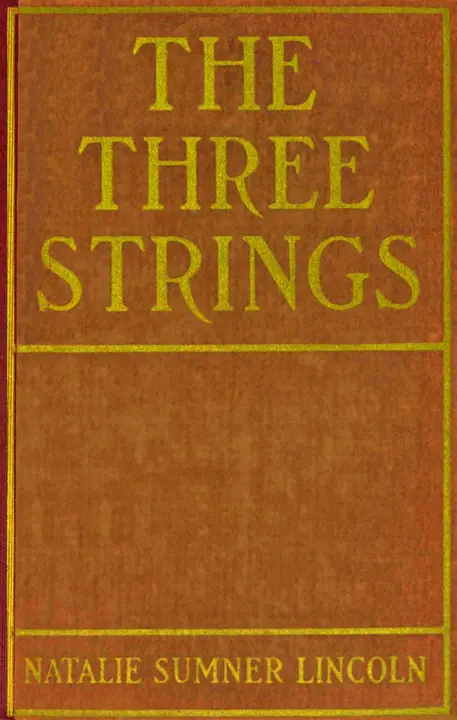
The three strings
Natalie Sumner Lincoln
THE CLASSIC COLLECTION · 1916
"I Spy" by Natalie Sumner Lincoln is a novel written during the early 20th century, around the time of World War I. The story unfolds against the backdrop of war, espionage, and the emotional struggles of its characters, particularly highlighting familial and romantic tensions amidst the chaos of the time. The narrative introduces John Hargraves, a young officer about to leave for the front, and explores his relationships with his uncle, Sir Percival Hargraves, and the women in his life, including Kathleen, an American girl who plays a significant role in his emotional journey. The opening of "I Spy" establishes a tense atmosphere, set in November 1914, where John and his uncle discuss the war and the undercurrents of espionage affecting England. Their conversation reveals deep concerns over the German Secret Service's influence within England, illustrating the pervasive anxiety of the time. Shortly after, John departs for Victoria Station, where he encounters a mysterious man associated with the German spy network. The chapter skillfully sets the stage for the unfolding drama, hinting at elements of intrigue, danger, and romance while introducing key characters whose lives are intricately connected to the war. As the story progresses, it promises to delve into themes of loyalty, love, and the impact of war on personal lives.
Introduction adapted from the source catalogue; source summaries may be automatically generated.
Free to read · English · 61,719 words · No account needed
MAKE TIME FOR A GOOD BOOK
On by default. Untick to stop anonymous reading totals. Each page counts after 10 seconds in view. How this works.
Anonymous counting is on unless you have switched it off.
"There is no such thing, Heinrich." Miller's voice deepened. "The hyphen cannot be recognized. You are either American or German."
The chauffeur straightened himself, and his heels clicked together as he raised his hand in salute.
"Hoch der Kaiser!"
The words were echoed by Miller as he sprang forward and grasped the chauffeur's hand. "For the Fatherland!" he added in German. "Why have you not declared yourself before?"
"Until last night, Herr Captain, I was not absolutely sure you were one of us. But later in the evening Baron von Fincke...."
"Stood sponsor for me," finished Miller, thrusting his hand in his pajama pocket, and thereby pushing an envelope still deeper in it. "What have you to report? Wait, speak English; the walls have ears."
The chauffeur whitened and moved closer to Miller. "Was Mr. Spencer in
your confidence?"
"No."
"And the Baron did not trust him," said Heinrich, reflectively. "If he was not one of us, how came he to be killed?"
"God knows." Miller threw out his hands in a hopeless gesture. "I don't."
"But there must be some motive for the crime," argued the chauffeur. "Miss Kathleen must have suspected something before taking ..." Powerful hands on his throat choked his utterance.
"Never mention Miss Kathleen's name in that connection again," commanded Miller, his voice low and stern. "You hear me, you dog!" and he shook Heinrich until his teeth rattled, then released him.
"Pardon," gasped the badly frightened man. "I meant no offense."
"See that you follow my instructions hereafter."
"Yes, sir"--Heinrich caressed his throat tenderly, and looked at Miller with a new respect. "I was only going to mention, sir, that Mr. Spencer meddled in what did not concern him. I believe he suspected what I have come to believe."
"And what is that?"
"That this photography business is only a blind."
"A blind?" Miller looked thoughtfully at his companion. "Suppose you pull up a chair; wait, first hang your cap over the keyhole of the hall door." While waiting for Heinrich to follow his instructions Miller seated himself. "A blind?" he repeated. "No, no, Heinrich, you are mistaken; Mr. Whitney has invented a very perfect aeroplane camera, of that I am thoroughly convinced. And our country needs it...."
"Undoubtedly, sir," Heinrich almost stuttered in his growing excitement. "But he has invented something that we need more...."
"What is that?"
"I don't know, sir."
Miller, who had been leaning forward in his eagerness, drew back. "Don't waste my time, Heinrich," he said roughly.
"Your time won't be wasted," protested the German. "Have patience and let me explain. I cannot manage this affair alone, I need assistance--and --you are a frequent caller at the Whitney house...."
Your reading position is saved on this browser. Take it to another device with a library code. Reading pages adapt to text, rather than matching a printed edition.
Natalie Sumner Lincoln
Natalie Sumner Lincoln
Natalie Sumner Lincoln
Natalie Sumner Lincoln
BEHIND THE BOOK
This eBook is for the use of anyone anywhere in the United States and most other parts of the world at no cost and with almost no restrictions whatsoever. You may copy it, give it away or re-use it under the terms of the Project Gutenberg License included with this eBook or online at www.gutenberg.org. If you are not located in the United States, you will have to check the laws of the country where you are located before using this eBook. Read the source licence.
The original source file, including credits and licence, is retained by this library. Request an original-format copy at no charge. Please include the book title and Project Gutenberg identifier #9812.
KEEP YOUR CURIOSITY GOING
Coulson Kernahan

Maurice Baring
Frances Wright
Cécile Tormay

Frederic Jesup Stimson

W. H. P. (William Henry Pope) Jarvis