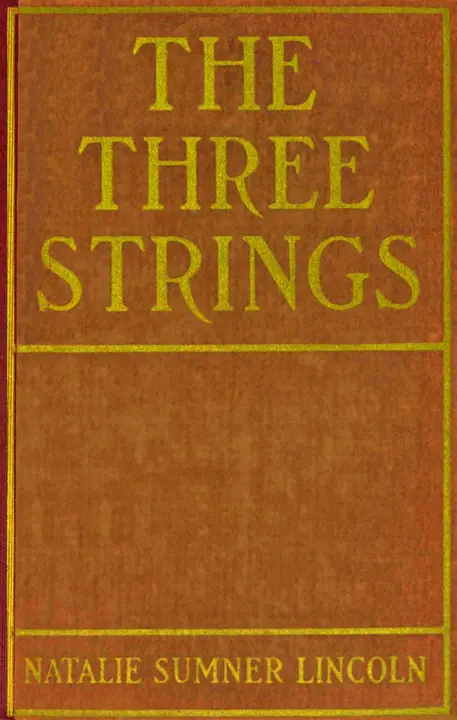
The three strings
Natalie Sumner Lincoln
THE CLASSIC COLLECTION · 1916
"I Spy" by Natalie Sumner Lincoln is a novel written during the early 20th century, around the time of World War I. The story unfolds against the backdrop of war, espionage, and the emotional struggles of its characters, particularly highlighting familial and romantic tensions amidst the chaos of the time. The narrative introduces John Hargraves, a young officer about to leave for the front, and explores his relationships with his uncle, Sir Percival Hargraves, and the women in his life, including Kathleen, an American girl who plays a significant role in his emotional journey. The opening of "I Spy" establishes a tense atmosphere, set in November 1914, where John and his uncle discuss the war and the undercurrents of espionage affecting England. Their conversation reveals deep concerns over the German Secret Service's influence within England, illustrating the pervasive anxiety of the time. Shortly after, John departs for Victoria Station, where he encounters a mysterious man associated with the German spy network. The chapter skillfully sets the stage for the unfolding drama, hinting at elements of intrigue, danger, and romance while introducing key characters whose lives are intricately connected to the war. As the story progresses, it promises to delve into themes of loyalty, love, and the impact of war on personal lives.
Introduction adapted from the source catalogue; source summaries may be automatically generated.
Free to read · English · 61,719 words · No account needed
MAKE TIME FOR A GOOD BOOK
On by default. Untick to stop anonymous reading totals. Each page counts after 10 seconds in view. How this works.
Anonymous counting is on unless you have switched it off.
"I'm glad to discover a man keeping later hours than I," he remarked, accepting the chair Foster pulled forward. "You must have an easy conscience to sleep so late in the morning."
"Or enjoyed the devil of a night--er--mare." The Senator's face was flushed and his strong voice husky. "You mistake; this is luncheon, not breakfast, Keep me company? No?" Foster pecked viciously at his lamb chop. "I've no appetite at all. Caught a beastly cold at the Sisters in Unity meeting last night. Cough all the time--beastly climate, Washington."
"Why stay here?"
"Oh, Congress...."
"But that adjourned three weeks ago."
Foster frowned, then smiled. "A woman's whim--we are not always independent, Miller"--a shrug completed the sentence. "Change your mind and have some Scotch?"
"No, thanks." Miller drew his chair closer to his companion, and lowered his voice. "I called this morning, Senator, to ask some questions about Winslow Whitney."
Foster's smile vanished, and the glance he shot at Miller was sharp.
"It depends on the questions," he began stiffly, "whether they are
answered or not."
"Quite right," with unruffled composure. "I shall ask nothing which cannot be answered with propriety." Miller ceased speaking to light a cigarette. "All Washington knows Whitney is a man of wealth"--his keen eyes detected the sudden alteration in Foster's expression--"of standing in the social and business world, but has he achieved success as an inventor?"
"Yes," was the instant and unqualified response, and Miller's eyes lighted, but it was some seconds before he put another question.
"Are you familiar with his latest invention?"
"You mean his camera for use in aeroplanes?"
"Yes. Do you think it has any hope of success?"
"I believe so; Whitney declares the experiments are entirely
satisfactory."
"Have you seen results of the tests?"
"Whitney showed me views of New York City and its environs taken from an aeroplane. They were--wonderful--" the Senator puffed nervously at his cigar--"perfect maps."
"Indeed?" Miller made no effort to conceal his eager curiosity. "At what height were they taken?"
"Ah, that I do not feel at liberty to disclose. How, when, and where this new camera can be utilized is of interest to all military men; but as Whitney's friend, I could not divulge details he may desire kept secret, even if I knew them."
"Pardon me, I thought you his most intimate friend...."
"I am, but not his confidant. And as his friend, I cannot discuss his
private affairs with you."
"I don't agree with you there." Miller tossed his cigarette stub into the iron grate. "Would it not be a friendly act to place Whitney in a position to coin money?"
Your reading position is saved on this browser. Take it to another device with a library code. Reading pages adapt to text, rather than matching a printed edition.
Natalie Sumner Lincoln
Natalie Sumner Lincoln
Natalie Sumner Lincoln
Natalie Sumner Lincoln
BEHIND THE BOOK
This eBook is for the use of anyone anywhere in the United States and most other parts of the world at no cost and with almost no restrictions whatsoever. You may copy it, give it away or re-use it under the terms of the Project Gutenberg License included with this eBook or online at www.gutenberg.org. If you are not located in the United States, you will have to check the laws of the country where you are located before using this eBook. Read the source licence.
The original source file, including credits and licence, is retained by this library. Request an original-format copy at no charge. Please include the book title and Project Gutenberg identifier #9812.
KEEP YOUR CURIOSITY GOING
Coulson Kernahan

Maurice Baring
Frances Wright
Cécile Tormay

Frederic Jesup Stimson

W. H. P. (William Henry Pope) Jarvis