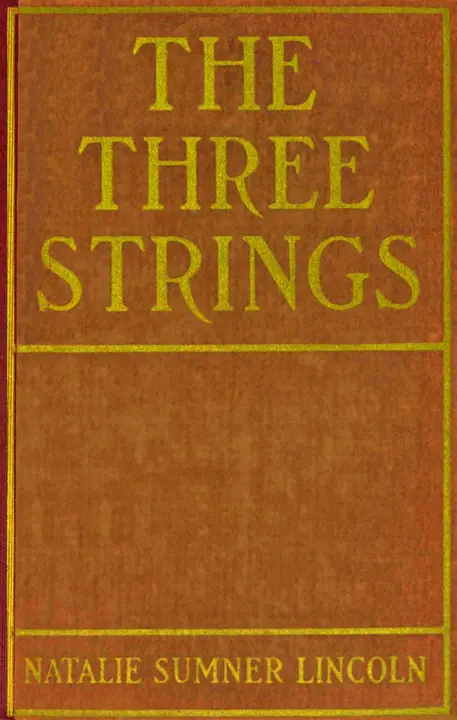
The three strings
Natalie Sumner Lincoln
THE CLASSIC COLLECTION · 1916
"I Spy" by Natalie Sumner Lincoln is a novel written during the early 20th century, around the time of World War I. The story unfolds against the backdrop of war, espionage, and the emotional struggles of its characters, particularly highlighting familial and romantic tensions amidst the chaos of the time. The narrative introduces John Hargraves, a young officer about to leave for the front, and explores his relationships with his uncle, Sir Percival Hargraves, and the women in his life, including Kathleen, an American girl who plays a significant role in his emotional journey. The opening of "I Spy" establishes a tense atmosphere, set in November 1914, where John and his uncle discuss the war and the undercurrents of espionage affecting England. Their conversation reveals deep concerns over the German Secret Service's influence within England, illustrating the pervasive anxiety of the time. Shortly after, John departs for Victoria Station, where he encounters a mysterious man associated with the German spy network. The chapter skillfully sets the stage for the unfolding drama, hinting at elements of intrigue, danger, and romance while introducing key characters whose lives are intricately connected to the war. As the story progresses, it promises to delve into themes of loyalty, love, and the impact of war on personal lives.
Introduction adapted from the source catalogue; source summaries may be automatically generated.
Free to read · English · 61,719 words · No account needed
MAKE TIME FOR A GOOD BOOK
On by default. Untick to stop anonymous reading totals. Each page counts after 10 seconds in view. How this works.
Anonymous counting is on unless you have switched it off.
Kathleen's back was to the entrance of the dining-room, but a sixth sense warned her who the newcomer was, and her face was expressionless when Foster introduced his friend, Captain Miller, to Mrs. Whitney and her husband. After greeting Miss Kiametia, Miller stepped to Kathleen's side.
"Good morning," he said quietly, and held out his hand. Kathleen drew back, then good breeding mastered her indignation. A second later her hand was laid in his and instantly withdrawn, but her fingers tingled from his strong clasp.
"Jolly party you must have had last night, Kiametia." Foster's cheery voice enabled Kathleen to control her somewhat shaken nerves. "Telephoned Sinclair Spencer to stop and see me this morning, but his servant said he never showed up until noon today."
"Kathleen pleaded guilty to a sleepless night," volunteered Mrs. Whitney, to the girl's secret indignation.
"It was the lobster," answered Miss Kiametia. "I tried to warn you not
to eat it, Kathleen."
"Well, your lobster won't account for the non-appearance of Henry," mourned Mrs. Whitney, her mind harking back to her own grievance. "How d'ye do, Mrs. Sunderland," as an elaborately gowned woman swept by their table, barely returning their greeting.
"It is the regret of my life," announced Miss Kiametia, her eyes twinkling, "that I never kept a photograph of Mrs. Sunderland taken when she first came to Washington ten years ago. It would provide a study in expression and expansion in social snobbery."
Mrs. Whitney, conscious that she was perhaps rude by her silence, turned to Captain Miller who had taken no part in the conversation.
"Is this your first visit to Washington, Captain?" she inquired.
"Yes, and I find its residents so delightful that I hope to
prolong my stay."
"What did you think of the speech today?" broke in Foster.
"Capital! The Senator is right; if this government ship purchase bill goes through, the country will indeed be buying a quarrel."
"Quite right," agreed Whitney, laying down his fork. "The only people who fail to see it in that light are those advocating the bill's passage. Every nation thinks the same."
"Except possibly Germany," argued Foster. "She would probably try and sell us the hundreds of interned ships in our seaports."
"Well, why shouldn't she?" Miss Kiametia, with recollections of her misgivings the night before, declined the lobster croquettes. "With the German steamships and freighters interned here we should have a merchant marine ready to our hand."
"And thereby provide instant use for our navy," retorted Whitney.
"Uncle Sam had better think twice before taking issue with the German submarines," grumbled Miss Kiametia.
Your reading position is saved on this browser. Take it to another device with a library code. Reading pages adapt to text, rather than matching a printed edition.
Natalie Sumner Lincoln
Natalie Sumner Lincoln
Natalie Sumner Lincoln
Natalie Sumner Lincoln
BEHIND THE BOOK
This eBook is for the use of anyone anywhere in the United States and most other parts of the world at no cost and with almost no restrictions whatsoever. You may copy it, give it away or re-use it under the terms of the Project Gutenberg License included with this eBook or online at www.gutenberg.org. If you are not located in the United States, you will have to check the laws of the country where you are located before using this eBook. Read the source licence.
The original source file, including credits and licence, is retained by this library. Request an original-format copy at no charge. Please include the book title and Project Gutenberg identifier #9812.
KEEP YOUR CURIOSITY GOING
Coulson Kernahan

Maurice Baring
Frances Wright
Cécile Tormay

Frederic Jesup Stimson

W. H. P. (William Henry Pope) Jarvis