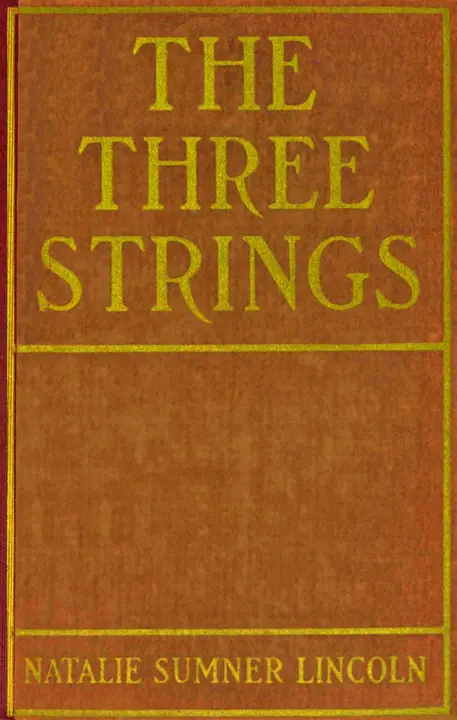
The three strings
Natalie Sumner Lincoln
THE CLASSIC COLLECTION · 1916
"I Spy" by Natalie Sumner Lincoln is a novel written during the early 20th century, around the time of World War I. The story unfolds against the backdrop of war, espionage, and the emotional struggles of its characters, particularly highlighting familial and romantic tensions amidst the chaos of the time. The narrative introduces John Hargraves, a young officer about to leave for the front, and explores his relationships with his uncle, Sir Percival Hargraves, and the women in his life, including Kathleen, an American girl who plays a significant role in his emotional journey. The opening of "I Spy" establishes a tense atmosphere, set in November 1914, where John and his uncle discuss the war and the undercurrents of espionage affecting England. Their conversation reveals deep concerns over the German Secret Service's influence within England, illustrating the pervasive anxiety of the time. Shortly after, John departs for Victoria Station, where he encounters a mysterious man associated with the German spy network. The chapter skillfully sets the stage for the unfolding drama, hinting at elements of intrigue, danger, and romance while introducing key characters whose lives are intricately connected to the war. As the story progresses, it promises to delve into themes of loyalty, love, and the impact of war on personal lives.
Introduction adapted from the source catalogue; source summaries may be automatically generated.
Free to read · English · 61,719 words · No account needed
MAKE TIME FOR A GOOD BOOK
On by default. Untick to stop anonymous reading totals. Each page counts after 10 seconds in view. How this works.
Anonymous counting is on unless you have switched it off.
"Hasn't your mother told you?" Mrs. Whitney shook her head, and answered
for Kathleen.
"Winslow said not to mention the matter to Kathleen yesterday, and today his illness put everything out of my mind," she explained.
Kathleen looked from one to the other. "What have I to do with his will?"
she repeated.
"Sinclair Spencer made you residuary legatee."
"What!" Kathleen sat up, for the moment bereft of further speech. "I shan't take any legacy left me by him," she announced, passionately. "Mother, you hear me, I won't."
"Yes, yes, dear," soothingly, and Senator Foster broke in hastily:
"We understand how you must feel."
"Feel!" echoed Kathleen. "Did you for one moment suppose I would accept a penny from Sinclair Spencer or his estate?" and the scorn in her eyes hurt Foster as she looked at him.
"The law requires certain formalities," he said hurriedly. "As executor, I shall have to talk over his will with you, but later will do."
"Both now and later, I flatly refuse to consider any such bequest he may have made me," went on Kathleen, unheeding his words as her excitement increased, and Miss Kiametia hastened to avert the threatened scene.
"Where were you yesterday afternoon, Randall?" she asked.
"In Baltimore." Foster flashed her a grateful glance. "I hope you made use of my car yesterday, Mrs. Whitney; I told Henry to take it out until yours was repaired."
"You were very kind; Winslow went out in it." Mrs. Whitney's glance strayed to the door; she was anxious to return to her husband's bedside.
"And with your permission, Randall, I'm going to use your car now to take me home," chipped in Miss Kiametia.
"Oh, Kiametia, you must not go," protested Mrs. Whitney. "You are such a comfort--such a help...."
"Don't go," added Kathleen. "Your presence makes my enforced idleness
here easier to bear."
"Thank you, my dears." The spinster looked immensely pleased. "Of course I'll stay, if you really feel you want me."
"I am the only one bereft," said Foster wistfully. "I cannot call upon
you tonight, Kiametia."
"Of course you can," exclaimed Mrs. Whitney, smiling faintly. "We are not so selfish as to keep Kiametia to ourselves all the time. If you will excuse me, I must go back to Winslow."
"Certainly." Foster rose and opened the door for her. "I must not stop longer. Good night, Miss Kathleen, I hope that you will feel better in the morning."
"Thanks; please come here just a moment," and reluctantly Foster approached the bed. He did not wish to resume discussion about Spencer's will. "Tell me," Kathleen lowered her voice, "when will the Grand Jury meet?"
"Not for ten days or more."
Your reading position is saved on this browser. Take it to another device with a library code. Reading pages adapt to text, rather than matching a printed edition.
Natalie Sumner Lincoln
Natalie Sumner Lincoln
Natalie Sumner Lincoln
Natalie Sumner Lincoln
BEHIND THE BOOK
This eBook is for the use of anyone anywhere in the United States and most other parts of the world at no cost and with almost no restrictions whatsoever. You may copy it, give it away or re-use it under the terms of the Project Gutenberg License included with this eBook or online at www.gutenberg.org. If you are not located in the United States, you will have to check the laws of the country where you are located before using this eBook. Read the source licence.
The original source file, including credits and licence, is retained by this library. Request an original-format copy at no charge. Please include the book title and Project Gutenberg identifier #9812.
KEEP YOUR CURIOSITY GOING
Coulson Kernahan

Maurice Baring
Frances Wright
Cécile Tormay

Frederic Jesup Stimson

W. H. P. (William Henry Pope) Jarvis