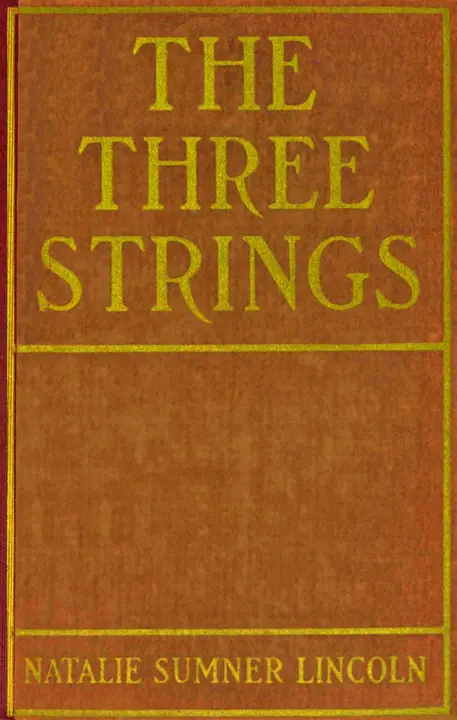
The three strings
Natalie Sumner Lincoln
THE CLASSIC COLLECTION · 1916
"I Spy" by Natalie Sumner Lincoln is a novel written during the early 20th century, around the time of World War I. The story unfolds against the backdrop of war, espionage, and the emotional struggles of its characters, particularly highlighting familial and romantic tensions amidst the chaos of the time. The narrative introduces John Hargraves, a young officer about to leave for the front, and explores his relationships with his uncle, Sir Percival Hargraves, and the women in his life, including Kathleen, an American girl who plays a significant role in his emotional journey. The opening of "I Spy" establishes a tense atmosphere, set in November 1914, where John and his uncle discuss the war and the undercurrents of espionage affecting England. Their conversation reveals deep concerns over the German Secret Service's influence within England, illustrating the pervasive anxiety of the time. Shortly after, John departs for Victoria Station, where he encounters a mysterious man associated with the German spy network. The chapter skillfully sets the stage for the unfolding drama, hinting at elements of intrigue, danger, and romance while introducing key characters whose lives are intricately connected to the war. As the story progresses, it promises to delve into themes of loyalty, love, and the impact of war on personal lives.
Introduction adapted from the source catalogue; source summaries may be automatically generated.
Free to read · English · 61,719 words · No account needed
MAKE TIME FOR A GOOD BOOK
On by default. Untick to stop anonymous reading totals. Each page counts after 10 seconds in view. How this works.
Anonymous counting is on unless you have switched it off.
"The very best," Kathleen smiled through her tears. "You must be worn out," and she stroked the hand on the bed with loving fingers. "You should take some rest."
"I am not tired," protested Mrs. Whitney. "The nurse has just come in from her afternoon constitutional, and I felt that I could leave Winslow for a little time. Tell me, dear," sinking her voice. "Can you let me have a hundred dollars?"
"I would gladly, mother, but I don't believe I have half that amount left. You are welcome to that, though; my purse is in my desk."
"Thank you, dear, I'll get it later," but the troubled shadow did not lift from Mrs. Whitney's pretty face. "Both Vincent and Henry have asked me for their wages; I have given Henry part ..."
"Give him the whole, only get rid of him," burst out Kathleen. "I cannot
bear the man."
"Why, Kathleen! Has he been disrespectful?"
"N-no, only--I don't trust him."
"Please, dear, don't excite yourself." Mrs. Whitney noticed with alarm the hectic flush that dyed Kathleen's white cheeks. "I will fill his place. Come to think of it, I did not like his manner this morning when he asked for his wages, and he went out without leave ..."
"He selected a curious time to make his request, with Dad so ill."
"Well, you see, my dear," coloring faintly. "I gathered your father has
not paid him recently."
"Don't believe that story until you have asked Dad." Kathleen choked back a sob, remembering that her father, her dear father, might never answer another question, no matter how trivial. "Don't look so worried, mother; Dad will get better shortly."
"I pray so." Mrs. Whitney's eyelashes were wet with tears. "Kathleen, did your father ever speak to you of a note for twenty thousand dollars?"
"No, never."
"It comes due next week." Mrs. Whitney looked hopelessly about the room.
"Surely the bank will hold over the matter until Dad is in a condition to attend to his affairs?"
"I sent word to that effect when answering the note teller's letter."
"Who is the holder of the note?"
"Sinclair Spencer." With ashy face Kathleen dropped back on her pillow as if shot. Failing to observe her expression in the semi-dark room, Mrs. Whitney continued wearily: "In your father's mail today I found a notice from his bank stating that he had overdrawn his account heavily. It just happens that my housekeeping allowance is almost exhausted, or I would never have mentioned the matter to you, Kathleen."
Your reading position is saved on this browser. Take it to another device with a library code. Reading pages adapt to text, rather than matching a printed edition.
Natalie Sumner Lincoln
Natalie Sumner Lincoln
Natalie Sumner Lincoln
Natalie Sumner Lincoln
BEHIND THE BOOK
This eBook is for the use of anyone anywhere in the United States and most other parts of the world at no cost and with almost no restrictions whatsoever. You may copy it, give it away or re-use it under the terms of the Project Gutenberg License included with this eBook or online at www.gutenberg.org. If you are not located in the United States, you will have to check the laws of the country where you are located before using this eBook. Read the source licence.
The original source file, including credits and licence, is retained by this library. Request an original-format copy at no charge. Please include the book title and Project Gutenberg identifier #9812.
KEEP YOUR CURIOSITY GOING
Coulson Kernahan

Maurice Baring
Frances Wright
Cécile Tormay

Frederic Jesup Stimson

W. H. P. (William Henry Pope) Jarvis