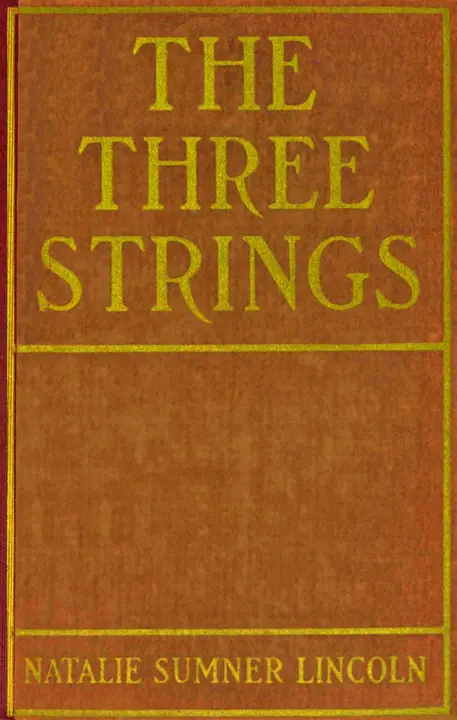
The three strings
Natalie Sumner Lincoln
THE CLASSIC COLLECTION · 1916
"I Spy" by Natalie Sumner Lincoln is a novel written during the early 20th century, around the time of World War I. The story unfolds against the backdrop of war, espionage, and the emotional struggles of its characters, particularly highlighting familial and romantic tensions amidst the chaos of the time. The narrative introduces John Hargraves, a young officer about to leave for the front, and explores his relationships with his uncle, Sir Percival Hargraves, and the women in his life, including Kathleen, an American girl who plays a significant role in his emotional journey. The opening of "I Spy" establishes a tense atmosphere, set in November 1914, where John and his uncle discuss the war and the undercurrents of espionage affecting England. Their conversation reveals deep concerns over the German Secret Service's influence within England, illustrating the pervasive anxiety of the time. Shortly after, John departs for Victoria Station, where he encounters a mysterious man associated with the German spy network. The chapter skillfully sets the stage for the unfolding drama, hinting at elements of intrigue, danger, and romance while introducing key characters whose lives are intricately connected to the war. As the story progresses, it promises to delve into themes of loyalty, love, and the impact of war on personal lives.
Introduction adapted from the source catalogue; source summaries may be automatically generated.
Free to read · English · 61,719 words · No account needed
MAKE TIME FOR A GOOD BOOK
On by default. Untick to stop anonymous reading totals. Each page counts after 10 seconds in view. How this works.
Anonymous counting is on unless you have switched it off.
Mitchell looked uncomfortable, and it was not until Miller repeated his question that he spoke. "I believe Spencer persuaded Miss Whitney to meet him clandestinely that night, and threatened to compromise her if she refused again to marry him."
"Oh, come!" Miller spoke more roughly than he realized. "Wake up, Mitchell; you've been reading penny dreadfuls. Try and think up a motive which will hold water."
The detective flushed. "That is quite motive enough," he said. "If Miss Whitney takes the stand in her own defense she can, on that motive, enter a plea of killing to protect her honor...."
"And any jury in the country would acquit her," broke in Miller. "She
would...."
"Thus escape the gallows," finished the detective.
"But I can suggest an even better solution of the problem," put in Miller suavely, although his fingers itched to choke his companion.
"And that is--?"
"That the detective force find the guilty party."
Mitchell suppressed a smile. "And where would you suggest that we hunt for this guilty party?" he asked. "Provided he or she is still at large, and not out on bail under indictment."
"Search among the men and women who spent Wednesday night at the Whitneys', servants as well as guests."
"Captain," in his earnestness Mitchell leaned across the table, "it is contrary to all records of crime that a man or woman will commit murder without motive...."
"You forget homicidal maniacs."
"True, but they do not belong in this category," protested Mitchell. "No person in that house, except Miss Whitney, had a motive for killing Spencer."
"Motives are not always on the surface; I advise you to investigate ..."
"Yes--?" eagerly.
"Is it true that arc lights have been installed at the United States navy yards and arsenals, which make them as light as day on the darkest night?"
"I believe so." Mitchell glanced perplexedly at his companion. Why was he changing the conversation?
"And that visitors are not encouraged to loiter on government
reservations?"
"I believe such an order has been issued," conceded the detective.
"Also visitors are forbidden at the Government Radio Station at
Arlington?"
"Yes."
"And still there is a leak--government secrets are secrets no longer."
"How do you know that, Captain?" and the detective shot a look full of
suspicion at him.
"I only know what Senator Foster has told me," carelessly. "I believe Foster's advice has been sought in the matter."
"And why did he confide in you?"
"He desired my help," responded Miller. "Seemed to think my opinion might be worth something, but, honestly, Mitchell, I can't see anything to this secret leak business--the Secret Service operatives are putting a scare over on the government."
Your reading position is saved on this browser. Take it to another device with a library code. Reading pages adapt to text, rather than matching a printed edition.
Natalie Sumner Lincoln
Natalie Sumner Lincoln
Natalie Sumner Lincoln
Natalie Sumner Lincoln
BEHIND THE BOOK
This eBook is for the use of anyone anywhere in the United States and most other parts of the world at no cost and with almost no restrictions whatsoever. You may copy it, give it away or re-use it under the terms of the Project Gutenberg License included with this eBook or online at www.gutenberg.org. If you are not located in the United States, you will have to check the laws of the country where you are located before using this eBook. Read the source licence.
The original source file, including credits and licence, is retained by this library. Request an original-format copy at no charge. Please include the book title and Project Gutenberg identifier #9812.
KEEP YOUR CURIOSITY GOING
Coulson Kernahan

Maurice Baring
Frances Wright
Cécile Tormay

Frederic Jesup Stimson

W. H. P. (William Henry Pope) Jarvis