THE CLASSIC COLLECTION✦Some Diversions of a Man of LettersCLASSIC FREE BOOKS
Some Diversions of a Man of Letters
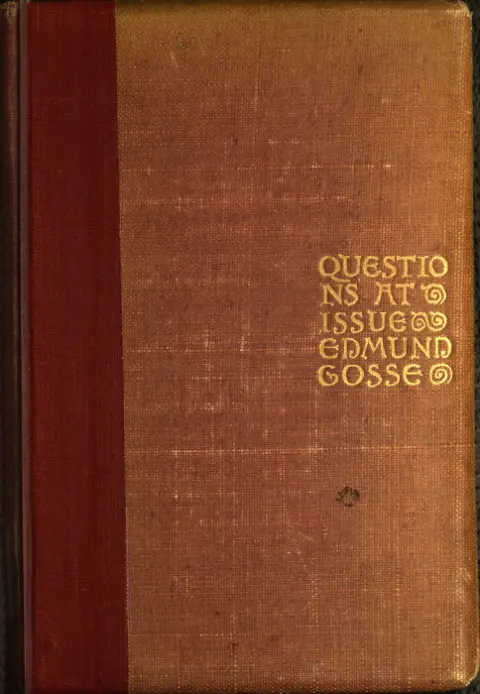
Edmund Gosse
THE CLASSIC COLLECTION · 1901
"Hypolympia; Or, The Gods in the Island, an Ironic Fantasy" by Edmund Gosse is a novel written in the early 20th century. The story imagines a whimsical yet ironical scenario where the ancient Greek gods find themselves exiled to a remote island, having lost their immortality and former grandeur. It explores themes of mortality, identity, and the transformation of these iconic deities as they attempt to adapt to their new, humbled existence. At the start of the novel, the setting introduces a terrace overlooking the sea, where the goddess Aphrodite and her son Eros arrive on the island. They are joined by other gods, including Poseidon and Athena, who express their bewilderment and sadness over their lost powers and status. The opening dialogue reveals their struggle to grasp their mortality, their nostalgia for Olympus, and their attempts to understand the dynamics of this new life among "barbarians." The characters grapple with feelings of weariness and the challenge of finding happiness in this unfamiliar territory, setting the stage for an exploration of their relationships and roles in a world where they are no longer supreme.
Introduction adapted from the source catalogue; source summaries may be automatically generated.
Free to read · English · 20,499 words · No account needed
MAKE TIME FOR A GOOD BOOK
On by default. Untick to stop anonymous reading totals. Each page counts after 10 seconds in view. How this works.
Anonymous counting is on unless you have switched it off.
I thought that Zeus had forgiven us. But never mind, never mind!
We are tired, Circe. And what does the new life matter to us now? The old life had run low, and we had long been prepared for mortality by the poverty of our immortality.
[Enter HERMES running.]
HERMES [in reply to a gesture of CIRCE].
I cannot stay. I am trying to rouse Demeter from her dreadful state of depression. She sits in the palace heaving deep sighs, and doing absolutely nothing else. It will affect her heart, Aesculapius say.
She has always been so closely wedded to the study of agriculture,
and now....
Precisely. And it has occurred to me that the way to rouse her will be to send Persephone to her in a little country cart I have discovered. I have two mouse-coloured ponies already caught and harnessed--such little beauties. The only thing left to do is to search for Persephone.
I will find her in a moment. [Exit.]
We hear that you have already invented a means of amusing Zeus, Hermes? Is he prepared to forget his thunderbolt?
He has mentioned it only twice this morning, and I have set Hephaestus to work to make him another, of yew-tree wood. It will be less incommodious, more fitted to this place, and in a very short time Zeus will forget the original.
KRONOS [loudly, to himself].
Zeus gave me an orb and sceptre to console me. I used to play cup and ball with them behind his throne.
RHEA [in a solicitous aside to HERMES].
Oh! it is not true. Kronos' mind now wanders so strangely. He thinks that it is Zeus who has turned him out of Olympus.
HERMES [in the same tone].
Do not distress him, Rhea, by contradiction and explanation. I will find modes of amusing him a little every day, and, for the rest, let him doze in the sunshine. His mind is worn so smooth that it fails any longer to catch in ideas as they flit against it. They pass off, glide away. It is useless, Rhea, to torment Kronos.
I shall watch him, all day long. For I, too, am weary. Do not propose to me, with your restless energy, any fresh interests. Let me sit, with my cold hands folded in my lap, and look at Kronos, nodding, nodding. It is very kind of Circe, but we are too old for love; and of you, but we are too old for amusement. Let us rest, Hermes, rest and sleep; perhaps dream a little, dream of the far-away past.
[CIRCE and PERSEPHONE enter from the left.]
PERSEPHONE [to HERMES].
Your reading position is saved on this browser. Take it to another device with a library code. Reading pages adapt to text, rather than matching a printed edition.
Edmund Gosse
Edmund Gosse
Edmund Gosse
Edmund Gosse
BEHIND THE BOOK
This eBook is for the use of anyone anywhere in the United States and most other parts of the world at no cost and with almost no restrictions whatsoever. You may copy it, give it away or re-use it under the terms of the Project Gutenberg License included with this eBook or online at www.gutenberg.org. If you are not located in the United States, you will have to check the laws of the country where you are located before using this eBook. Read the source licence.
The original source file, including credits and licence, is retained by this library. Request an original-format copy at no charge. Please include the book title and Project Gutenberg identifier #28270.
KEEP YOUR CURIOSITY GOING
Coulson Kernahan

Maurice Baring
Frances Wright
Cécile Tormay
Francis Greenleaf Allinson & Anne C. E. (Anne Crosby Emery) Allinson

Frederic Jesup Stimson