THE CLASSIC COLLECTION✦Some Diversions of a Man of LettersCLASSIC FREE BOOKS
Some Diversions of a Man of Letters
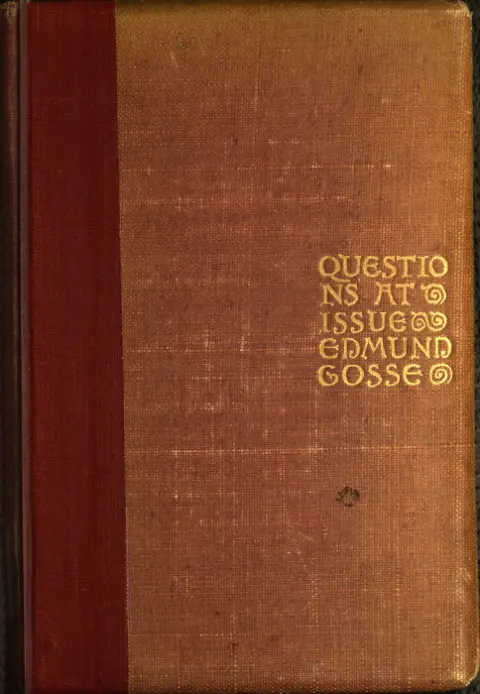
Edmund Gosse
THE CLASSIC COLLECTION · 1901
"Hypolympia; Or, The Gods in the Island, an Ironic Fantasy" by Edmund Gosse is a novel written in the early 20th century. The story imagines a whimsical yet ironical scenario where the ancient Greek gods find themselves exiled to a remote island, having lost their immortality and former grandeur. It explores themes of mortality, identity, and the transformation of these iconic deities as they attempt to adapt to their new, humbled existence. At the start of the novel, the setting introduces a terrace overlooking the sea, where the goddess Aphrodite and her son Eros arrive on the island. They are joined by other gods, including Poseidon and Athena, who express their bewilderment and sadness over their lost powers and status. The opening dialogue reveals their struggle to grasp their mortality, their nostalgia for Olympus, and their attempts to understand the dynamics of this new life among "barbarians." The characters grapple with feelings of weariness and the challenge of finding happiness in this unfamiliar territory, setting the stage for an exploration of their relationships and roles in a world where they are no longer supreme.
Introduction adapted from the source catalogue; source summaries may be automatically generated.
Free to read · English · 20,499 words · No account needed
MAKE TIME FOR A GOOD BOOK
On by default. Untick to stop anonymous reading totals. Each page counts after 10 seconds in view. How this works.
Anonymous counting is on unless you have switched it off.
[The glen, through which the stream, slightly flooded by a night's rain, runs faintly turbid. DIONYSUS, earnestly engaged in angling, does not hear the approach of AESCULAPIUS.]
AESCULAPIUS [in a high, voluble key].
It is not to me but to you, O ruddy son of Semele, that the crowds of invalids will throng, if you cultivate this piscatory art so eagerly, since to do nothing, serenely, in the open air, without becoming fatigued, is to storm the very citadel of ill-health, and----
DIONYSUS [testily, without turning round].
Hush! hush!... I felt a nibble.
AESCULAPIUS [in a whisper, flinging himself upon the grass].
It was in such a secluded spot as this that Apollo heard the trout at Aroanius sing like thrushes.
How these poets exaggerate! The trout sang, I suppose, like the
missel-thrush.
What song has the missel-thrush?
It does not sing at all. Nor do trout.
You are sententious, Dionysus.
No, but closely occupied. I am intent on the subtle movements of my rod, round which my thoughts and fancies wind and blossom till they have made a thyrsus of it. Now, however, I shall certainly catch no more fish, and so I may rest and talk to you. Are you searching for simples in this glen?
To tell you the plain truth, I am waiting for Nike. She has given
me an appointment here.
I have not seen her since we arrived on this island.
You have seen her, but you have not recognised her. She goes about in a perpetual incognito. Poor thing, in our flight from Olympus she lost all her attributes--her wings dropped off, her laurel was burned, she flung her armour away, and her palm-tree obstinately refused to up-root itself.
No doubt at this moment it is obsequiously rustling over the odious
usurper.
It was always rather a poor palm-tree. What Nike misses most are her wings. She was excessively dejected when we first arrived, but Pallas very kindly allowed her to take care of the jewel for half an hour. Nike--if still hardly recognisable--is no longer to be taken for Niobe.
DIONYSUS [rising to his feet].
I shall do well, however, to go before she comes.
By no means. I should prefer your staying. Nike will prefer it, too. In the old days she always liked you to be her harbinger.
Not always; sometimes my panthers turned and bit her. But my panthers and my vines are gone to keep her laurels and her palm-tree company. I think I will not stay, Aesculapius. But what does Nike want with you?
[Slowly and pensively descending from the upper woods, NIKE
enters.]
Your reading position is saved on this browser. Take it to another device with a library code. Reading pages adapt to text, rather than matching a printed edition.
Edmund Gosse
Edmund Gosse
Edmund Gosse
Edmund Gosse
BEHIND THE BOOK
This eBook is for the use of anyone anywhere in the United States and most other parts of the world at no cost and with almost no restrictions whatsoever. You may copy it, give it away or re-use it under the terms of the Project Gutenberg License included with this eBook or online at www.gutenberg.org. If you are not located in the United States, you will have to check the laws of the country where you are located before using this eBook. Read the source licence.
The original source file, including credits and licence, is retained by this library. Request an original-format copy at no charge. Please include the book title and Project Gutenberg identifier #28270.
KEEP YOUR CURIOSITY GOING
Coulson Kernahan

Maurice Baring
Frances Wright
Cécile Tormay
Francis Greenleaf Allinson & Anne C. E. (Anne Crosby Emery) Allinson

Frederic Jesup Stimson