THE CLASSIC COLLECTION✦Some Diversions of a Man of LettersCLASSIC FREE BOOKS
Some Diversions of a Man of Letters
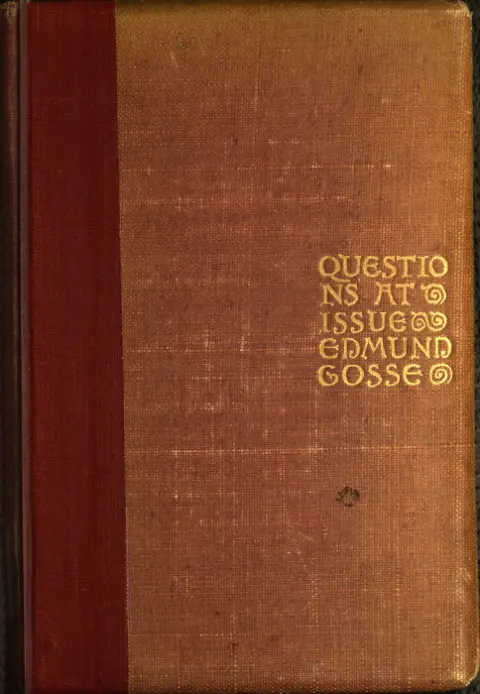
Edmund Gosse
THE CLASSIC COLLECTION · 1901
"Hypolympia; Or, The Gods in the Island, an Ironic Fantasy" by Edmund Gosse is a novel written in the early 20th century. The story imagines a whimsical yet ironical scenario where the ancient Greek gods find themselves exiled to a remote island, having lost their immortality and former grandeur. It explores themes of mortality, identity, and the transformation of these iconic deities as they attempt to adapt to their new, humbled existence. At the start of the novel, the setting introduces a terrace overlooking the sea, where the goddess Aphrodite and her son Eros arrive on the island. They are joined by other gods, including Poseidon and Athena, who express their bewilderment and sadness over their lost powers and status. The opening dialogue reveals their struggle to grasp their mortality, their nostalgia for Olympus, and their attempts to understand the dynamics of this new life among "barbarians." The characters grapple with feelings of weariness and the challenge of finding happiness in this unfamiliar territory, setting the stage for an exploration of their relationships and roles in a world where they are no longer supreme.
Introduction adapted from the source catalogue; source summaries may be automatically generated.
Free to read · English · 20,499 words · No account needed
MAKE TIME FOR A GOOD BOOK
On by default. Untick to stop anonymous reading totals. Each page counts after 10 seconds in view. How this works.
Anonymous counting is on unless you have switched it off.
[On the terrace beside the house are seated PERSEPHONE, MAIA, and CHLORIS. The afternoon is rapidly waning, and lights are seen to twinkle on the farther shore of the sea. As the twilight deepens, from just out of sight a man's voice is heard singing as follows:]
As I lay on the grass, with the sun in the west,
A woman went by me, a babe at her breast;
She kissed it and pressed it,
She cooed, she caressed it,
Then rocked it to sleep in her elbow-nest.
She rocked it to rest with a sad little song,
How the days were grown short, and the nights grown long;
How love was a rover,
How summer was over,
How the winds of winter were shrill and strong.
We must haste, she sang, while the sky is bright,
While the paths are plain and the town's in sight,
Lest the shadows that watch us
Should creep up and catch us,
For the dead walk here in the grass at night.
[The voice withdraws farther down the woods, but from a lower distance, in the clear evening, the last stanza is heard repeated. The GODDESSES continue silent, until the voice has died away.]
Rude words set to rude music; but they seem to penetrate to the
very core of the heart.
Are you sad to-night, Chloris?
Not sad, precisely; but anxious, feverish, a little excited.
Hark! the song begins again.
[They listen, and from far away the words come faintly back:
For the dead walk here in the grass at night.]
The dead! Shall we see them?
Why not? These barbarians appear to avoid them with an invincible terror, but why should we do so?
I do not feel that it would be possible for the dead to "catch" me, since I should be instantly and keenly watching for them, and much more eager to secure their presence than they could be to secure mine.
We do not know of what we speak, for it may very well be that the barbarians have some experience of these beings. Their influence may be not merely malign, but disgusting.
How ignorant we are!
Surely, Persephone, you must be able to give us some idea of the dead. Were they not the sole occupants of your pale dominions?
It is very absurd of me, but really I do not seem to recollect
anything about them.
I suppose you disliked living in Hades very much?
Your reading position is saved on this browser. Take it to another device with a library code. Reading pages adapt to text, rather than matching a printed edition.
Edmund Gosse
Edmund Gosse
Edmund Gosse
Edmund Gosse
BEHIND THE BOOK
This eBook is for the use of anyone anywhere in the United States and most other parts of the world at no cost and with almost no restrictions whatsoever. You may copy it, give it away or re-use it under the terms of the Project Gutenberg License included with this eBook or online at www.gutenberg.org. If you are not located in the United States, you will have to check the laws of the country where you are located before using this eBook. Read the source licence.
The original source file, including credits and licence, is retained by this library. Request an original-format copy at no charge. Please include the book title and Project Gutenberg identifier #28270.
KEEP YOUR CURIOSITY GOING
Coulson Kernahan

Maurice Baring
Frances Wright
Cécile Tormay
Francis Greenleaf Allinson & Anne C. E. (Anne Crosby Emery) Allinson

Frederic Jesup Stimson