
The Writing of News A Handbook with Chapters on Newspaper Correspondence and Copy Reading
Charles G. (Charles Griffith) Ross
THE CLASSIC COLLECTION · 1898
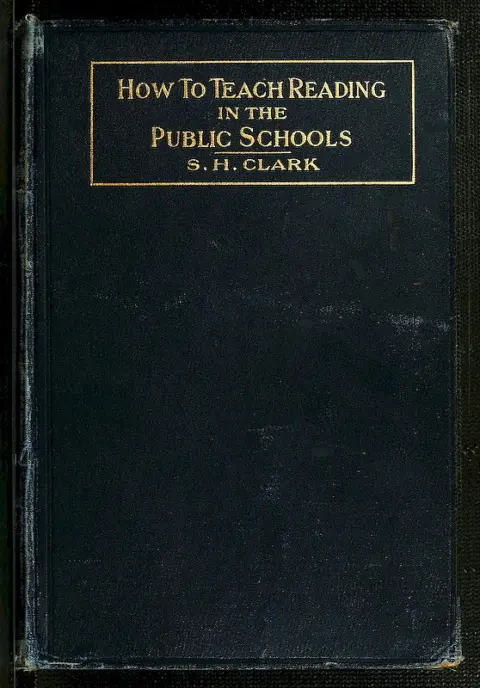
"How to Teach Reading in the Public Schools" by S. H. Clark is an instructional manual aimed at educators, written in the late 19th century. This work provides insights and methodologies for teaching reading effectively in public schools, stressing the importance of understanding vocal expression and its various components. The book appears to focus on improving both the teachers’ and students’ abilities to extract meaning from text, thereby elevating the standard of reading instruction. The opening of this manual establishes its purpose by addressing the inadequacies of reading education in public schools. The author outlines common remedial approaches, such as mechanical methods of teaching vocal expression and comprehension techniques, explaining why they often fall short in fostering a true understanding of literature. Clark emphasizes the need for teachers to appreciate great literature, to understand the psychology behind vocal expression, and to implement a structured, methodical approach to instruction that prioritizes clarity and comprehension, rather than rote learning.
Introduction adapted from the source catalogue; source summaries may be automatically generated.
Free to read · English · 80,383 words · No account needed
MAKE TIME FOR A GOOD BOOK
On by default. Untick to stop anonymous reading totals. Each page counts after 10 seconds in view. How this works.
Anonymous counting is on unless you have switched it off.
You know me well, and herein spend but time
To wind about my love with circumstance.
Not that I loved Caesar less, but that I loved Rome more.
It is not that I doubt the gentleman’s honesty, but that I
question his authority.
It was at the end of the war that this incident occurred; not at
the beginning.
Uncertainty, confusion, hesitation, and other forms of doubt, are really questions,--the mind seeking solution of difficult and perplexing problems.
I wish I could find some way out of this, but--
There ought to be some other method of solving this difficulty:
let me see, let me see.
I would I had been there.
Are you the owner of this house?
Can you tell me what time it is?
Care must be taken not to confuse this form of interrogation with Figurative Interrogation. The latter is often strongly assertive. For instance:
God of battles, was ever a battle like this in the world before?
This is equivalent to asking a question and answering it at the same time. It asks in words, “was ever?” It answers in inflection, “there never was.” Grammatically, then, it is a question; rhetorically, it is an exclamation. Here is another form of Figurative Interrogation:
Are you going out? (No answer.) Are you going out? (I demand an
answer.)
In this case, the second question becomes a demand. The speaker cares for an answer not so much because of any interest in it as such, but because he desires his authority respected.
The following examples of Figurative Interrogation should be
carefully studied:
Is there a single atrocity of the French more unprincipled and inhuman than that of Russia, Austria, and Prussia, in Poland?
Did he not know that he was making history that hour? Did he not
know this, I say?
If I were to propose three cheers for Washington, is there a single man, woman, or child in this vast audience who would refuse to lift his voice?
Have you, gentlemen of the jury, considered the price the state asks the prisoner to pay for what is only an indiscretion at most? I repeat, have you considered the price?
Has the gentleman done? Has he completely done?
Your reading position is saved on this browser. Take it to another device with a library code. Reading pages adapt to text, rather than matching a printed edition.
BEHIND THE BOOK
This eBook is for the use of anyone anywhere in the United States and most other parts of the world at no cost and with almost no restrictions whatsoever. You may copy it, give it away or re-use it under the terms of the Project Gutenberg License included with this eBook or online at www.gutenberg.org. If you are not located in the United States, you will have to check the laws of the country where you are located before using this eBook. Read the source licence.
The original source file, including credits and licence, is retained by this library. Request an original-format copy at no charge. Please include the book title and Project Gutenberg identifier #61727.
KEEP YOUR CURIOSITY GOING
Charles G. (Charles Griffith) Ross
Hannah Webster Foster

Emily Lawless
Edwin Hamlin Carr

Charles De Lano Hine
Andrew Ure