
The Writing of News A Handbook with Chapters on Newspaper Correspondence and Copy Reading
Charles G. (Charles Griffith) Ross
THE CLASSIC COLLECTION · 1898
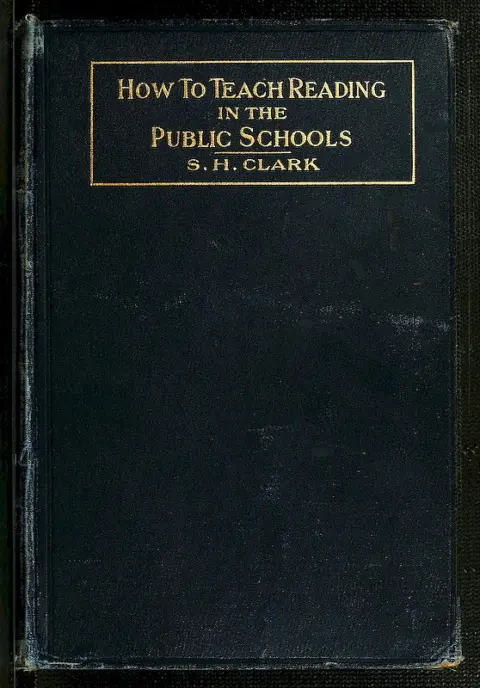
"How to Teach Reading in the Public Schools" by S. H. Clark is an instructional manual aimed at educators, written in the late 19th century. This work provides insights and methodologies for teaching reading effectively in public schools, stressing the importance of understanding vocal expression and its various components. The book appears to focus on improving both the teachers’ and students’ abilities to extract meaning from text, thereby elevating the standard of reading instruction. The opening of this manual establishes its purpose by addressing the inadequacies of reading education in public schools. The author outlines common remedial approaches, such as mechanical methods of teaching vocal expression and comprehension techniques, explaining why they often fall short in fostering a true understanding of literature. Clark emphasizes the need for teachers to appreciate great literature, to understand the psychology behind vocal expression, and to implement a structured, methodical approach to instruction that prioritizes clarity and comprehension, rather than rote learning.
Introduction adapted from the source catalogue; source summaries may be automatically generated.
Free to read · English · 80,383 words · No account needed
MAKE TIME FOR A GOOD BOOK
On by default. Untick to stop anonymous reading totals. Each page counts after 10 seconds in view. How this works.
Anonymous counting is on unless you have switched it off.
l. 65-82.--This speech needs no commentary. It is a plain and unmistakable arraignment, uttered in unequivocal language, and in simple, direct manner.
l. 82.--Cassius is pained that his friend should so misunderstand him. From now to line 93 Cassius seems to throw himself upon the mercy of his friend, while the latter repels his advances, each time with greater harshness.
l. 93-107.--Cassius’ heart is broken. If his best friend can so wantonly misunderstand him, what can he hope from his enemies? There is nothing left to live for, and he would eagerly welcome death even at the hands of Antony. The passage is overflowing with heartbreak, and gains our sympathy for one who else would seem but a crafty, self-seeking schemer.
l. 107.--The speech of Cassius brings Brutus back to himself. Here is the real Brutus, full of tenderness and love.
To understand fully the unusual display of feeling in this scene we should read further to the stage direction, Re-enter Lucius, with wine and taper.
[15] Let it be understood once for all that the various elements in expression should be the spontaneous outcome of the mental action. As has been so often stated, to tell a pupil to use a rising inflection or to emphasize this word or that, is a violation of the fundamental principle of correct teaching.
[16] The stanzas are numbered as in the original poem.
Antithesis, rhetorical, 143.
Atmosphere, 184;
examples illustrating, 185;
analysis of a selection illustrating, 193;
of description, psychology of, 199.
Central idea, 138;
study of, a logical process, 141.
Character, contrast of, 207.
Climaxes, 212;
of significance, 212, 214, 215;
of intensity, 213;
gradation of, 216.
Complexity, defined, 11.
Contrasts, 205;
two kinds of, 211.
Criteria of vocal expression, 17.
Criterion of force, 101.
Criterion of pitch, 42.
Criterion of quality, 80.
Criterion of time, 19.
Emotion, 172;
affects quality, 82;
how to develop, 172;
contrast of, 205.
Emotional transitions, examples of, 162.
Emphasis, rules for, 139;
drills in, 140.
Expression, complexity of, 178
Figurative interrogation, 61.
Force, criterion of, 101;
pedagogical aspects of, 112.
Grouping, 28, 128;
independent of punctuation, 28;
extract from Legouvé on, 40.
Hints on readings, 254.
Imagination and quality, 84.
Imitation, 227;
not art, 189;
tendency toward, 191.
Inflections, meaning of, 57;
rising, 57;
falling, 63;
circumflex, examples of, 67.
Intangibility, defined, 11.
Interpretation, literary, 231;
vocal, 232.
Key, defined, 45;
reasons for, 49;
dependent upon degree of tension, 54.
Literary interpretation, 231;
analysis of a selection illustrating, 284.
Melody, 43, 54;
analysis of a selection illustrating, 71;
of long sentences, 77.
Mental attitude of the reader, 117.
Mental technique, 129.
Methods, mechanical, 9;
“get-the-thought,” 9;
laxity of, 13;
concluding remarks on, 224.
Momentary completeness, 61, 136;
drills in, 65;
analysis of a selection illustrating, 256.
Movement, analysis of selection illustrating, 266.
Pause, as related to time, 27;
an expressive element, 32;
examples of, 35.
Pedagogical aspects, of time, 38;
of pitch, 75;
of quality, 98;
of force, 112.
Phases, studies in, 163.
Phrases, subordinate, 150.
Pitch, criterion of, 42;
meaning of, 42;
Raymond’s definition of, 42;
melody of, 42;
analysis of a selection illustrating, 71;
pedagogical aspects of, 75;
low, 107.
Your reading position is saved on this browser. Take it to another device with a library code. Reading pages adapt to text, rather than matching a printed edition.
BEHIND THE BOOK
This eBook is for the use of anyone anywhere in the United States and most other parts of the world at no cost and with almost no restrictions whatsoever. You may copy it, give it away or re-use it under the terms of the Project Gutenberg License included with this eBook or online at www.gutenberg.org. If you are not located in the United States, you will have to check the laws of the country where you are located before using this eBook. Read the source licence.
The original source file, including credits and licence, is retained by this library. Request an original-format copy at no charge. Please include the book title and Project Gutenberg identifier #61727.
KEEP YOUR CURIOSITY GOING
Charles G. (Charles Griffith) Ross
Hannah Webster Foster

Emily Lawless
Edwin Hamlin Carr

Charles De Lano Hine
Andrew Ure