
The Writing of News A Handbook with Chapters on Newspaper Correspondence and Copy Reading
Charles G. (Charles Griffith) Ross
THE CLASSIC COLLECTION · 1903
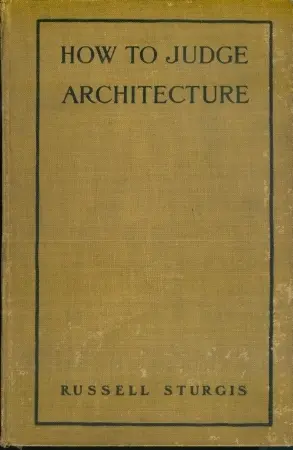
"How to Judge Architecture: A Popular Guide to the Appreciation of Buildings" by Russell Sturgis is a comprehensive guide focusing on architectural appreciation written in the early 20th century. The text aims to educate readers on how to evaluate and understand different styles and elements of architecture, emphasizing the importance of personal judgment in the appreciation of buildings without being swayed by external influences or preconceived notions. The opening of the book sets the stage for a journey through architectural history, beginning with early Greek design. Sturgis emphasizes the need for patience and independent thought in forming opinions about architecture. He suggests that readers should gradually acquire knowledge of architectural principles and characteristics, starting with the universally admired early Greek temples. The discussion includes details about the design and purpose of structures like the Parthenon, illustrating various architectural concepts such as proportions, curvature, and the historical context of these ancient buildings. Through this thorough examination, the author lays a foundation for deeper exploration of architectural styles and encourages readers to cultivate their own appreciation for the art of building.
Introduction adapted from the source catalogue; source summaries may be automatically generated.
Free to read · English · 39,614 words · No account needed
MAKE TIME FOR A GOOD BOOK
On by default. Untick to stop anonymous reading totals. Each page counts after 10 seconds in view. How this works.
Anonymous counting is on unless you have switched it off.
Valencia: Casa Lonja, 116
Valhalla, The, (near Ratisbon, Bavaria), 181
Valladolid: Portal of Church of St. Paul, 116
Vaulting, 50-51
Vaulting, Roman, 50
Venice: Church of San Marco, 92
Verona: Church of San Zeno, 77
West Ham (Essex), England, West Ham Institute, 204
Windsor Castle, St. George’s Chapel, 121
Wollaton Hall, England, 151
Workmanship of Greek buildings, 24
Pictorial Composition and the Critical Judgment of Pictures
A Companion Volume to “How to Judge Architecture.”
Quarto, Handsomely Illustrated with 80 Reproductions. Net $1.50.
Postage 14 Cents.
The book develops the processes of pictorial construction, setting forth the principles which, as a necessary foundation, underlie the work of the artist.
R. SWAIN GIFFORD, N.A., Director of the Cooper Union Art School,
New York
“ ‘Fills the bill’ admirably and must be of great use not only to beginners, but to professional artists. I shall use it and refer to it.”
“Not only charmingly written, but remarkably able and instructive. I have read nothing on the subject that compares with it in clear explanations of qualities in painting that are always most mysterious to the layman and frequently so to the professional artist.”
Publishers
Mr. Sturgis is acknowledged the leading critic of art and architecture in the country. In this book he has sketched the history of modern opinion of architecture. Aided by plentiful illustrations from the early Grecian temples, and passing through the great Cathedrals to the modern business blocks, he has shown the influences which have brought about the various styles and deduced simple rules for the architectural judgment of these buildings. No attempt is made to set up absolute standards, but the reader is enabled to form bases for his own opinion, and to learn the fundamentals of good and bad in buildings. A reading of the book will give even the common buildings which are passed every day a new interest and a new meaning. This book is a companion to “Pictorial Composition and the Critical Judgment of Pictures,]” by H. R. Poore.
(Corrected in etext)
Page 14, for “Campagna,” read Campania.
Plate II, for “Southeast,” read Northeast.
Page 36, line 6, for “plan given here shows,” read views given here
show.
Page 70, last line, for “make,” read makes.
Page 89, middle, for “North, west,” read Northwest.
Page 95, middle, for “Mercy,” read Mersey.
Page 102, middle, delete comma after “them”; insert comma after
“nave.”
Page 120, the plate opposite this page should be lettered XXXIII.
Page 145, middle, for “was called,” read is called.
Page 172, middle, for “LV,” read LIV.
Plate LV, upper figure, for “Madama,” read Carignano.
Plate LVI, for “Gebaude,” read Gebäude.
Your reading position is saved on this browser. Take it to another device with a library code. Reading pages adapt to text, rather than matching a printed edition.
BEHIND THE BOOK
This eBook is for the use of anyone anywhere in the United States and most other parts of the world at no cost and with almost no restrictions whatsoever. You may copy it, give it away or re-use it under the terms of the Project Gutenberg License included with this eBook or online at www.gutenberg.org. If you are not located in the United States, you will have to check the laws of the country where you are located before using this eBook. Read the source licence.
The original source file, including credits and licence, is retained by this library. Request an original-format copy at no charge. Please include the book title and Project Gutenberg identifier #47937.
KEEP YOUR CURIOSITY GOING
Charles G. (Charles Griffith) Ross
Hannah Webster Foster

Emily Lawless
Edwin Hamlin Carr

Charles De Lano Hine
Andrew Ure