
The Writing of News A Handbook with Chapters on Newspaper Correspondence and Copy Reading
Charles G. (Charles Griffith) Ross
THE CLASSIC COLLECTION · 1903
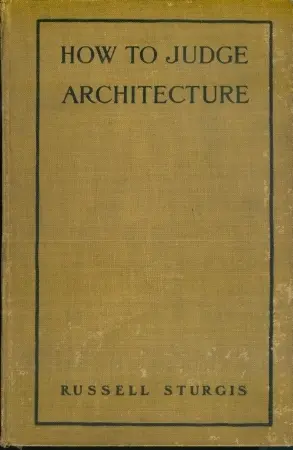
"How to Judge Architecture: A Popular Guide to the Appreciation of Buildings" by Russell Sturgis is a comprehensive guide focusing on architectural appreciation written in the early 20th century. The text aims to educate readers on how to evaluate and understand different styles and elements of architecture, emphasizing the importance of personal judgment in the appreciation of buildings without being swayed by external influences or preconceived notions. The opening of the book sets the stage for a journey through architectural history, beginning with early Greek design. Sturgis emphasizes the need for patience and independent thought in forming opinions about architecture. He suggests that readers should gradually acquire knowledge of architectural principles and characteristics, starting with the universally admired early Greek temples. The discussion includes details about the design and purpose of structures like the Parthenon, illustrating various architectural concepts such as proportions, curvature, and the historical context of these ancient buildings. Through this thorough examination, the author lays a foundation for deeper exploration of architectural styles and encourages readers to cultivate their own appreciation for the art of building.
Introduction adapted from the source catalogue; source summaries may be automatically generated.
Free to read · English · 39,614 words · No account needed
MAKE TIME FOR A GOOD BOOK
On by default. Untick to stop anonymous reading totals. Each page counts after 10 seconds in view. How this works.
Anonymous counting is on unless you have switched it off.
Masonry, Roman, 50
Masonry with dry joints, ch. I, II, 56
Masonry with mortar, 50
Mayence (Mainz): Cathedral, 82
Metope (def.), (note) 17
Milan: Church of Sant’ Ambrogio, 77
Modern Design:
English the freest, 202
French the most tasteful, 203, 208
German marked by innovations, 206
How marked by thought in U. S., 209, 210
How marked by thought in England, 214
why made difficult, 212
Modern Taste in the U. S.--in England, 201
in Germany, in France, 202
Mohammedan Architecture, 70
Monreale: Cathedral, 77, 96
Mosaic, 76
Munich: Allerheiligenhofkirche, 180
Munich: Auer-Kirche (Mariahilf-Kirche), 181
Munich: Basilica of St. Boniface, 181
Munich: Church of All Saints (see Ch. of Allerheiligenhofkirche).
Munich: Church of St. Boniface (Basilica), 181
Munich: Church of St. Louis, (see Ludwigskirche).
Munich: Church of The Theatiner Monks, 162
Munich: Exhibition Building, 185
Munich: Glyptothek, 180-185
Munich: Königsbau, southern front, 180
Munich: Ludwigskirche, 179
Munich: Pinakothek, the old, 180
Munich: Post Office, north front, 180
Munich: Propylæa, 186
Munich: Royal Library, 180
Munich: Royal Palace (see Königsbau).
Munich: Ruhmeshalle, 181
Naos (def.), (note) 18
Nave (def.), (note) 53
Neo-classic (def.), (note) 32
Neo-classic architecture begins to decline in less than a century, 159
Octastyle (def.), (note) 18
Olympia: Temple of Zeus, 26, 29
Orders of columnar architecture, the Roman use of them, 56
Orvieto: Cathedral, 94
Pæstum: Temple, 14, 24, 29
Painting of Greek buildings, 24
Palazzo, the, in Florence, 137
Palazzo, the, in Rome, 138
Palermo: Cathedral, 77
Pandrosion (def.), (note) 38
Parenzo (in Istria): Basilica (8th century), 77
Paris: Buildings on Place de la Concorde, 174
Paris: Cathedral, 31
Paris: Cercle de la Librairie, 208
Paris; École Militaire, 173
Paris: Louvre (east front), 141
Parma: Baptistery, 85
Parthenon (Athens), 14, 26, 28
Pavia: Church of San Michaele, 77
Pediment (def.), (note) 28
Peterborough: Vault of Choir-aisle of Cathedral, 120
Pilaster in ancient and modern works, 135, 137
Pisa: Baptistery, 85
Poitiers: Tower of St. Radegonde, 83
Poitiers: Church of Notre Dame la Grande, 83
Portico of the Maidens (Caryatides), 36-37
Priene (in Asia Minor): Temple of Athena Polias, 43
Proportion varied in Greek art, 19-20, 29-30
Cathedral, (ff) 102, 105
Pteroma (def.), (note) 17, 27
Purpose of the artist, the important thing, 16
Ravenna: Baptistery, 84
Ravenna: Basilica of St. Apollinare Nuovo, 77
Ravenna: Basilica of St. Apollinare in Classe, 77
Refinements of Design (see Curvature, Intercolumniation, Slope).
Reims: Cathedral, 31, 101
Renaissance in Italy; (see Classical Revival, Risorgimento).
Renaissance in the North, cause and dates, 144
Renaissance in art at first not classic, (ff) 145
Renaissance introduced gradually, 148
Renaissance classical at Écouen, 149
Respond (def.), (note) 75
Revivals in architecture numerous, 176
Revivals, those only which succeed are notable, 177
Revivals, those of the 19th century did not succeed, 179, 184
Risorgimento (def.), (note) 46
Rocaille (def.), (note) 168
Roman Art of the Empire, 47
Roman changes in Greek design, 56
Roman Empire, intellectual influence, 66-67
Roman Empire, its divergent influence East and West, 66-68
Romanesque (def.), (note) 69
Romanesque Architecture, (ff) 69, 74, 77
Roman Order, the, 139
Rome: Altar of Peace (Arar Pacis), 66
Rome: Basilica of Maxentius, 53
Rome: Basilica of Septa Julia, 53
Rome: Church of S. Maria Maggiore, 72
Rome: Church of S. Maria della Pace Cloister, 141
Your reading position is saved on this browser. Take it to another device with a library code. Reading pages adapt to text, rather than matching a printed edition.
BEHIND THE BOOK
This eBook is for the use of anyone anywhere in the United States and most other parts of the world at no cost and with almost no restrictions whatsoever. You may copy it, give it away or re-use it under the terms of the Project Gutenberg License included with this eBook or online at www.gutenberg.org. If you are not located in the United States, you will have to check the laws of the country where you are located before using this eBook. Read the source licence.
The original source file, including credits and licence, is retained by this library. Request an original-format copy at no charge. Please include the book title and Project Gutenberg identifier #47937.
KEEP YOUR CURIOSITY GOING
Charles G. (Charles Griffith) Ross
Hannah Webster Foster

Emily Lawless
Edwin Hamlin Carr

Charles De Lano Hine
Andrew Ure