
Last letters from the living dead man
David Patterson (Spirit) Hatch
THE CLASSIC COLLECTION · 1917
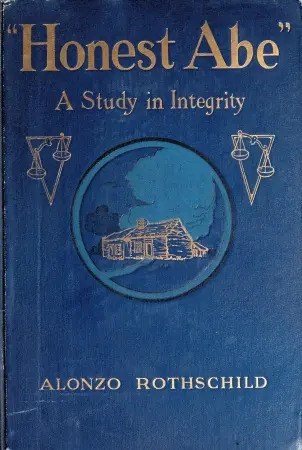
"Honest Abe: A Study in Integrity Based on the Early Life of Abraham Lincoln" by Alonzo Rothschild is a historical account written in the early 20th century. This work explores the formative years of Abraham Lincoln, focusing on his character, integrity, and the influence of his family background. It aims to shed light on how his early experiences shaped him into the emblematic figure of honesty and moral fortitude that he is celebrated as today. The opening of the book sets the foundation for a detailed exploration of Lincoln’s life, particularly emphasizing his inherent honesty and the hardships faced by his family during his upbringing. It describes the poverty Lincoln endured in his childhood and how the moral values instilled by his parents, especially his mother, played a crucial role in shaping his character. The narrative recounts anecdotes that highlight his early understanding of right and wrong and his unwavering commitment to truth, such as his willful efforts to settle debts and his conscientiousness in dealings with others. Throughout this introductory segment, Rothschild firmly establishes Lincoln's reputation as "Honest Abe," illustrating how his integrity was evident from a young age.
Introduction adapted from the source catalogue; source summaries may be automatically generated.
Free to read · English · 102,593 words · No account needed
MAKE TIME FOR A GOOD BOOK
On by default. Untick to stop anonymous reading totals. Each page counts after 10 seconds in view. How this works.
Anonymous counting is on unless you have switched it off.
Things looked bad for farmer Case. “What!” thought a by-stander,--the teller of the story,--“is this good old man, who confided in these boys, to be wronged in this way, and even his counsel, Mr. Lincoln, to submit in silence!”
After the principle of law that a minor may avoid his contracts had been duly cited, Judge Treat who presided, inquired:--
“Is there a count in the declaration for oxen and plow, sold and
delivered?”
“Yes,” answered Lincoln, “and I have only two or three questions to ask
the witness.”
Addressing the men who had been called to prove the ages of the
defendants, he asked:--
“Where is that prairie team now?”
“On the farm of the Snow boys,” was his answer.
“Have you seen any one breaking prairie with it, lately?”
“Yes, the Snow boys were breaking up with it, last week.”
“How old are the boys now?”
“One is a little over twenty-one, and the other near twenty-three.”
“That is all,” said Lincoln.
Arising slowly, when the time came for his closing argument, and standing in an awkward, half-erect attitude, he began:--
“Gentlemen of the jury, are you willing to allow these boys to begin life with this shame and disgrace attached to their character? If you are, I am not. The best judge of human character that ever wrote, has left these immortal words for all of us to ponder:
“‘Good name in man and woman, dear my lord,
Is the immediate jewel of their souls.
Who steals my purse steals trash; ’tis something, nothing;
’Twas mine, ’tis his, and has been slave to thousands;
But he that filches from me my good name,
Robs me of that which not enriches him,
And makes me poor indeed.’”
Then drawing himself up to his full height, and looking down upon the defendants as if with the compassion of an older brother, while his long right arm was extended toward their attorney, he continued:--
“Gentlemen, these boys never would have tried to cheat old farmer Case out of these oxen and that plow, but for the advice of counsel. It was bad advice--bad in morals and bad in law. The law never sanctions cheating, and a lawyer must be very smart indeed to twist it so that it will seem to do so. The judge will tell you, what your own sense of justice has already told you, that these Snow boys, if they were mean enough to plead the baby act, when they came to be men should have taken the oxen and plow back. They cannot go back on their contract, and also keep what the note was given for.”
Your reading position is saved on this browser. Take it to another device with a library code. Reading pages adapt to text, rather than matching a printed edition.
BEHIND THE BOOK
This eBook is for the use of anyone anywhere in the United States and most other parts of the world at no cost and with almost no restrictions whatsoever. You may copy it, give it away or re-use it under the terms of the Project Gutenberg License included with this eBook or online at www.gutenberg.org. If you are not located in the United States, you will have to check the laws of the country where you are located before using this eBook. Read the source licence.
The original source file, including credits and licence, is retained by this library. Request an original-format copy at no charge. Please include the book title and Project Gutenberg identifier #49679.
KEEP YOUR CURIOSITY GOING
David Patterson (Spirit) Hatch
Cécile Tormay

Moritz Busch
Coulson Kernahan
John L. Ransom

Ralph Waldo Emerson