
Last letters from the living dead man
David Patterson (Spirit) Hatch
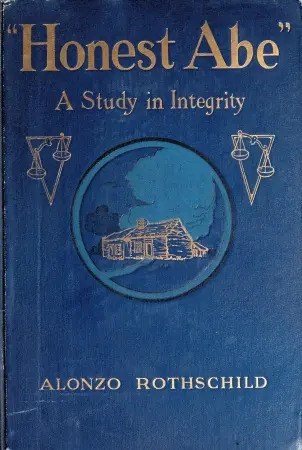
THE CLASSIC COLLECTION · 1917
"Honest Abe: A Study in Integrity Based on the Early Life of Abraham Lincoln" by Alonzo Rothschild is a historical account written in the early 20th century. This work explores the formative years of Abraham Lincoln, focusing on his character, integrity, and the influence of his family background. It aims to shed light on how his early experiences shaped him into the emblematic figure of honesty and moral fortitude that he is celebrated as today. The opening of the book sets the foundation for a detailed exploration of Lincoln’s life, particularly emphasizing his inherent honesty and the hardships faced by his family during his upbringing. It describes the poverty Lincoln endured in his childhood and how the moral values instilled by his parents, especially his mother, played a crucial role in shaping his character. The narrative recounts anecdotes that highlight his early understanding of right and wrong and his unwavering commitment to truth, such as his willful efforts to settle debts and his conscientiousness in dealings with others. Throughout this introductory segment, Rothschild firmly establishes Lincoln's reputation as "Honest Abe," illustrating how his integrity was evident from a young age.
Introduction adapted from the source catalogue; source summaries may be automatically generated.
Free to read · English · 102,593 words · No account needed
MAKE TIME FOR A GOOD BOOK
On by default. Untick to stop anonymous reading totals. Each page counts after 10 seconds in view. How this works.
Anonymous counting is on unless you have switched it off.
But perhaps his most notable desertion of a client occurred once at Postville, before Circuit Judge Treat, in the midst of a Logan County trial. The suit of Hoblit against Farmer had come up on appeal from a decision given by some local justice of the peace. What the alleged circumstances were Lincoln did not know until he was retained, in the Circuit Court, to represent the plaintiff. That worthy went upon the witness stand to prove his claim. After testifying about the items of the account against Farmer, and after allowing all set-offs, he swore positively that the balance had not been paid. Yet when the defendant’s attorney, Asahel Gridley, produced a receipt in full, given prior to the bringing of the action, the witness was obliged to admit that he had signed the paper. Whether or not it had been introduced at the original hearing is left in doubt, as the story goes; but there can be no question about the plaintiff’s surprise. Taken off his guard, Hoblit turned to his counsel and exclaimed that he “supposed the cuss had lost it.” Whereupon Lincoln arose, and left the court-room. Taking notice of his departure, Judge Treat sent the sheriff, Dr. John Deskins, in pursuit. When that officer found the missing lawyer, he was seated in the tavern across the court-house square, with his feet on the stove and his head among the clouds.
“Mr. Lincoln,” said the sheriff, “the judge wants you.”
“Oh, does he?” was the reply. “Well, you go back and tell the judge that I can’t come. My hands are dirty and I came over to clean them.”[ii-38]
The message was duly delivered to the honorable court, and Lincoln’s unprincipled client suffered a nonsuit.[ii-39]
There is a pretty little sequel to this episode. Some time later, when Gridley discontinued practice for more lucrative pursuits, he manifested his confidence in Lincoln, as well as his esteem, by transferring his entire law business to him without compensation. This was somewhat after the manner in which Robert Carter Nicholas, a veteran member of the profession during a former generation, had turned over his clientage to Patrick Henry. But no such encounter appears to have taken place between the Virginians as has just been related concerning the Illinois men. Nor is it to be expected. That abandonment by Lincoln of a case in mid-career, so to say, without regard for the judge’s wishes, is perhaps unique. It certainly is characteristic. There are instances of honorable counsel, who, finding themselves in the course of a trial grossly misled by their clients, have declined to serve them further, and have obtained leave from the court to withdraw. But if any other celebrated American pleader, at any time during his career, rushed from a court-room in a passion of righteous indignation over such a deception, and refused to return upon the mandate of the presiding magistrate, that occurrence is not commonly known. Moreover, from a professional point of view, the propriety, generally speaking, of Lincoln’s course in these matters has been gravely questioned. Some critics, conceding the misconduct of the clients whom he deserted, still appear to think that his treatment of them detracted somewhat from his character as a lawyer. And with reason, if an advocate’s first duty, as has been repeatedly asserted, is fidelity to the cause in which his services are enlisted. Yet how far does that duty require him to go after he has lost confidence in the rectitude of his cause? Some barristers--and the number includes men of distinction--have frankly set no limits to their obligations. They hold that a lawyer, once he has accepted a client’s retainer, is pledged to stand by him through thick and thin. The blacker the evidence develops against him, in a criminal action, or the less palpable become the merits of his case in a civil one, the more firmly they consider his counsel bound in honor to battle for a verdict. Should that verdict, if it is finally won, seem contrary to morality or justice, the fault, in their opinion, does not lie with the man to whose skill and eloquence it may be due. His attention, they believe, was properly fixed, to the exclusion of everything else, upon that part of the proceedings which had been committed to his care. If the same singleness of purpose, perhaps the same ability with which he discharged this function, had been exercised by the attorney on the other side, as well as by the judge and the jury, to say nothing of witnesses and lawmakers, the administration of justice would, according to their code, have been secure. It is as though they were priests in the temple of the blindfolded goddess, interceding for sinners no less persuasively than for saints; as though, serving every comer however unclean, they thought it no shame on their sacred office if they seized a chance, when the divinity should relax her vigilance, or the high-priest should nod, to jog the delicately poised balance in their suppliant’s favor.
Your reading position is saved on this browser. Take it to another device with a library code. Reading pages adapt to text, rather than matching a printed edition.
BEHIND THE BOOK
This eBook is for the use of anyone anywhere in the United States and most other parts of the world at no cost and with almost no restrictions whatsoever. You may copy it, give it away or re-use it under the terms of the Project Gutenberg License included with this eBook or online at www.gutenberg.org. If you are not located in the United States, you will have to check the laws of the country where you are located before using this eBook. Read the source licence.
The original source file, including credits and licence, is retained by this library. Request an original-format copy at no charge. Please include the book title and Project Gutenberg identifier #49679.
KEEP YOUR CURIOSITY GOING
David Patterson (Spirit) Hatch
Cécile Tormay

Moritz Busch
Coulson Kernahan
John L. Ransom

Ralph Waldo Emerson