
Last letters from the living dead man
David Patterson (Spirit) Hatch
THE CLASSIC COLLECTION · 1917
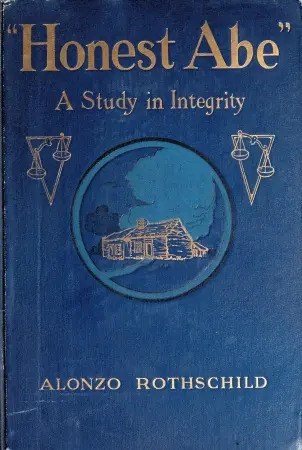
"Honest Abe: A Study in Integrity Based on the Early Life of Abraham Lincoln" by Alonzo Rothschild is a historical account written in the early 20th century. This work explores the formative years of Abraham Lincoln, focusing on his character, integrity, and the influence of his family background. It aims to shed light on how his early experiences shaped him into the emblematic figure of honesty and moral fortitude that he is celebrated as today. The opening of the book sets the foundation for a detailed exploration of Lincoln’s life, particularly emphasizing his inherent honesty and the hardships faced by his family during his upbringing. It describes the poverty Lincoln endured in his childhood and how the moral values instilled by his parents, especially his mother, played a crucial role in shaping his character. The narrative recounts anecdotes that highlight his early understanding of right and wrong and his unwavering commitment to truth, such as his willful efforts to settle debts and his conscientiousness in dealings with others. Throughout this introductory segment, Rothschild firmly establishes Lincoln's reputation as "Honest Abe," illustrating how his integrity was evident from a young age.
Introduction adapted from the source catalogue; source summaries may be automatically generated.
Free to read · English · 102,593 words · No account needed
MAKE TIME FOR A GOOD BOOK
On by default. Untick to stop anonymous reading totals. Each page counts after 10 seconds in view. How this works.
Anonymous counting is on unless you have switched it off.
=Statute of Limitations=, Lincoln’s attitude toward, 122-123.
=Stephens, Alexander H.=, refuses to take bad cases, 338.
=Stevens, Frank E.=, investigates the “Black Hawk” wrestling match, 29, 330.
=Stone, Daniel=, one of the “Long Nine,” 211.
=Stuart, Maj. John T.=, attorney at Springfield, 37;
fellow-candidate of Lincoln, 37;
helps Lincoln study law, 39;
partner of Lincoln, 44, 181, 335.
=Sulpicius, Servius=, believes in tempering the severity of law, 336.
=Swett, Leonard=, on Lincoln as arbitrator, 49;
on Lincoln’s honesty, 64-65;
on Lincoln and the law, 80-81, 98;
on Lincoln’s simplicity, 352.
=Thomas, Judge Jesse B.=, holds “shirt sleeve court,” 140-141.
=Thompson, Lorenzo Dow=, beats Lincoln at wrestling, 30.
=Thornton, Anthony=, on Lincoln as an advocate, 341.
=Todd, Mary=, Lincoln’s wife, 174, 267;
her trials with money-matters, 185, 188.
=Toombs, Robert=, refuses to take bad cases, 338.
=Trailor brothers=, defended on murder charge by Lincoln, 138.
=Treat, Judge Samuel H.=, presides in Hoblit vs. Farmer case, 70; 121; on Lincoln’s straightforwardness as an advocate, 340.
=Tremont, Ill.=, 120.
=Trent, Alexander and William=, buy out Lincoln and Berry on notes and abscond, 23.
=Turnham, David=, lends copy of Indiana Statutes to Lincoln, 331.
=Usury=, prevalence, 227;
Lincoln takes up fight against, 228;
law limiting rates of interest, 230.
=Van Bergen=, obtains judgment against Lincoln on note, 26.
=Van Cleave, James R. B.=, describes route Lincoln took from Springfield to New Salem, 332.
=Vandalia, Ill.=, 42;
state capital transferred to Springfield, 219.
=Volk, Leonard W.=, describes Lincoln’s habit of waiting on himself, 351.
=Warburton, George=, one of parties in horse-race, 32.
=Warden, Charles E.=, tells of Lincoln’s decision to enter law, 332.
=Washington, George=, punctilious honesty compared to Lincoln’s, 19;
Weems’s Life of, 12.
=Watkins, Thomas=, sues Lincoln for debt, 26.
=Webster, Daniel=, impressed with Lincoln’s moderation in fees, 150-151;
resemblances to Lincoln, 224;
attitude toward money, 225;
secures acquittal of forger by his admissions, 343.
=Weems, Mason L.=, author of “Life of Washington,” 326.
=Weems’s “Life of Washington,”= influence on Lincoln, 12, 326.
=Weik, Jesse W.=, on date of Lincoln’s admission to the bar, 333; anecdote on Lincoln and money, 351.
=Weldon, Lawrence=, opposing counsel to Lincoln in Dungee case, 153; on Lincoln’s moderate fees, 154-155; on Lincoln’s methods of meeting personal attacks, 344.
=Whig Party=, Lincoln elected to State Legislature on, 37;
Henry Clay its hero, 201.
=White, Horace=, on Lincoln as a politician, 256;
on counterfeit money, 326.
=Whitney, Henry C.=, on Lincoln’s honesty, 65, 86, 87;
on Lincoln and the law, 75-76;
on Lincoln and money, 164;
contradicts Lamon on Patterson case, 339;
on Lincoln’s simplicity, 352.
=Williams, Archibald=, endorses Lincoln’s charge against the Illinois Central R.R., 168.
=Wilson, Robert L.=, one of the “Long Nine,” 211;
befriends Lincoln, 224.
=Winters, William H.=, on O’Conor’s professional propriety, 350.
=Wythe, George=, method of guarding against deception of clients, 65-66.
The Riverside Press
CAMBRIDGE . MASSACHUSETTS
U . S . A
Typographical errors corrected by the etext transcriber:
Your reading position is saved on this browser. Take it to another device with a library code. Reading pages adapt to text, rather than matching a printed edition.
BEHIND THE BOOK
This eBook is for the use of anyone anywhere in the United States and most other parts of the world at no cost and with almost no restrictions whatsoever. You may copy it, give it away or re-use it under the terms of the Project Gutenberg License included with this eBook or online at www.gutenberg.org. If you are not located in the United States, you will have to check the laws of the country where you are located before using this eBook. Read the source licence.
The original source file, including credits and licence, is retained by this library. Request an original-format copy at no charge. Please include the book title and Project Gutenberg identifier #49679.
KEEP YOUR CURIOSITY GOING
David Patterson (Spirit) Hatch
Cécile Tormay

Moritz Busch
Coulson Kernahan
John L. Ransom

Ralph Waldo Emerson